Shibuya Crossing: How the Scramble Works, and Where to Watch
Why Shibuya Crossing has one diagonal, what the Hachiko story leaves out, where to watch from above, and the rules for Halloween and New Year's Eve.
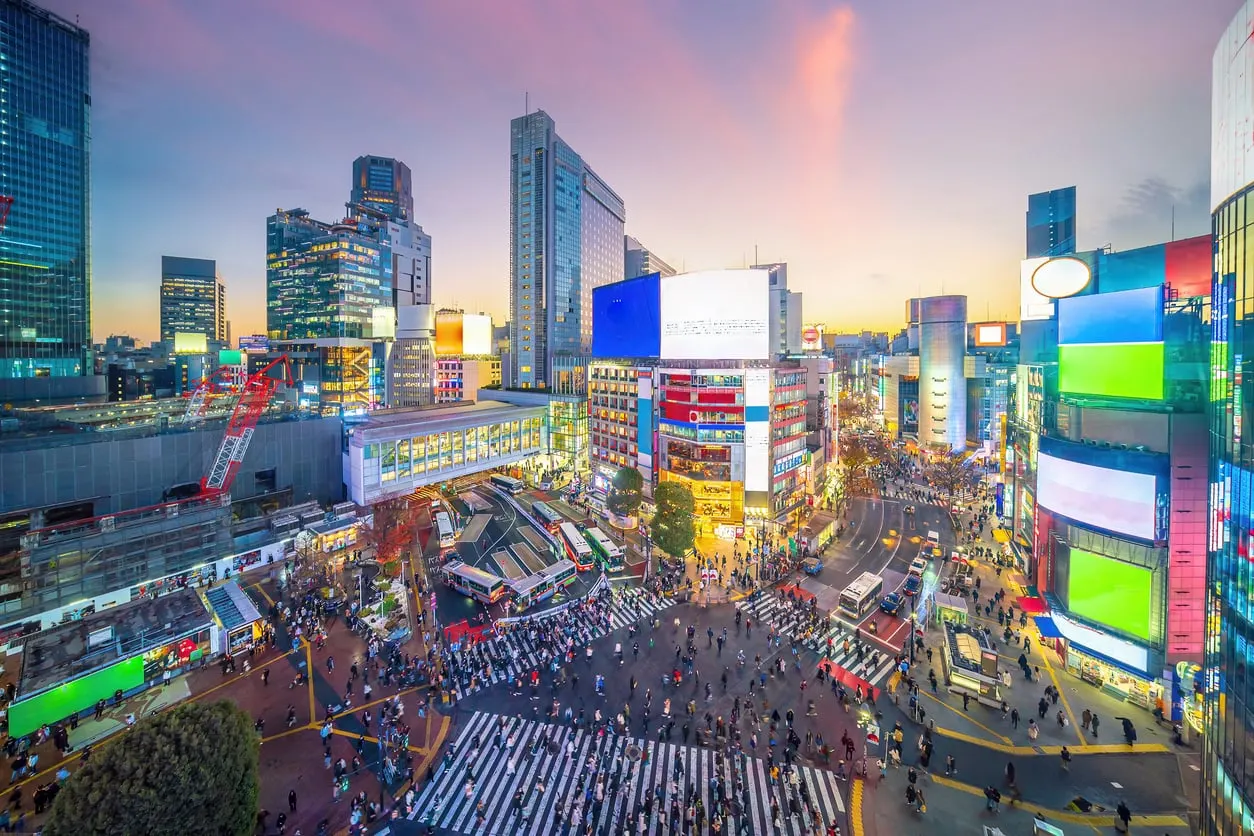
Look down on Shibuya Crossing and you can count only one diagonal crosswalk, not the X you might expect. In 2022, Tokyo’s Metropolitan Police Department told the Japanese transport site Norimono News why: five roads meet here, not four, and the layout follows pedestrian flows, traffic volume and the effect on passing vehicles. The police also said they had no documents or records of ever considering a second diagonal.
Shibuya Crossing, also called Shibuya Scramble Crossing (Shibuya sukuranburu kosaten in Japanese), is the intersection directly outside the Hachiko exit of Shibuya Station, in Tokyo’s Shibuya City. While the walk signal is green, people may cross in any direction, and GO TOKYO, the city’s official travel guide, describes upwards of 1,000 people crossing at a time. It is a public street, so crossing costs nothing.
At a glance
| Where | Shibuya City, directly outside the Hachiko exit of Shibuya Station |
| Trains | JR Yamanote, Saikyo and Shonan-Shinjuku lines; Tokyu Toyoko and Den-en-toshi lines; Keio Inokashira Line; Tokyo Metro Ginza, Hanzomon and Fukutoshin lines |
| Cost | Free to cross. Shibuya Sky, the paid deck above the station: ¥2,700 online for adults entering before 3 p.m., ¥3,400 from 3 p.m. |
| Crowds | An estimated 1,000–2,500 people every two minutes at the busiest times, according to JNTO |
| Views from above | Shibuya Sky (10 a.m.–10:30 p.m., last entry 9:20 p.m.); the Starbucks in the QFRONT building; inside the station, between the JR lines and the Keio Inokashira Line entrance |
| Hachiko statue | 2-1 Dogenzaka, on Hachiko Square outside the station |
| Rules | No drinking in public places such as streets and parks around the station, 6 p.m.–5 a.m., all year |
Checked Nov 11, 2026, against GO TOKYO, JNTO, Shibuya City and Shibuya Sky’s official site. Shibuya Station is being rebuilt, so gates and passages move; follow the signs on the day.
How does Shibuya Crossing work?
It works as a scramble: all traffic at the intersection stops so that pedestrians can cross in any direction, including diagonally. That is how the US Federal Highway Administration defines the term in a short history of walk signals, adding that the pattern became known in the US as the “Barnes Dance,” after Henry A. Barnes, who had been traffic commissioner in Denver, Baltimore and New York City.
Shibuya’s version bends the template. A typical scramble has two diagonal crosswalks that form an X, as Norimono News points out. Here five roads meet, and the only diagonal links Hachiko Square, on the station side, with the QFRONT building across the junction.
Norimono News dates the scramble to 1973 and, judging from aerial photographs, says the lone diagonal from Hachiko Square seems to have been there from the start.
To walk it, start at Hachiko Square and head for QFRONT. From above, it is the long stripe through the middle of the junction.
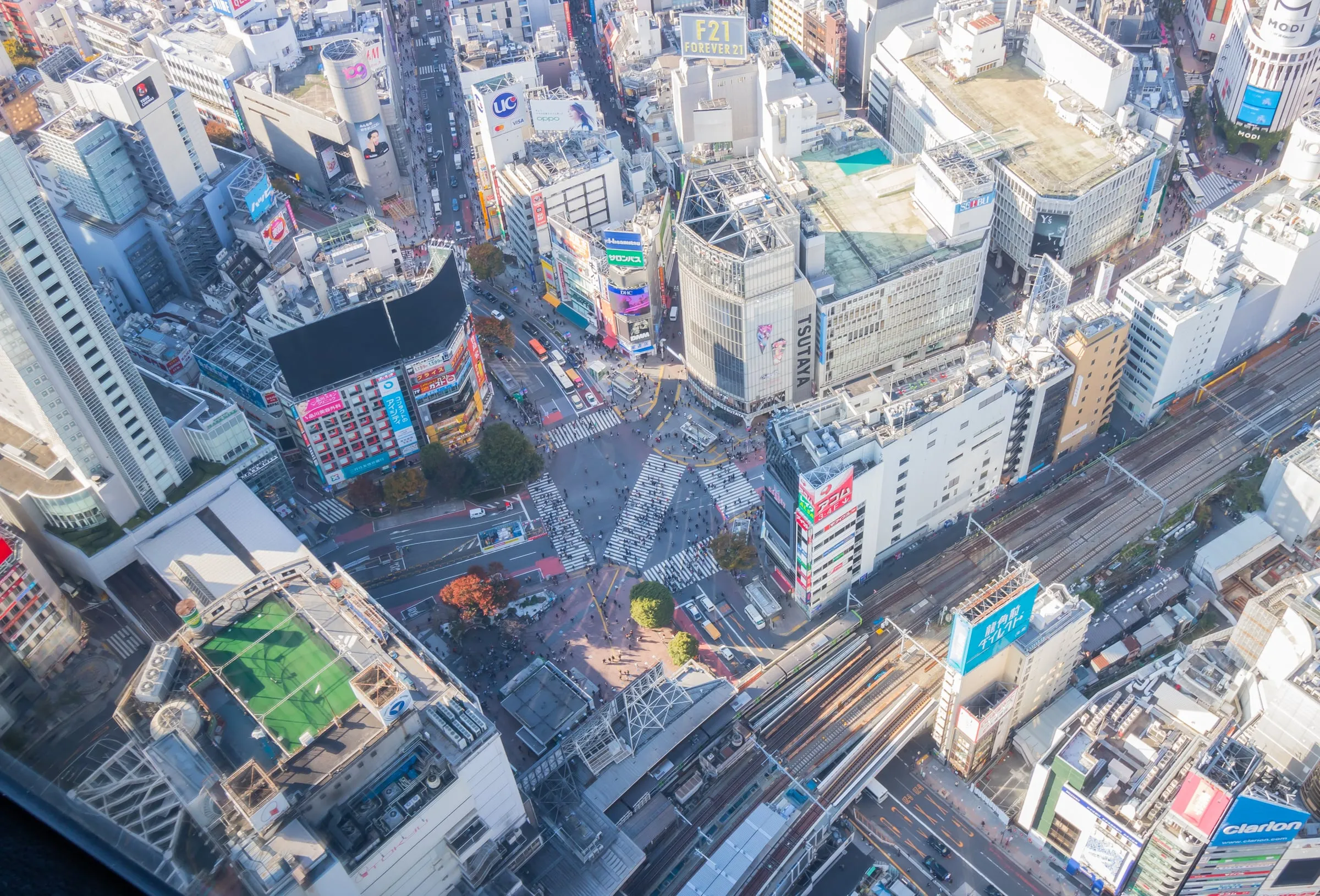
Shibuya Crossing from Shibuya Sky’s 46th-floor indoor gallery in November 2019, with Hachiko Square at the bottom and the single diagonal through the middle of the junction; signs and screens have changed since. Photo: Kakidai / Wikimedia Commons (CC BY-SA 4.0).
Why is Shibuya Crossing so famous, and how many people cross?
Location does most of the work. The crossing sits directly outside Shibuya Station, which JNTO says is served by nine major lines, and GO TOKYO’s suggested route runs from the station end toward Shibuya Center Gai, the shopping street across the junction.
How many people cross is an estimate, not a count. JNTO puts it at 1,000 to 2,500 people every two minutes during the busiest times; GO TOKYO says upwards of 1,000 at a time. In the travel guides we checked on Nov 11, 2026, the bigger claims, up to 3,000 people every 90 seconds and “the world’s busiest crossing,” came without a source.
The rest is exposure. JNTO compares the junction to New York’s Times Square and notes that it has been pictured in countless films, magazines and blogs.
What is the real story of Hachiko?
Hachiko was an Akita dog who kept going to Shibuya Station for years after his owner died. The dates come from the HACHI100 project, organized by the tourism division of Odate, his hometown in Akita Prefecture: he was born there in 1923, went to live with a Tokyo professor in 1924, lost him to a sudden death in 1925, and died on March 8, 1935.
The professor was Hidesaburo Ueno, as the University of Tokyo spells his name; JNTO’s English page calls him Eizaburo. The university describes him as Japan’s first scholar of agricultural civil engineering.
The story spread through the press. An Asahi Shimbun article of Oct 4, 1932, reported the dog waiting at the station after his master’s death, according to the university’s own account. In November 1934, an elementary-school ethics textbook told a fuller version, in which Hachiko also walked his master to the station every morning.
That is the part a University of Tokyo scholar doubts. Ueno lived in Shoto, about a 10-minute walk from the university’s Komaba campus, and Associate Professor Takashi Tamura says it is not true that he commuted by train, though he did ride trains to some other sites. In Tamura’s account, Hachiko saw Ueno off at the campus gate, and the textbook appears to have merged those send-offs with the dog’s waiting at the station after Ueno died.
Another professor quoted in the same feature, Masaru Mizoguchi, recalls a plainer theory from a class he took as a student: that Hachiko might have been at Shibuya Station only for yakitori, grilled chicken skewers. He tells it as a classroom story, and it should be read as one.
Hachiko’s body was found before dawn on March 8, 1935, on the south side of the station, the university says. What is left of him is kept in three places in Tokyo. His body was stuffed and put on display at the National Museum of Nature and Science, in Ueno Park; if he is the reason for your visit, check with the museum first. His lungs, heart, esophagus, liver and spleen are kept on the university’s Yayoi campus, where its Agricultural and Life Sciences Museum began showing them in 2006. His grave is with Ueno’s at Aoyama Cemetery, according to the HACHI100 project.
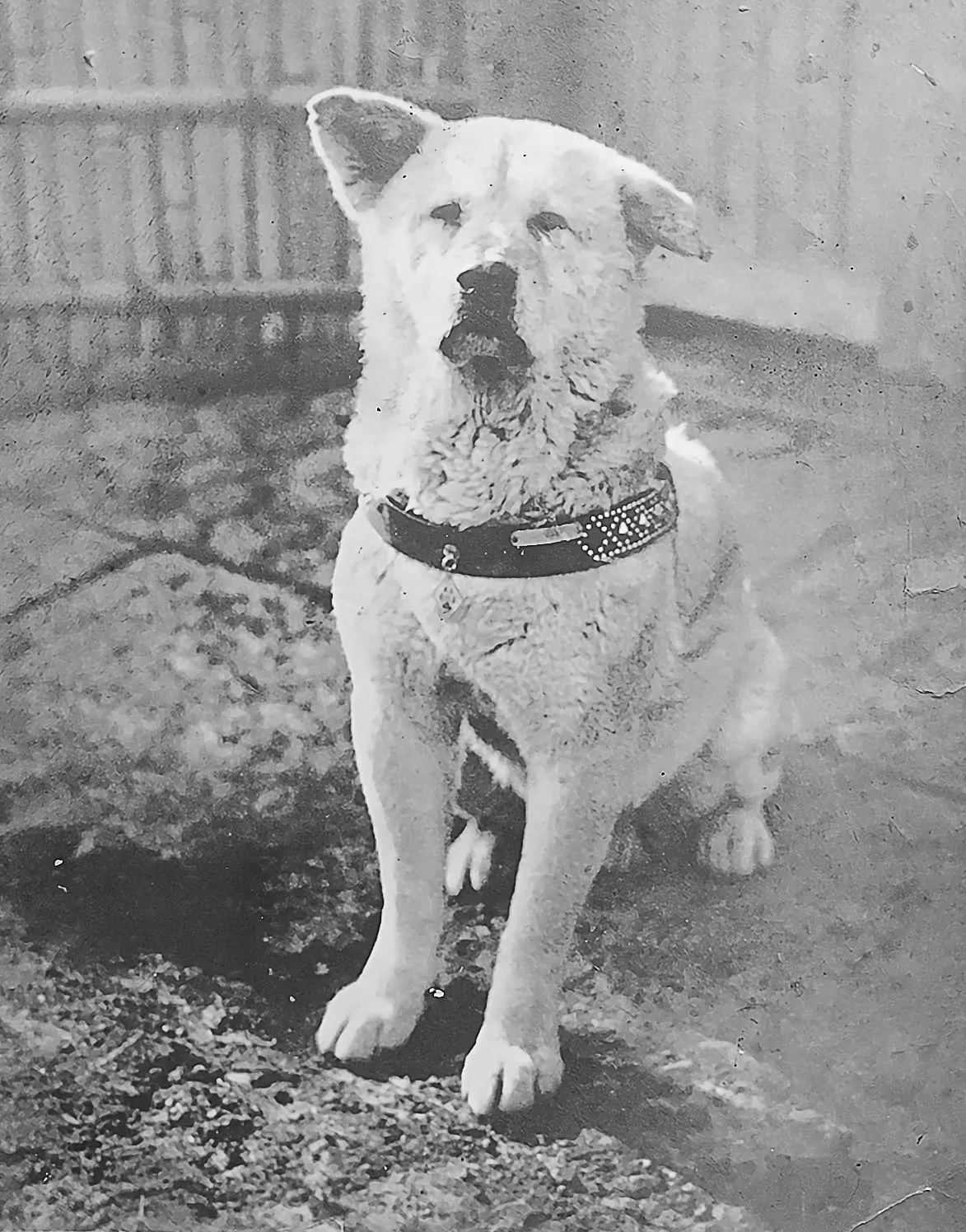
Hachiko himself, not the statue, in a photograph that Wikimedia Commons dates to about 1934, the year before he died. Photo: Unknown photographer / Wikimedia Commons (public domain).
Is the Hachiko statue the original?
No. The statue by the station is the second one, put up in August 1948. The first went up in front of Shibuya Station in 1934, while Hachiko was still alive, and was removed in 1944, when the war effort collected metal, according to the HACHI100 project.
GO TOKYO gives its address as 2-1 Dogenzaka and calls it Shibuya’s main meeting point. It is also the statue that has been fenced off on recent Halloween and New Year’s Eve nights to keep crowds from lingering around it (more on that below).
Two other statues are worth knowing. Odate put one in front of its station in July 1935; it too was removed in the war, went back up in 1987 and now stands at the entrance of the Akita Dog Visitor Center, the HACHI100 project says. In March 2015, 80 years after Hachiko’s death, the University of Tokyo dedicated a statue of Hachiko and Ueno just inside and to the left of the Faculty of Agriculture’s main gate on its Yayoi campus. In the university’s words, it shows “the gleeful reunion of a young Hachiko and his master.”
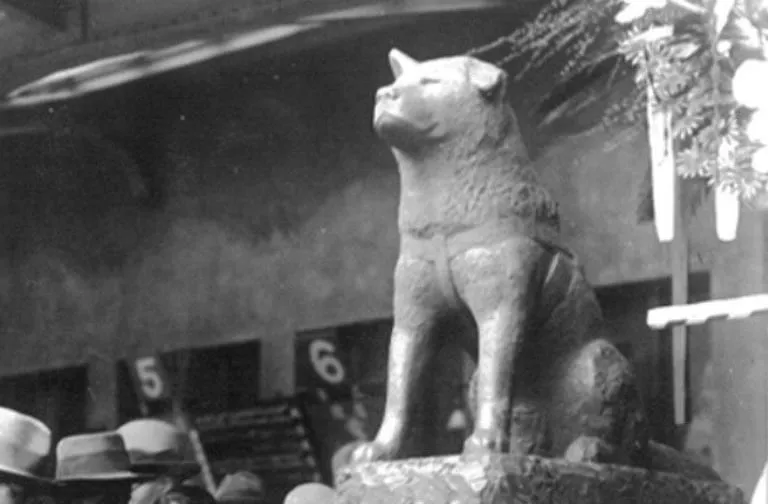
The first Hachiko statue at Shibuya Station, photographed sometime between 1934, when it went up, and its removal in 1944; the statue there today is the 1948 replacement. Photo: Unknown photographer / Wikimedia Commons (public domain).
Where can you watch Shibuya Crossing from above?
From Shibuya Sky, the ticketed deck on top of Shibuya Scramble Square; from the Starbucks in the QFRONT building; or from a spot inside the station.
Shibuya Sky is the observation deck of Shibuya Scramble Square, the 47-story tower above Shibuya Station. It opened in November 2019, its open-air roof is 229 meters above Shibuya, and an area of the roof called Sky Edge looks straight down on the scramble, according to the operator.
Entry is by timed ticket, in 20-minute slots, sold from midnight Japan time two weeks ahead. Adults pay ¥2,700 online to enter before 3 p.m. and ¥3,400 from 3 p.m.; at the 14th-floor ticket counter, ¥3,000 and ¥3,700. When online adult tickets for a slot sell out, the counter has none either, and children’s tickets are sold only at the counter on the day. Hours are 10 a.m.–10:30 p.m., with last entry at 9:20 p.m., and regular operation pauses on New Year’s Day (checked Nov 11, 2026, on the official ticket and FAQ pages).
Bags, tripods, monopods and selfie sticks are not allowed on the roof; they go into dedicated lockers on the 46th floor. Suitcases and other large luggage should be left elsewhere before you arrive. The roof may close for strong wind, rain, snow, approaching thunderclouds, photochemical smog or extreme heat, while the 46th-floor indoor gallery stays open. Do not confuse the deck with the Sky Lobby on the 11th floor of Shibuya Hikarie, a neighboring building; Shibuya Sky’s access page says visitors mix the two up very often.
Without a ticket, GO TOKYO suggests heading to “the Starbucks directly above” the crossing “to snap a shot of the pedestrian horde below.” JNTO places it in the QFRONT building, the one the diagonal points to.
JNTO also points to a “less-trafficked vantage point” inside the station, between the JR lines and the Keio Inokashira Line entrance. In the same station complex, the walkway that links the station with Shibuya Mark City has displayed Taro Okamoto’s mural Myth of Tomorrow since Nov 18, 2008. Painted in Mexico in 1968–69 and found in storage on the outskirts of Mexico City in 2003, it shows the moment an atomic bomb explodes, according to the Okamoto Memorial Foundation. The foundation’s Japanese page says a three-stage repair of the mural, begun in 2023, finished on May 31, 2026.
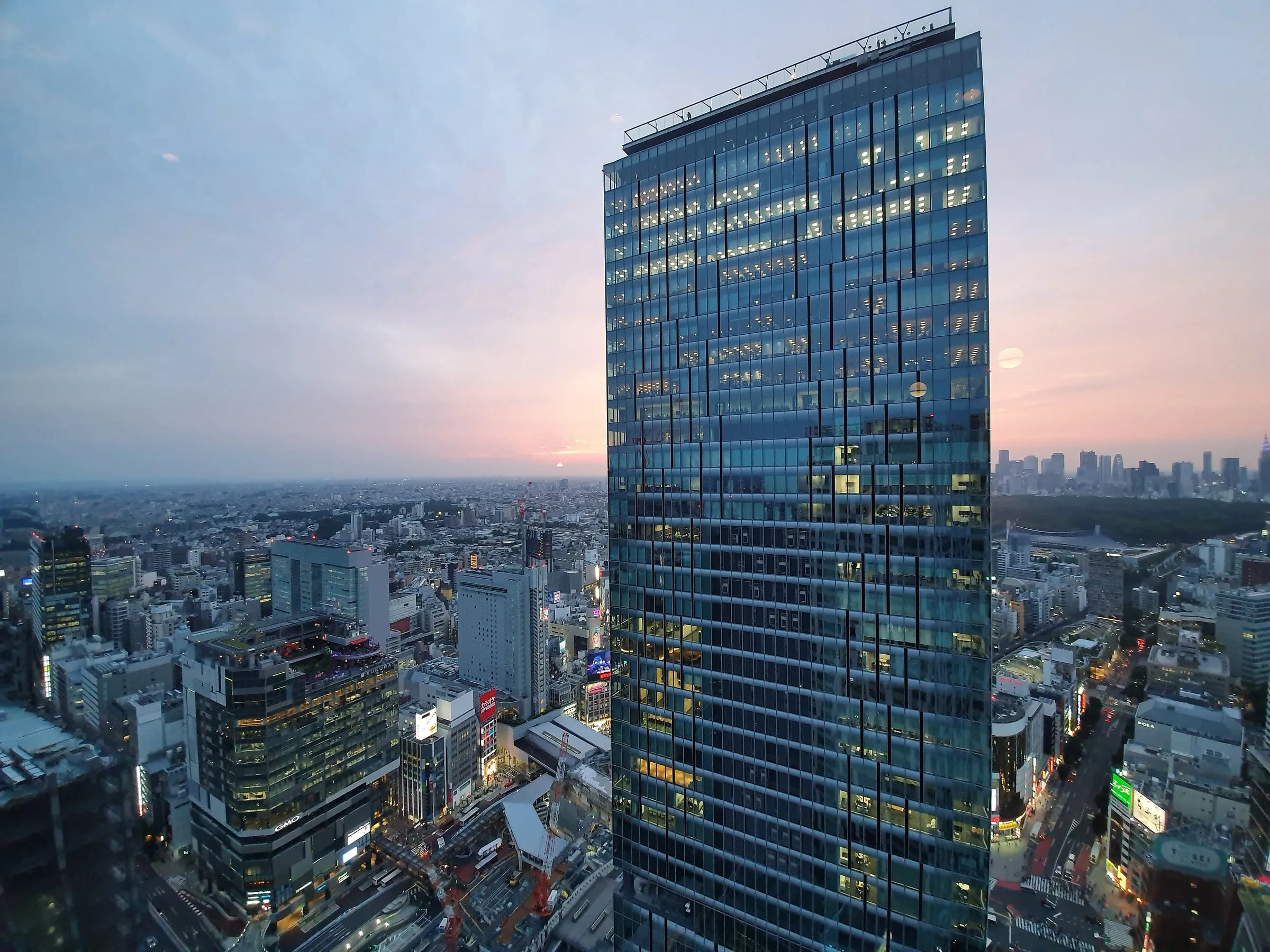
Shibuya Scramble Square at dusk in June 2022, seen from Shibuya Stream; Shibuya Sky’s open-air deck is on the roof. Photo: Syced / Wikimedia Commons (CC0). Resized.
Is Shibuya Crossing closed on Halloween and New Year’s Eve?
Not according to Shibuya City’s notices, which fence off the Hachiko statue on both nights rather than the crossing. The ward also tells visitors to check police and rail announcements for traffic changes, and a drinking ban applies around the station all year.
The baseline first. Since Oct 1, 2024, drinking in public places around Shibuya Station, such as streets and parks, has been banned from 6 p.m. to 5 a.m. all year. The ward first passed the ordinance in June 2019, citing nuisance behavior during periods such as Halloween and the year-end countdown, and its English leaflet sums up the rule.
For Halloween 2026, the ward fenced off the Hachiko statue from 6 a.m. on Oct 30 until the morning of Nov 1, according to its notice of Oct 21, and suggested visiting the statue on Oct 29 or earlier, or from the morning of Nov 1. On the night itself, vehicles were kept off part of the road in front of the station, under the ward’s slogan “Goodbye Bad Halloween,” a Japanese TV news report said (KAB, Oct 31, 2026).
New Year’s Eve follows the same pattern. For 2025–26, the organizers called off the countdown event in front of the station again; the ward fenced off the Hachiko statue from 6 a.m. on Dec 31 to 1 a.m. on Jan 1 and asked convenience stores and other shops that sell alcohol to hold off on night-time sales, according to its notice of Dec 3, 2025 (2025–26 season, checked Nov 11, 2026). Shibuya Sky, for its part, pauses regular operation on New Year’s Day. Look for the ward’s notices for 2026–27 and for next Halloween before you plan a night here.
If you go: the route, the rules and what’s nearby
Take any line to Shibuya Station and follow the signs for the Hachiko exit or Hachiko Square. The station is mid-rebuild: on Jan 26, 2025, JR East’s Hachiko gate moved from the square to the free passage toward the Miyamasuzaka exit and kept its name, according to the business magazine Toyo Keizai and the Japanese travel news site Tabiris. The gate no longer opens onto the square.
GO TOKYO suggests starting from the station end and crossing toward Shibuya Center Gai. For the diagonal, step off from Hachiko Square toward QFRONT, then come back on a straight crosswalk.
If Shibuya Sky is on your list, book online: tickets go on sale two weeks ahead, and slots before 3 p.m. cost ¥700 less. Leave large luggage first; Shibuya Sky’s information page points to the shibuya-san tourist information & art center, on the first floor of Shibuya Fukuras, which stores suitcases when it has space.
The nightly drinking ban covers the streets here. Flying a drone over a densely inhabited district needs advance permission from Japan’s transport ministry, MLIT, whose drone rules page links a map of those districts; on that map, the area around Shibuya Station is inside one (checked Nov 11, 2026).
For more things to do in Shibuya and next door, Harajuku, the next station on the JR Yamanote Line, is the stop for Takeshita Street, Meiji Shrine and Yoyogi Park. Omotesando is one stop away on the Tokyo Metro Ginza Line, from Shibuya (G01) to Omote-sando (G02), and the same line runs on to Ueno (G16), for the science museum in Ueno Park.
When you do cross, take the diagonal. There is only one.
More in Travel & Destinations
View all →
Sunshine City Ikebukuro: Aquarium, Observatory, and Tickets
Travel & Destinations · Tokyo
Imperial Palace Tokyo: Tours, East Gardens and Edo Castle
Travel & Destinations · Tokyo
Kabukiza Theatre: Single-Act Tickets, Captions and History
Travel & Destinations · Tokyo
Odaiba: Sea Forts, a Rainbow Bridge Walk and What Has Closed
Travel & Destinations · Tokyo
Related articles
Akihabara: How Tokyo's Electric Town Began, and When to Go
Travel & Destinations · Tokyo
Ebisu Garden Place: Brewery, Sky Lounge and Winter Lights
Travel & Destinations · Tokyo
Ginza, Tokyo: History, Landmarks, and Car-Free Weekends
Travel & Destinations · Tokyo


Hanayashiki Amusement Park: Rides, Tickets and 1853 Roots
Travel & Destinations · Tokyo