Omotesando: The Meiji Shrine Approach and Its Architecture
How Omotesando began as Meiji Shrine's approach, why its zelkovas are younger than the street, what Omotesando Hills replaced, and when the trees are lit.
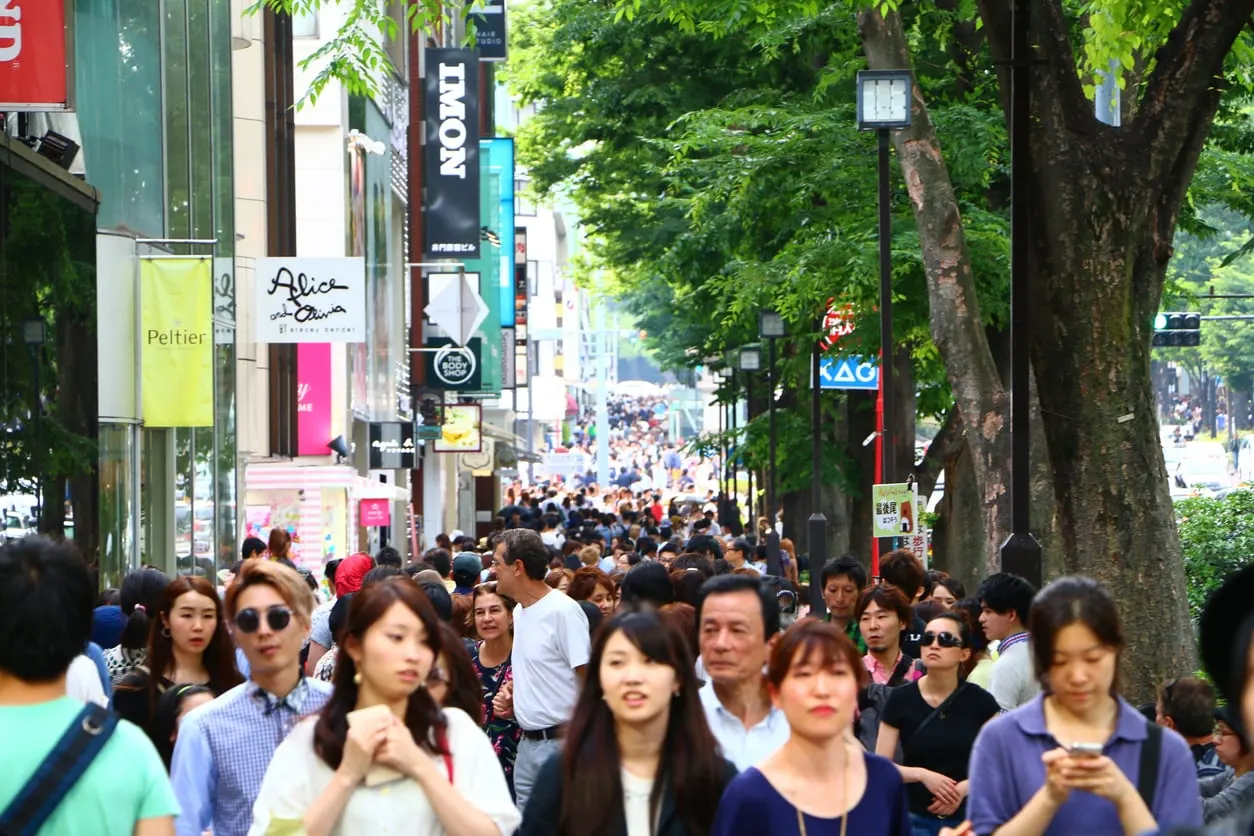
Omotesando Hills, the shopping complex that lines about a quarter of Tokyo’s Omotesando, is 23.3 meters tall at its highest point and 31.4 meters deep at its lowest. Its architect, Tadao Ando, buried more than half of the building so that it would rise only about as high as the zelkova trees outside, the complex’s official site explains. On this avenue, the trees came first.
Omotesando is the zelkova-lined avenue in Tokyo that opened in 1920 as the front approach to Meiji Shrine (Meiji Jingu). The name says as much: omote means front, and sando is the approach to a shrine or temple. It runs about 900 meters from Aoyama-dori to the shrine’s south entrance by JR Harajuku Station, by the count of Japan’s land and transport ministry, and walking it costs nothing. Omotesando Station (Ginza, Chiyoda and Hanzomon lines) is at the Aoyama-dori end, Harajuku Station is at the shrine end, and Meiji-jingumae Station (Chiyoda and Fukutoshin lines) opens onto the avenue in between.
At a glance
| Where | Jingumae, Shibuya City; the Aoyama-dori end borders Minato City. Omotesando Station (Ginza, Chiyoda and Hanzomon lines) at the Aoyama-dori end, JR Harajuku Station (Omotesando Exit) at the shrine end, Meiji-jingumae Station (Chiyoda and Fukutoshin lines) in between |
| Length | About 900 m |
| Trees | About 200 zelkovas. First planted in 1921; most of the present trees were replanted after 1945 |
| Cost | Free; it is a public road |
| Illumination | Dec 1–27, 2026, sunset to 10 p.m., from the Jingumae crossing to the Omotesando crossing |
| Don’t miss | The chipped stone lanterns at Aoyama-dori; the Spiral Slope and Dojunkan at Omotesando Hills; the facades of TOD’S and Prada Aoyama; the zelkova paving on Jingu-bashi bridge |
| Nearby museums | Ota Memorial Museum of Art (ukiyo-e): 10:30 a.m.–5:30 p.m., closed Mondays and between exhibitions; adults ¥1,200 until Dec 6, ¥1,000 from Dec 12; cash only. Nezu Museum: 10 a.m.–5 p.m., closed Mondays; adults from ¥1,400 online |
| Official information | The street’s merchants’ association, omotesando.or.jp (Japanese) |
Checked Nov 11, 2026, against pages from Japan’s land and transport ministry, the Ministry of the Environment, Shibuya City, Minato City, the Harajuku Omotesando Keyakikai merchants’ association, Omotesando Hills and the two museums.
Why was Omotesando built?
Omotesando was built as the main road into Meiji Shrine. A timeline in Shibuya City’s plan for its green spaces puts the shrine’s founding and the opening of Omotesando in the same year, 1920, and records young zelkovas, keyaki in Japanese, planted along the approach in 1921.
The shrine had a back road as well. A Ministry of the Environment guide to the shrine’s big trees notes that the road linking its north gate with the Outer Garden was called the Ura-sando, the back approach, in contrast to Omotesando.
Each end of the avenue has a marker. At the shrine end, Jingu-bashi bridge was built for the shrine’s opening in 1920. When Tokyo rebuilt it between 1979 and 1982, it restored the 1920 lantern-shaped posts and paved the sidewalk with a design of the zelkovas that line Omotesando, according to Meiji Jingu’s history database. At the Aoyama-dori end, a pair of large stone lanterns marks the entrance to the approach; Minato City describes them as a well-known meeting spot.
The present roadway is a 1960s project. A case sheet from the land and transport ministry records that the Tokyo government upgraded it from 1961 to 1964 as Radial Road No. 23, one of the streets readied for the 1964 Olympics. The athletes’ village was nearby, on land that became Yoyogi Park in 1967. From 1977 until 1998, Shibuya City’s timeline adds, the stretch from Harajuku Station to Aoyama-dori had a hokoten, a car-free “pedestrian paradise.”
The street’s shopkeepers made the familiar comparison official. Their association was founded in April 1973 as the Harajuku Champs-Élysées Association, and in 1999 it renamed itself the Harajuku Omotesando Keyakikai, after the zelkova it calls its symbol. It counted about 550 member shops in January 2026.
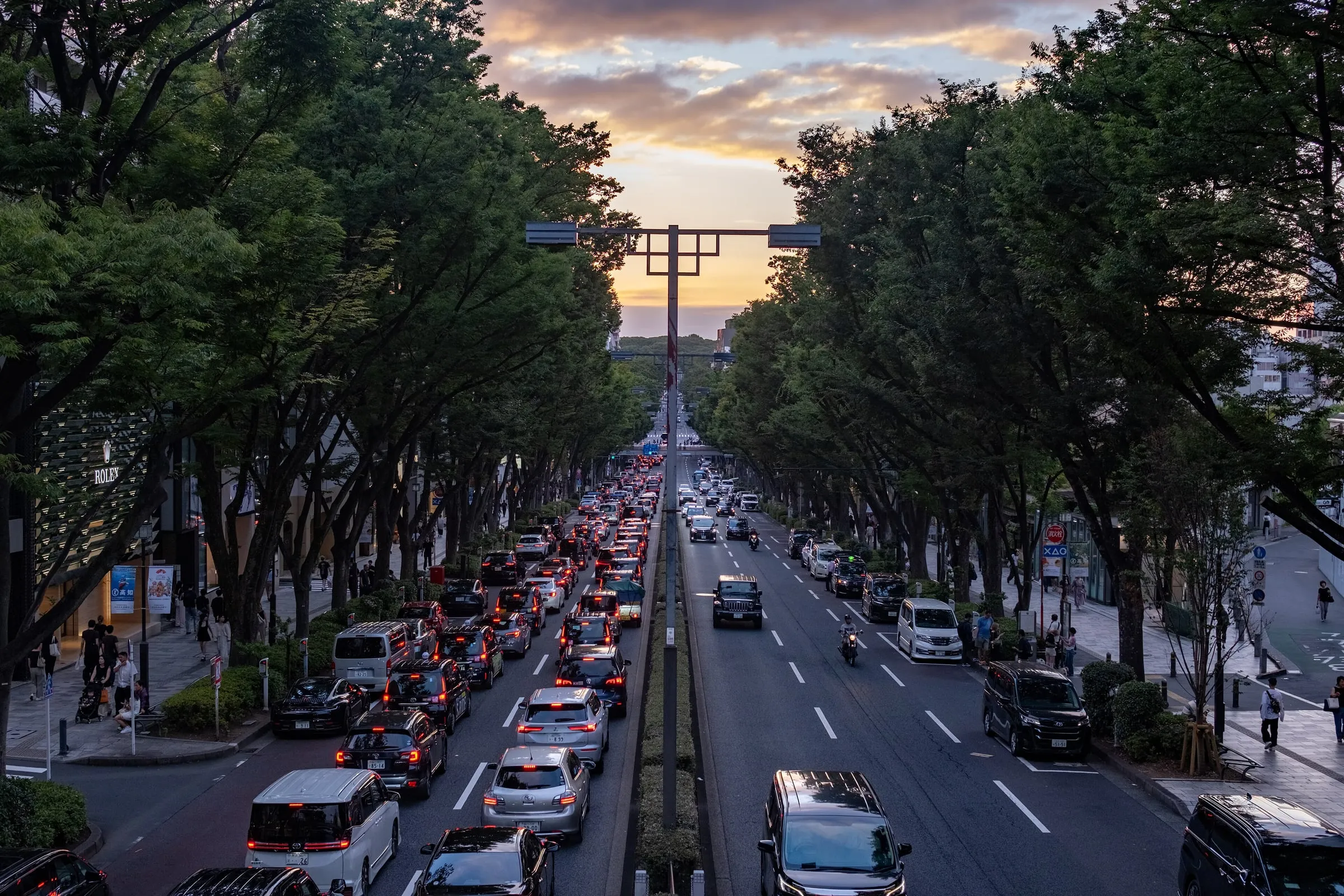
Zelkovas line both sides of Omotesando on a summer evening in August 2026, seen from a footbridge in Jingumae. Photo: gog.creator / Wikimedia Commons (CC BY 4.0). Resized.
Why are Omotesando’s zelkovas younger than the street?
Because almost all of the first trees burned in May 1945. Of the 200 zelkovas planted along both sides of the approach, incendiary bombs left 13, according to a peace guide published by Minato City. Most of the trees on the avenue now grew from saplings planted after the war.
That month’s air raid on Tokyo’s Yamanote districts burned out most of Akasaka and Aoyama, the city says. In January 2007 it dedicated a monument, Wa o Nozomu (roughly, “hoping for peace”), near the Omotesando crossing, where the avenue meets Aoyama-dori. Its inscription records that the zelkovas burned and that many people died near that crossing, trapped by fire and hot wind. Flowers are laid there every May 25.
The stone lanterns still show it. The chips in their pedestals came from the bombing, Minato City’s guide says.
At the same crossing, Sanyodo Shoten, a bookshop that is still in business, was one of the few concrete buildings in the area. Nearly 100 people took refuge inside, the guide recounts, and fought the fire from within, passing buckets of water from a well in the basement.
The avenue has its trees back. The Ministry of the Environment’s guide counts 200 zelkovas between Omotesando Station and the shrine’s south approach. The last in the row, near the shrine’s south gate, was planted after the war; the guide gives its trunk as 302 centimeters around. The merchants’ association has been checking the trees’ health since 1981.
What is Omotesando Hills, and what stood there before?
Omotesando Hills is a complex of about 100 shops and 38 homes that opened on Feb 11, 2006, on the site of the Dojunkai Aoyama Apartments, according to its official site. Its facade runs for 250 meters along the avenue.
The apartments were part of Tokyo’s recovery from the Great Kanto Earthquake of 1923. Shibuya City’s timeline lists them as completed in 1926 (the complex’s own gives 1927) and counts them among Japan’s earliest modern apartment buildings of fireproof reinforced concrete.
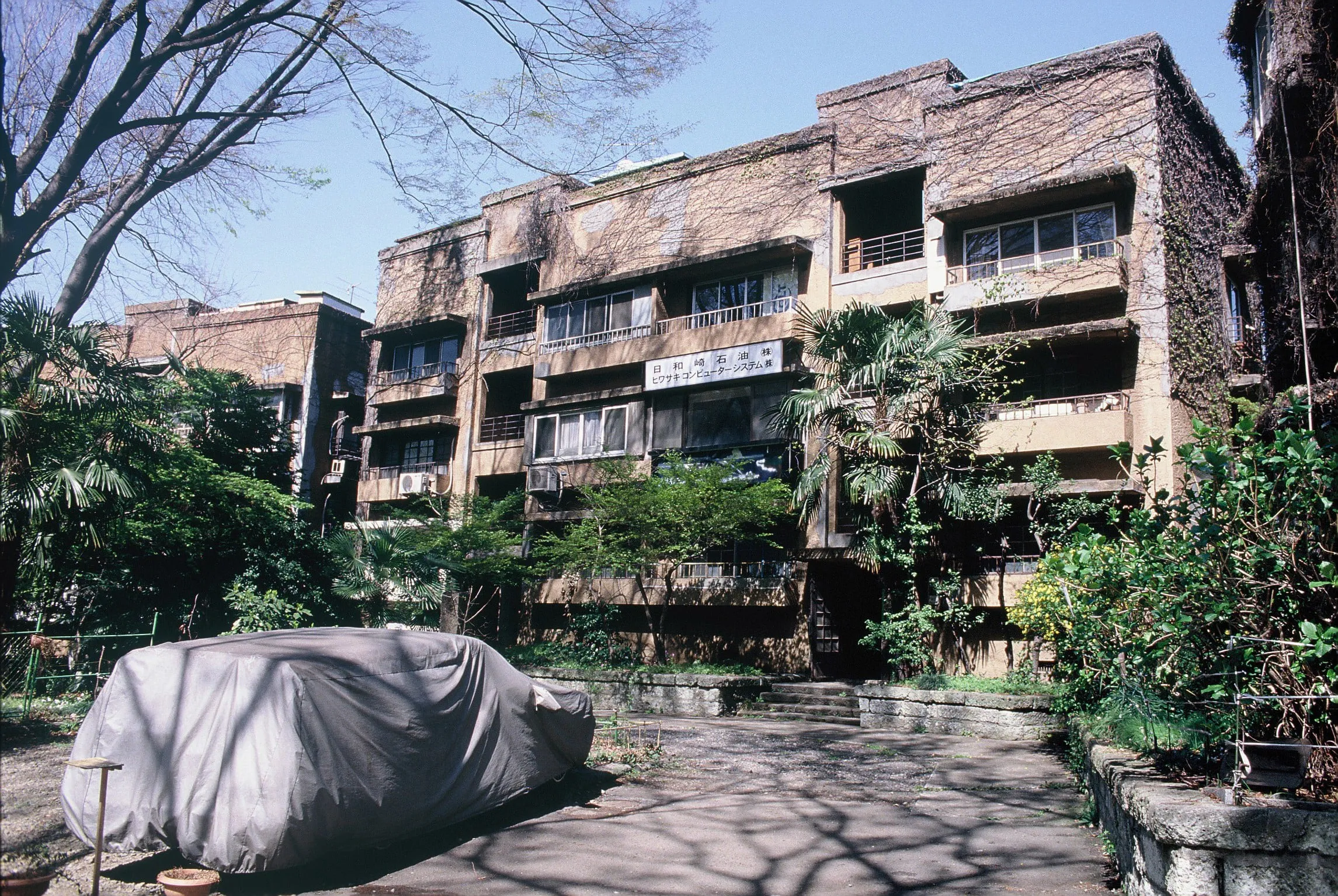
The Dojunkai Aoyama Apartments in March 2002, about a year and a half before work on Omotesando Hills began; the buildings no longer stand. Photo: PhantomII.Rider / Wikimedia Commons (CC BY-SA 4.0). Resized.
Replacing them took decades. The complex’s own timeline dates the first rebuilding efforts to around 1968. The Great Hanshin-Awaji Earthquake of 1995 added urgency, Ando was hired in 1998, and construction began in August 2003.
Ando wrote that restoring the old buildings as they stood was impossible, physically and economically. To carry the city’s memory forward, he chose two moves: bury most of the new building to keep it level with the zelkovas, and bring Omotesando’s gentle slope indoors.
That slope is the Spiral Slope, a 700-meter ramp that winds around a six-level atrium at about 3 degrees, nearly the same gradient as the avenue outside. The complex calls it a second Omotesando. A wing named Dojunkan reproduces part of the old apartments.
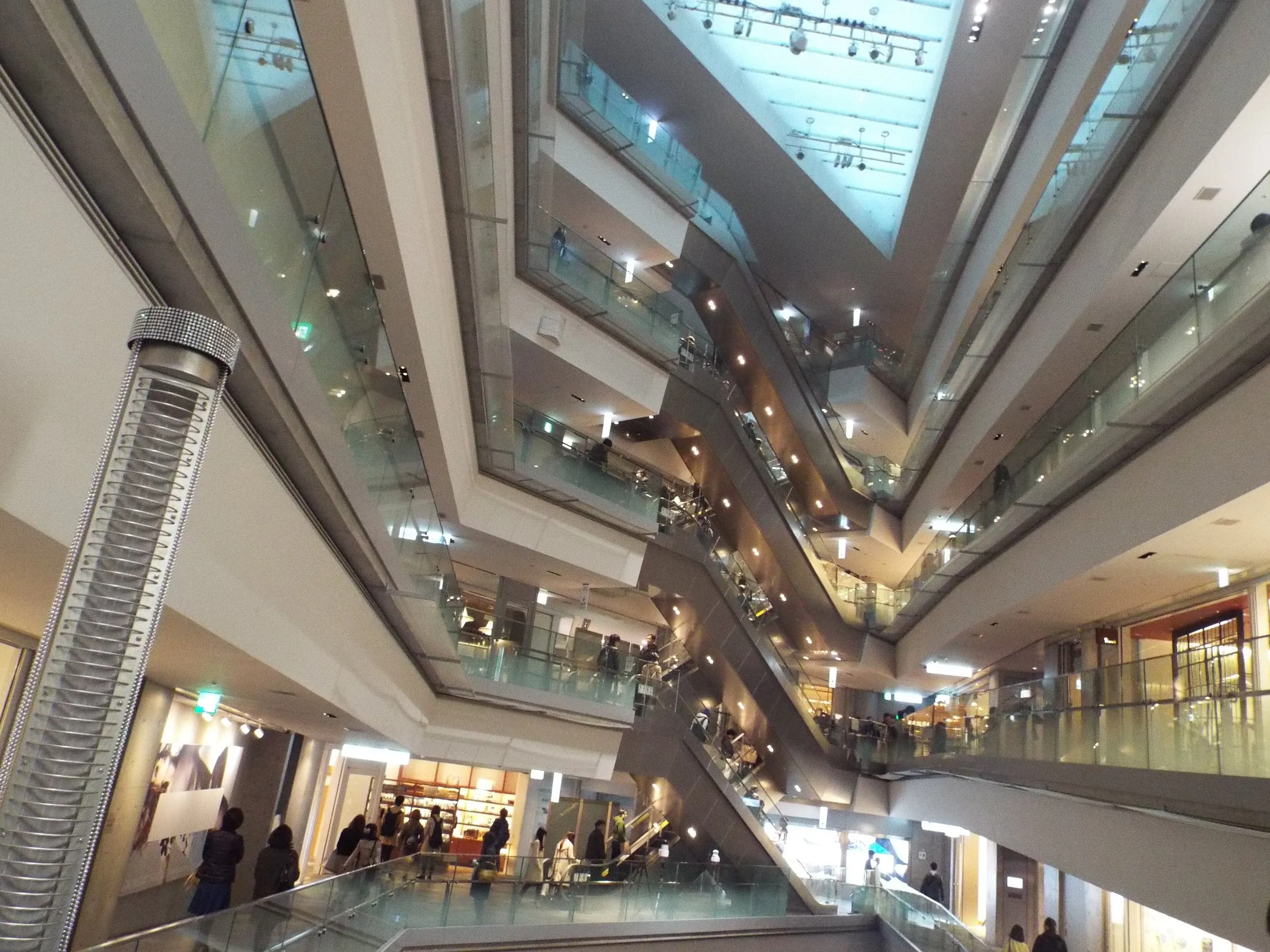
Inside Omotesando Hills in March 2015, with the ramps of the Spiral Slope circling the central atrium. Photo: Syced / Wikimedia Commons (CC BY-SA 3.0). Resized.
Which buildings should you look for on Omotesando?
Beyond Omotesando Hills, look for three buildings whose architects have described them in their own words: Toyo Ito’s TOD’S building, Herzog & de Meuron’s Prada Aoyama and Kengo Kuma’s Nezu Museum.
Ito’s office lists the TOD’S Omotesando Building, for the Italian shoe and handbag maker, as a project from April 2002 to November 2004: seven floors and a basement on a lot of about 516 square meters. Its concrete facade is also its structure. The office describes the pattern as overlapping tree silhouettes, with branches that grow thinner and more numerous toward the top, leaving more room for openings. When Ito won the Pritzker Prize in 2013, the jury pointed to this building, “where the building skin also serves as structure.”
Prada Aoyama, across Aoyama-dori in Minami-Aoyama, was built from 2001 to 2003. Herzog & de Meuron made it tall so that part of the lot could stay open as “a kind of plaza, comparable to the public spaces of a European city.” They wrapped it in a rhomboid grid of convex, concave and flat glass panes that offer, in the architects’ words, “vistas of the city as if through a lens.”
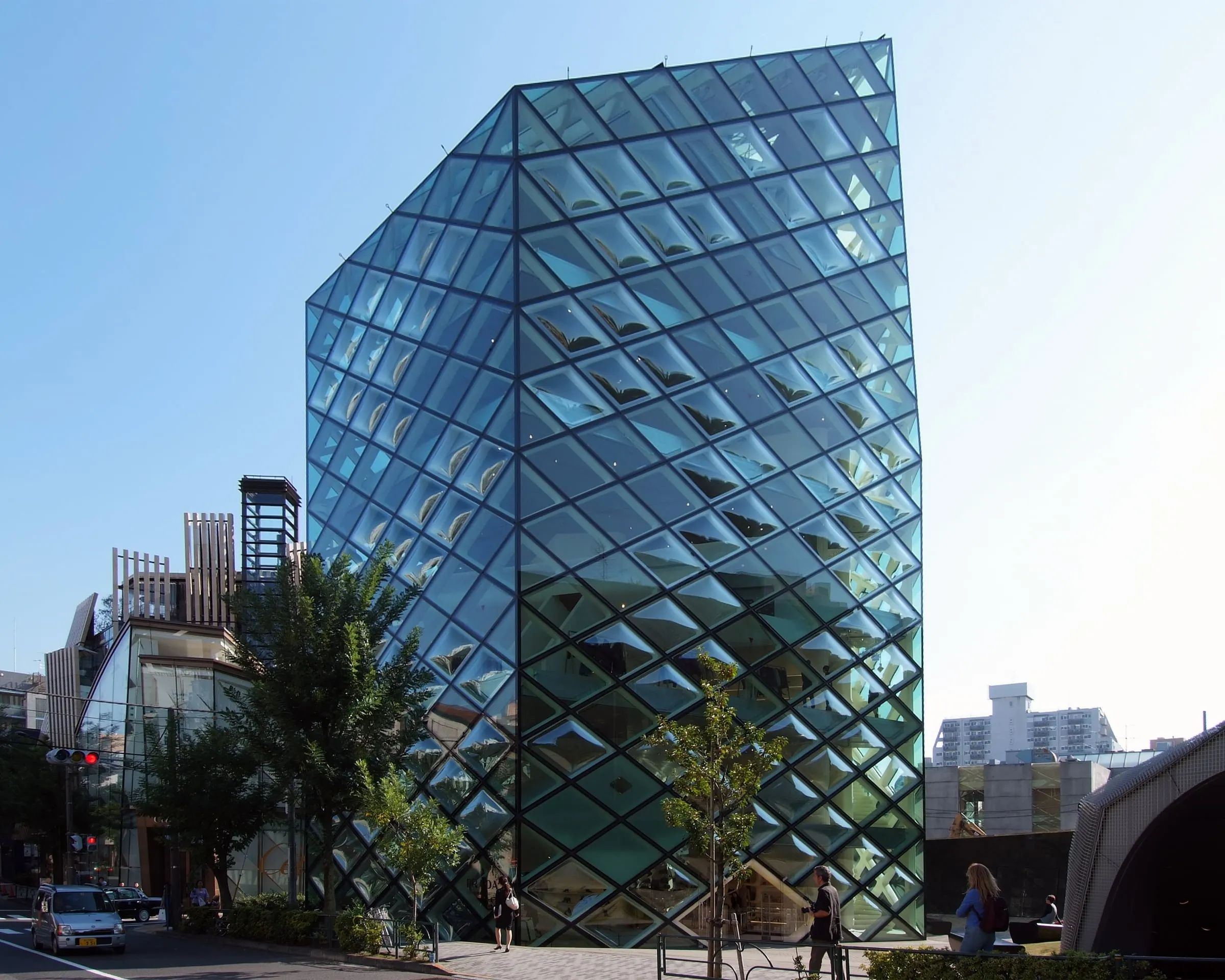
Prada Aoyama by Herzog & de Meuron, clad in diamond-shaped glass panes, in July 2008. Photo: Wiiii / Wikimedia Commons (CC BY-SA 3.0). Resized.
Eight minutes on foot from Exit A5 of Omotesando Station, the Nezu Museum reopened in 2009 in a building by Kengo Kuma. His office describes a roof designed to blend the interior with the garden, large glass openings and a bamboo-lined approach. The museum began with the collection of its founder, Nezu Kaichiro, whose residence and garden burned in a 1945 air raid, the museum’s history notes.
When is the Omotesando illumination?
In 2026 it runs from Dec 1 to Dec 27, from sunset to 10 p.m. About 900,000 champagne-gold LEDs light the zelkovas between the Jingumae crossing, where Omotesando meets Meiji-dori, and the Omotesando crossing at Aoyama-dori, according to Omotesando Hills. The lights in the low planting strips stay on until Jan 5, 2027.
The merchants’ association organizes it, under a name that includes its sponsor’s: the Omotesando Dior Illumination 2026. The association credits Meiji Jingu for special cooperation.
The association lit the zelkovas from 1991 to 1998. The lights returned in December 2009, after 11 years, Omotesando Hills says, and that winter the association ran one tree, the zelkova outside the Jingumae police box, on solar power.
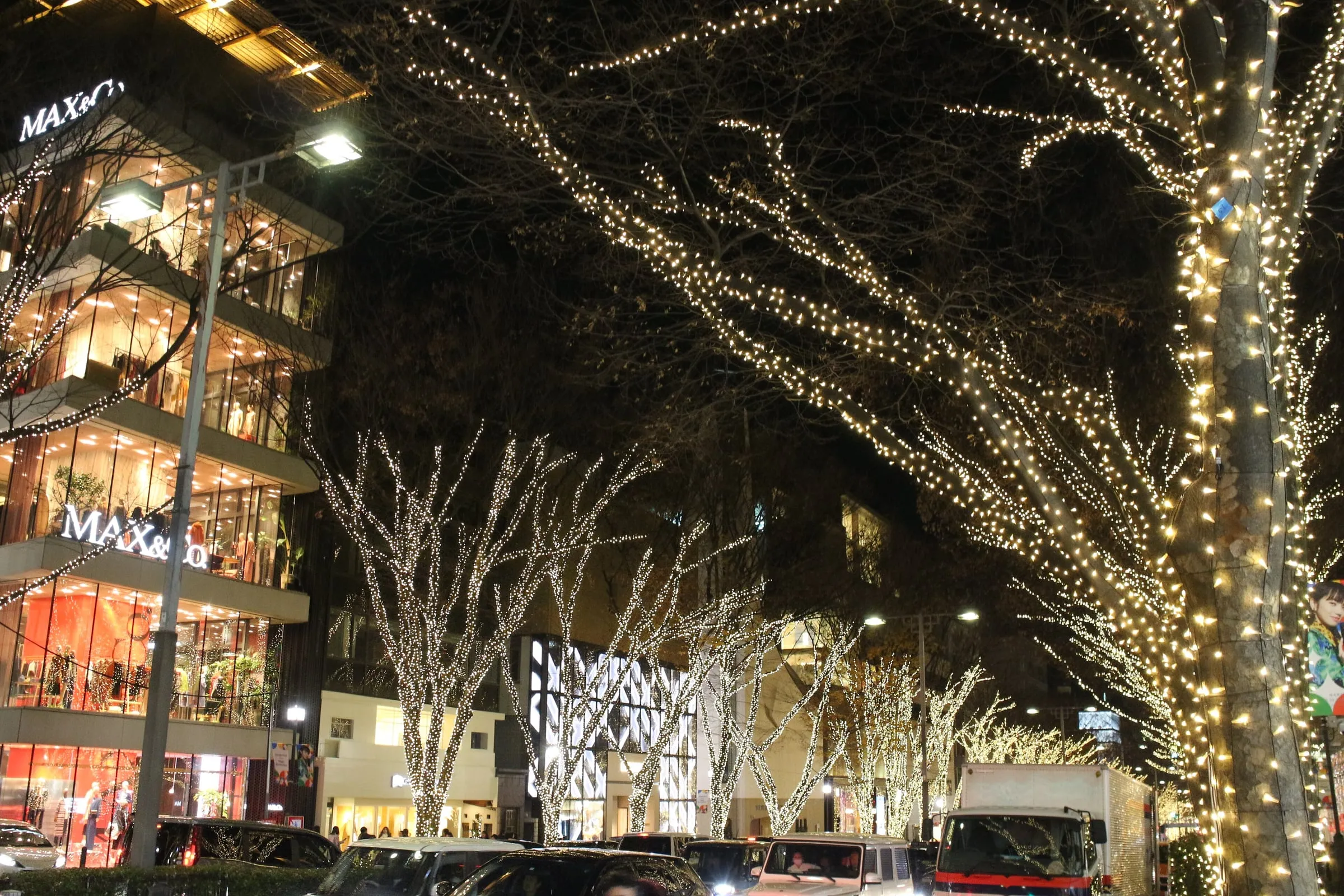
Omotesando’s zelkovas wrapped in lights on the evening of Dec 15, 2019; this season’s color and lit stretch may differ. Photo: Suicasmo / Wikimedia Commons (CC BY-SA 4.0). Resized.
If you go
The buildings along the avenue, from Omotesando Hills to the Ota Memorial Museum, have Jingumae addresses in Shibuya City. The shrine end is at Harajuku Station, which is why Omotesando turns up under both Shibuya and Harajuku. At the Aoyama-dori end you step into Minato City: the memorial at the crossing stands in Kita-Aoyama, and Prada Aoyama and the Nezu Museum are in Minami-Aoyama.
Start at Jingu-bashi, the bridge at the shrine end, and look down at the zelkova paving. Our guides to Meiji Shrine and Yoyogi Park cover what lies beyond it.
Walk toward Aoyama-dori. Just before Meiji-dori, a lane on the left leads to the Ota Memorial Museum of Art. It was built on the ukiyo-e collection of Ota Seizo V, about 12,000 works, and has been open at this address since Jan 13, 1980. It opens 10:30 a.m.–5:30 p.m. (last entry 5 p.m.) and closes on Mondays (the next weekday when Monday is a national holiday) and between exhibitions. Admission is cash only: ¥1,200 for adults until Dec 6, then ¥1,000.
The museum has no permanent display and changes works about monthly, and it does not allow translation apps, which mean holding a phone over the works and captions. Until Dec 6, 2026, it is showing Night Scene in the Yoshiwara by Katsushika Oi, Hokusai’s daughter, for the first time in three years, along with night views by other ukiyo-e artists. Lesser-Known Masters of Ukiyo-e follows from Dec 12 to Jan 17, 2027, with the museum closed from Dec 24 to Jan 5.
Where Cat Street crosses the avenue, look for a stone post inscribed 参道橋, Sando-bashi, “approach bridge.” Cat Street follows the old course of the Shibuya River, and an explanatory board there says water wheels polished rice along it until the Meiji era (1868–1912), a Japanese newspaper reported in December 2025.
Then comes Omotesando Hills, its 250-meter facade on your left. At the Omotesando crossing, find the stone lanterns, the Wa o Nozomu monument and Sanyodo Shoten; Omotesando Station is at this end.
Across Aoyama-dori are Prada Aoyama and, eight minutes from Exit A5, the Nezu Museum. It opens 10 a.m.–5 p.m. (last entry 4:30 p.m.) and closes on Mondays (Tuesday when Monday is a national holiday), between exhibitions and over the New Year holidays. Adults pay ¥1,400 online or ¥1,600 at the door for exhibitions from the collection, and from ¥1,600 online or ¥1,800 at the door for special exhibitions; high school students and younger enter free with student ID.
The museum asks visitors not to use cameras in its galleries. Ogata Korin’s Irises folding screens, a National Treasure in its collection, lead a special exhibition from April 17 to May 16, 2027.
We checked both museums’ hours, fees and exhibition dates on their own sites on Nov 11, 2026. If you come for the lights, check the calendars again: the Ota is between exhibitions from Dec 7 to Dec 11, and the Nezu opens its next exhibition on Dec 5. Our guides to Harajuku and Takeshita Street and Shibuya Crossing cover the neighboring districts.
The trees came first, and most of them came twice: in 1921, and again after 1945.
More in Travel & Destinations
View all →
Sunshine City Ikebukuro: Aquarium, Observatory, and Tickets
Travel & Destinations · Tokyo
Imperial Palace Tokyo: Tours, East Gardens and Edo Castle
Travel & Destinations · Tokyo
Kabukiza Theatre: Single-Act Tickets, Captions and History
Travel & Destinations · Tokyo
Odaiba: Sea Forts, a Rainbow Bridge Walk and What Has Closed
Travel & Destinations · Tokyo
Related articles
Akihabara: How Tokyo's Electric Town Began, and When to Go
Travel & Destinations · Tokyo
Ebisu Garden Place: Brewery, Sky Lounge and Winter Lights
Travel & Destinations · Tokyo
Ginza, Tokyo: History, Landmarks, and Car-Free Weekends
Travel & Destinations · Tokyo


Hanayashiki Amusement Park: Rides, Tickets and 1853 Roots
Travel & Destinations · Tokyo