Odaiba: Sea Forts, a Rainbow Bridge Walk and What Has Closed
How Odaiba grew from 1853 sea forts, which landmarks have closed, and how to walk the Rainbow Bridge and catch the free fountain shows, hours checked.
In the year to March 2024, 81,488 people visited Daiba Park, one of two surviving forts from the gun batteries that gave Odaiba its name, according to the Tokyo Metropolitan Government’s plan for the park. In calendar 2023, the government’s Port and Harbor Bureau counted about 47.7 million visitors to the waterfront district around it. The two counts are kept differently, but the gap is wide enough to suggest that most of the district’s visitors never set foot on the fort.
Odaiba is the popular name for the district of reclaimed land in Tokyo Bay that the Rainbow Bridge joins to central Tokyo. Its name comes from daiba, the gun batteries that the Tokugawa shogunate began building offshore in 1853. It is part of Tokyo, not a separate city: Fuji Television’s address is Daiba, in Minato City, and the Miraikan science museum stands in Aomi, in Koto City. GO TOKYO puts the trip from Tokyo Station at about 30 minutes, changing at Shimbashi to the Yurikamome, a driverless line that opened in 1995.
At a glance
| Where | Daiba (Minato City) and Aomi (Koto City), on Tokyo Bay. Yurikamome line: Odaiba-kaihinkoen and Daiba stations. Rinkai Line: Tokyo Teleport Station |
| Getting there | About 30 minutes from Tokyo Station, changing at Shimbashi to the Yurikamome; 22 minutes from Shinjuku to Tokyo Teleport on through trains of the JR Saikyo Line. Yurikamome one-day pass ¥820 |
| Rainbow Bridge walkway | Free. 1.7 km, 20–30 minutes on foot. 9 a.m.–9 p.m. (April–October), 10 a.m.–6 p.m. (November–March), last entry 30 minutes before closing. Closed on the third Monday of each month (the next day if that Monday is a holiday) |
| Tokyo Aqua Symphony | Fountain show off Odaiba Seaside Park: 10 shows a day, about 10 minutes each, free, no reservation. On the normal schedule since Oct 31, the first show is at 3 p.m. and the last at 9:30 p.m. No shows Nov 16–19, 2026 (maintenance) |
| Daiba Park | The Third Daiba battery: a national historic site since 1926 and a public park since July 7, 1928. No fee or set hours |
| Hachitama | The sphere on the Fuji Television building, 100 m up. ¥800 (high school age and older). 10 a.m.–6 p.m., last entry 5:30 p.m.; closed Mondays (Tuesday when Monday is a holiday) |
| Time needed | A full day, GO TOKYO suggests |
| Official information | TokyoOdaiba.net (area site); Tokyo Aqua Symphony (show schedule) |
Checked Nov 14, 2026, against the Tokyo Metropolitan Government’s Port and Harbor Bureau and Bureau of Construction, the Tokyo Aqua Symphony, Fuji Television and Yurikamome sites, Minato City’s tourism association and GO TOKYO; Daiba Park’s fee and hours come from the travel guide Good Luck Trip, in a listing supervised by the park’s manager, Tokyo Port Terminal Corporation (updated April 1, 2026). Hours change around New Year and for maintenance.
Is Odaiba man-made?
Yes, twice over. The first Odaiba was a cluster of artificial islands. After Commodore Perry’s American squadron arrived in 1853, the shogunate began building gun batteries in the sea off Shinagawa, on islands faced with stone, Minato City says.
Work began on seven, the city says. The metropolitan government’s plan for Daiba Park says six were finished in about a year and three months, to designs by Egawa Tarozaemon, the shogunate’s magistrate at Nirayama in Izu. The same plan calls them the first batteries in Japan built with Western methods of fortification, and the only surviving example of a large stone-walled structure built in the sea.
Two remain, the Third and the Sixth Daiba, and both were designated a national historic site in 1926.
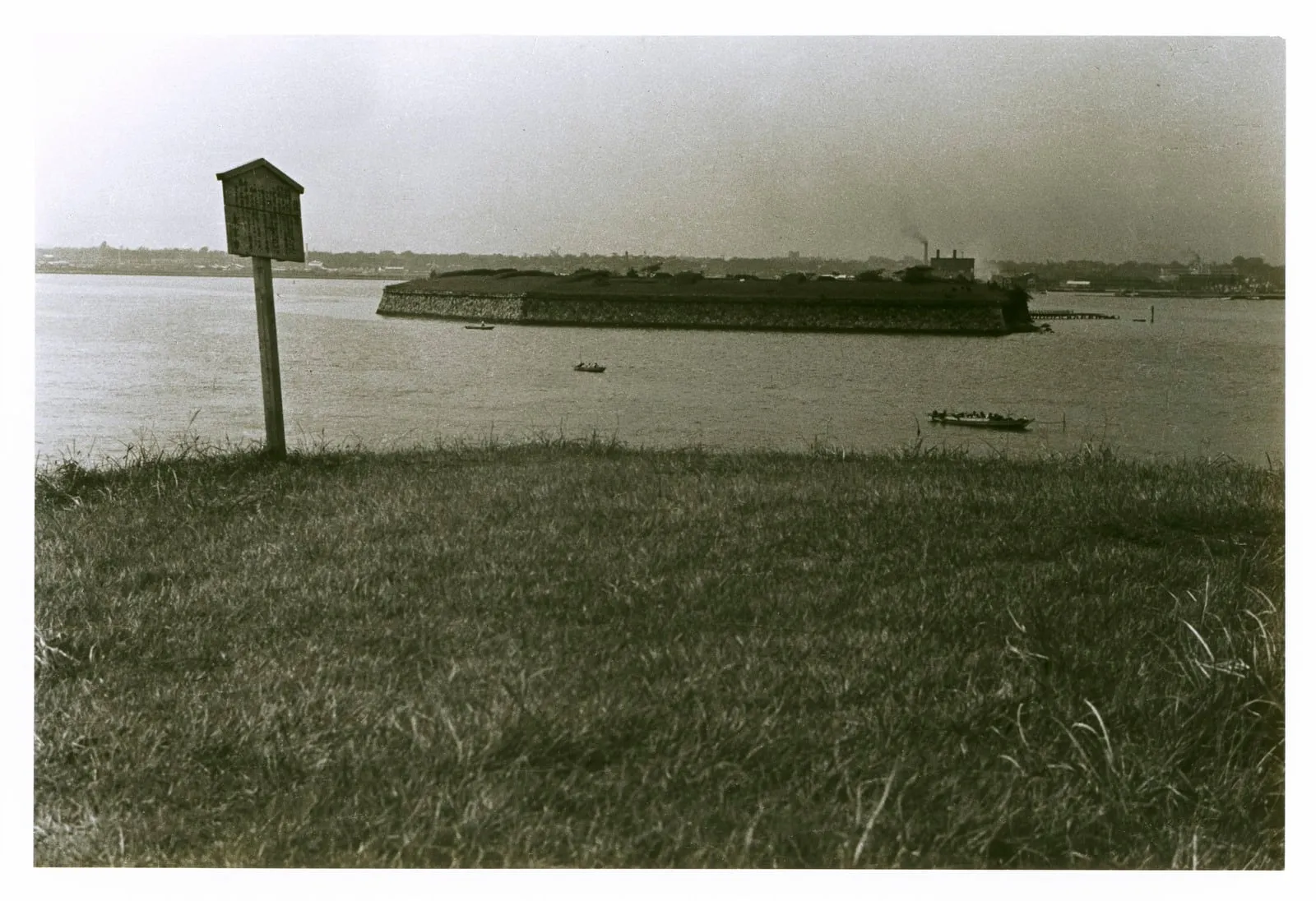
The Sixth Daiba seen across the water from the Third Daiba in 1937, long before the landfill; it does not show the area today. Photo: Kōji Morooka / Wikimedia Commons (public domain).
The second Odaiba is the landfill around them. The Port and Harbor Bureau describes the Rinkai Fukutoshin, the waterfront subcenter that takes in Odaiba, as 442 hectares of reclaimed land planned for about 34,500 residents and about 90,000 workers.
Odaiba Seaside Park opened in 1975, according to the bureau. The Rainbow Bridge followed in 1993, Minato City notes, and the Yurikamome began running on Nov 1, 1995, its operator says.
The crowds have nearly returned since the pandemic. The bureau counted about 52 million visitors to the waterfront subcenter in 2025, against 31.1 million in 2020 and 55.8 million in 2019.
What is left of the original batteries?
The Third Daiba survives as Daiba Park: a square about 160 meters on each side, walled in stone 5 to 7 meters high, with black pines along its banks. It sits at the foot of the Rainbow Bridge, about 10 minutes on foot from Odaiba-kaihinkoen Station, GO TOKYO says.
The park plan describes it as open to the public. The travel guide Good Luck Trip, in a listing supervised by the park’s manager, Tokyo Port Terminal Corporation, calls it free to wander, with no fee, set hours or closing days (updated April 1, 2026).
Inside the banks is a grassy hollow where the garrison appears to have lived. The plan lists the site of the barracks, a powder magazine set under an earthen bank, two cannons recreated in concrete in 1933 on the old gun positions, and a stone boat landing on the north side, now fenced off.
The rest of the island’s story is in the same document. A breakwater built after the Great Kanto Earthquake of 1923 reached its northeast corner. The City of Tokyo opened the island as a park on July 7, 1928, and in 1944 it became an air-defense position, with shelters dug into it that changed the shape of the banks.
It was still an island in 1961, when Minato City opened a summer camp there for a month each summer; it seems to have closed a few years later, the city says. A resident who went that first year, as a junior high school student, recalled in a city publication that the group sailed from Takeshiba Pier because there was no land route yet. The first summer drew 349 campers, 249 of them overnight.
Landfill by the Port and Harbor Bureau effectively joined the island to land in 1963, the park plan says. The Sixth Daiba is still an island, and it has gone the other way. It is not open to the public, and the plan describes it as left in its natural state, without human intervention, as a home for plants and wild birds. Its barracks collapsed of old age in January 1965.
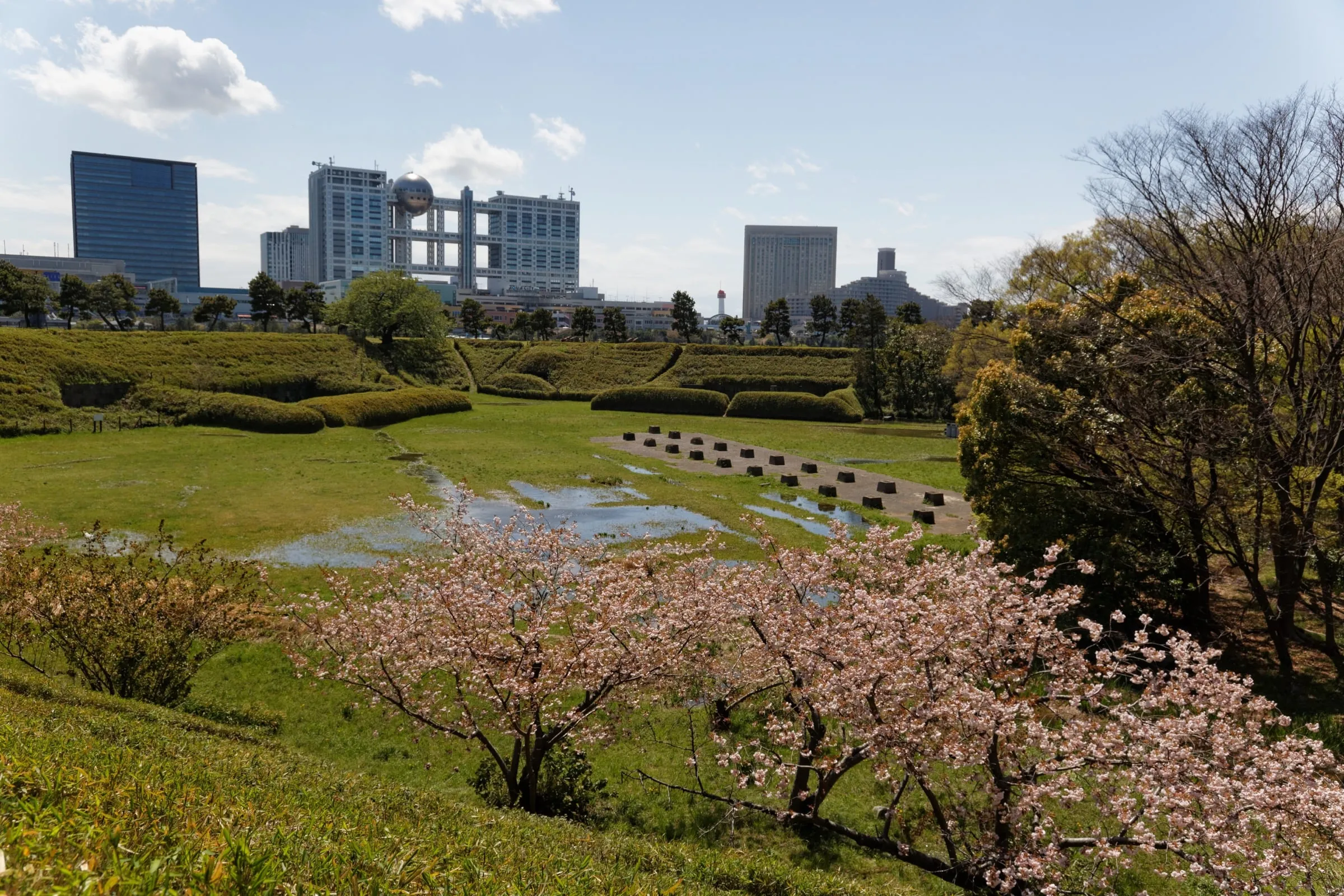
Inside Daiba Park on the Third Daiba in April 2013: the grassy hollow within the banks, a line of foundation stones and cherry trees in bloom, with the Fuji Television building behind. Photo: KimonBerlin / Wikimedia Commons (CC BY-SA 2.0). Resized.
Can you walk across the Rainbow Bridge?
Yes, and it costs nothing. The bridge carries an expressway, the Yurikamome and a pedestrian walkway along each side, GO TOKYO notes, and Minato City’s tourism association says walkers pay neither an admission fee nor a toll. By the Port and Harbor Bureau’s count, the walk from the Shibaura entrance to the Daiba entrance is 1.7 kilometers and takes 20 to 30 minutes, and you can start from either end.
The walkway opens 9 a.m.–9 p.m. from April through October and 10 a.m.–6 p.m. from November through March, with last entry 30 minutes before closing. It closes on the third Monday of each month, or the next day when that Monday is a holiday. The bureau may also turn walkers away for maintenance or weather; its notices name strong wind and heavy snow.
You may not ride a bicycle, but you can push one on a stand lent for the purpose, or carry it folded or taken apart in a bike bag. Pets must travel in a cage; a pet with its head poking out of a bag does not count. Wheelchairs are allowed, but the slopes are steep enough that the bureau asks every wheelchair user to come with a helper.
Toilets are at the Shibaura end, and neither entrance has parking. The bureau’s notice for New Year 2025–26 also lists drinking, smoking and tripods as banned on the walkway.
For New Year 2025–26, the bureau kept the walkway open through the night, from 10 a.m. on Dec 31 until 6 p.m. on Jan 1 (last entry 5:30 p.m.), and noted that the first sunrise of the year can be seen from the south walkway near Odaiba Seaside Park (2025–26 season, checked Nov 14, 2026).
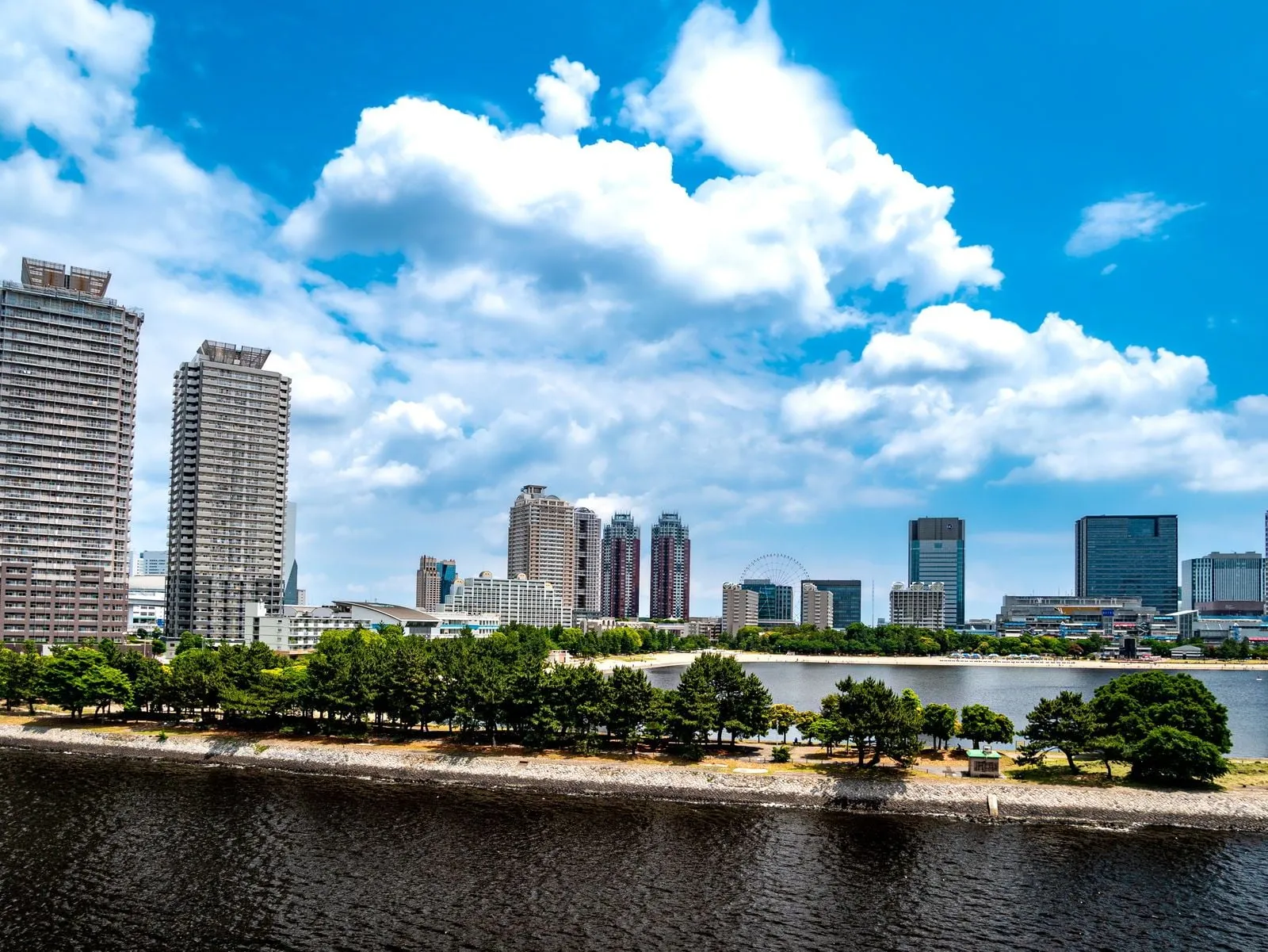
Odaiba’s tree-lined shore and its high-rises, seen from the Rainbow Bridge walkway in June 2022; the Ferris wheel on the skyline closed that August. Photo: くろふね / Wikimedia Commons (CC BY 4.0).
What is the fountain show at Odaiba Seaside Park?
It is the Tokyo Aqua Symphony, a free show that has run in the water off Odaiba Seaside Park since March 28, 2026, according to GO TOKYO. A jet that reaches 150 meters is paired with a 250-meter-wide fountain shaped after the Somei-yoshino cherry, Tokyo’s official flower, and the Port and Harbor Bureau ranks the combination among the largest in the world. It stands 170 meters offshore, GO TOKYO says, with the Rainbow Bridge and Tokyo Tower as the backdrop.
Each show lasts about 10 minutes and needs no ticket or reservation, and there are 10 a day. On the normal schedule in force since Oct 31, the first starts at 3 p.m. and the last at 9:30 p.m. The official site posts the exceptions, such as a pause for maintenance on Nov 16–19, 2026, and warns that weather can cancel shows.
The fountain cost about ¥2.64 billion to build. The bureau notes that the money came from its account for developing the waterfront, which is funded by selling reclaimed land, not from general tax revenue. The name was chosen from about 7,500 public suggestions, after a popularity vote among local elementary and junior high school students.
Swimming at the park’s beach is prohibited, GO TOKYO notes, except during Odaiba Plage, a swimming event Minato City has held there in summer; the 2026 edition ran July 17–21, 2 p.m.–7 p.m.
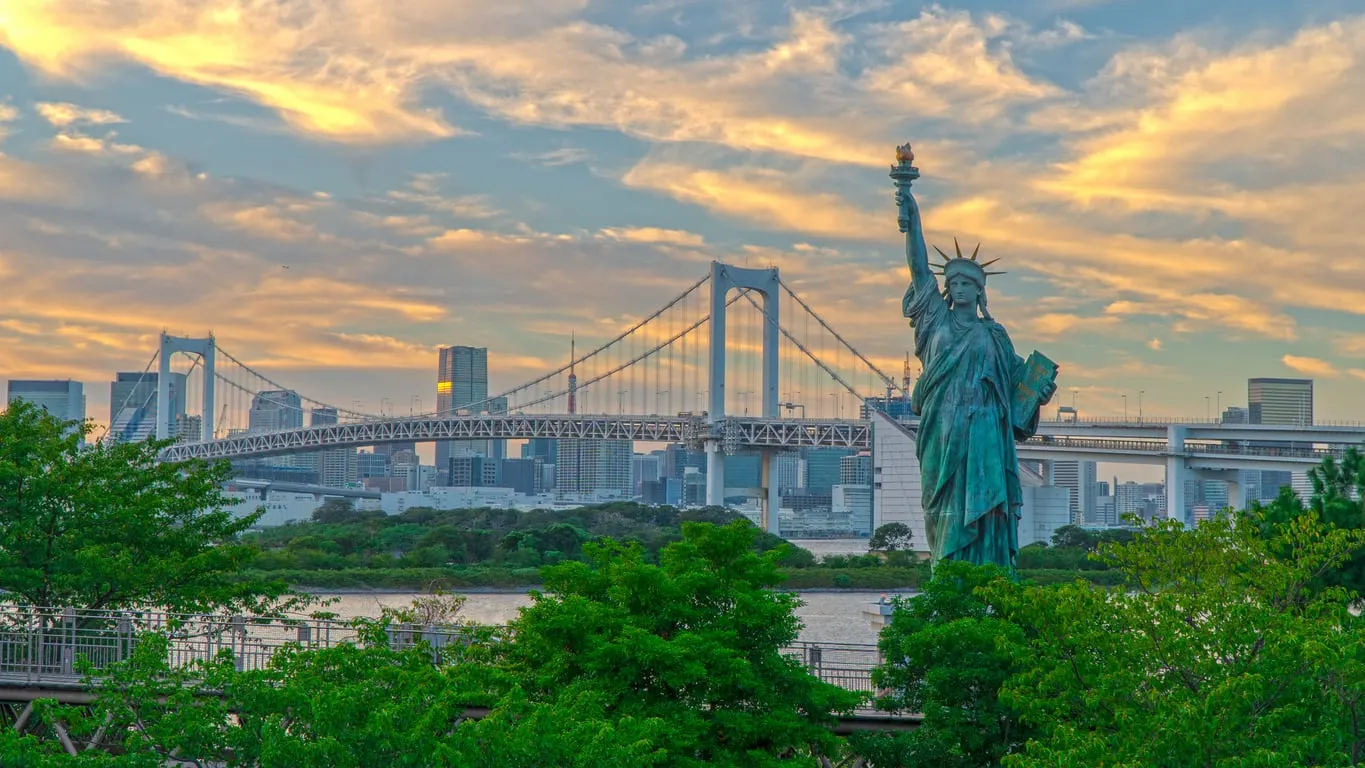
On the shore stands a bronze replica of the Statue of Liberty. GO TOKYO says a statue first went up here in April 1998 as a temporary tribute for the French Year in Japan and proved popular enough to become a permanent feature in 2000. The bronze there now was made by the Tokyo Waterfront City Association and presented to the metropolitan government, according to Minato City’s tourist map, and GO TOKYO puts it at about one-seventh the size of the New York original.
In December, fireworks go up from the water off the statue. TokyoOdaiba.net, the area site run by Tokyo Rinkai Holdings, lists the Odaiba Rainbow Fireworks for Saturdays Dec 5, 12, 19 and 26, 2026, at 7 p.m. for about five minutes, with a show set to music on the 19th; severe weather cancels them (checked Nov 14, 2026).
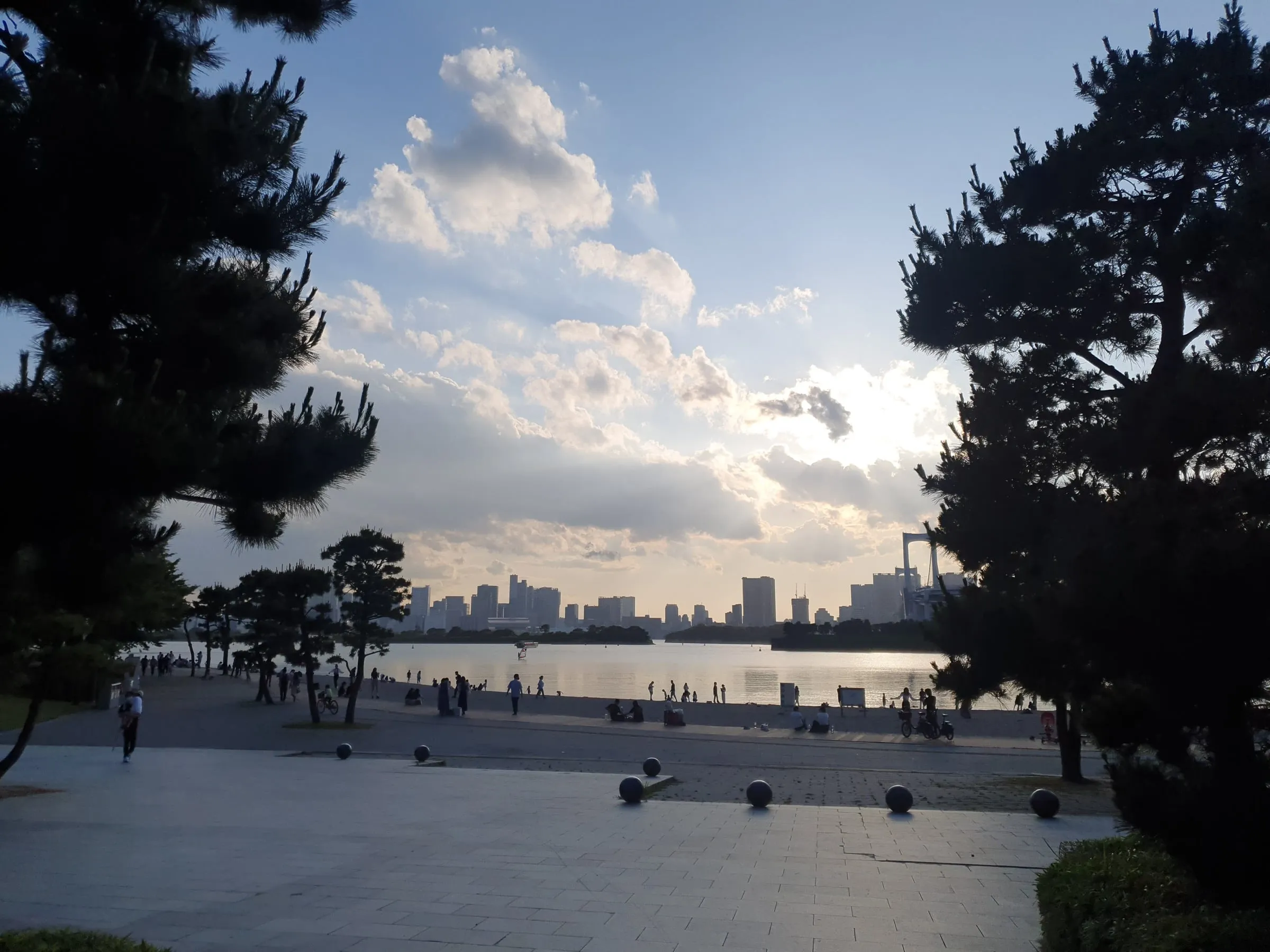
The waterfront promenade of Odaiba Seaside Park at dusk in June 2022, before the fountain was built offshore. Photo: Syced / Wikimedia Commons (CC0). Resized.
Is the Gundam statue still in Odaiba?
No. The life-size Unicorn Gundam statue on the second-floor Festival Plaza of DiverCity Tokyo Plaza, completed on Sept 24, 2017, ended its display on Aug 31, 2026, after almost nine years, its official site says.
Other landmarks in older guides are gone as well. Palette Town, an entertainment complex, closed in stages on a schedule its operators announced in July 2021, Impress Watch reported: MEGA WEB on Dec 31, 2021, the Zepp Tokyo concert hall on Jan 1, 2022, the VenusFort mall on March 27, 2022, and the giant Ferris wheel on Aug 31, 2022.
The teamLab Borderless digital art museum was on the same schedule, closing in Odaiba on the day the wheel did. It now operates at Azabudai Hills, according to teamLab’s site. For an observation deck and an art museum in central Tokyo, see our guide to Roppongi Hills.
One closure is temporary. Miraikan, the National Museum of Emerging Science and Innovation, is shut for facility work from Oct 1, 2026, to April 22, 2027, the museum says (checked Nov 14, 2026). It stands a five-minute walk from Tokyo International Cruise Terminal Station on the Yurikamome.
Gundam fans keep one consolation: the fountain’s current program includes “Tobe! Gundam,” the opening song of the original 1979 series, on some of its shows.
Is Odaiba worth visiting, and how long should you spend?
Yes, if you go for the batteries, the bridge and the water rather than the malls, and give it the full day that GO TOKYO suggests. The fountain shows, Daiba Park and the bridge walkway all cost nothing.
The sphere on the Fuji Television building is Hachitama, an observation room on the 25th floor, 100 meters above the ground. Adults pay ¥800 and elementary and junior high school students ¥500. It opens 10 a.m.–6 p.m., with last entry at 5:30 p.m., and closes on Mondays; in November 2026 the broadcaster lists closures on the 9th, 16th, 24th and 30th.
For shopping, GO TOKYO lists three malls: Aqua City, DiverCity and Decks. After dark, the bridge is lit, and on the normal schedule the last fountain show starts at 9:30 p.m.
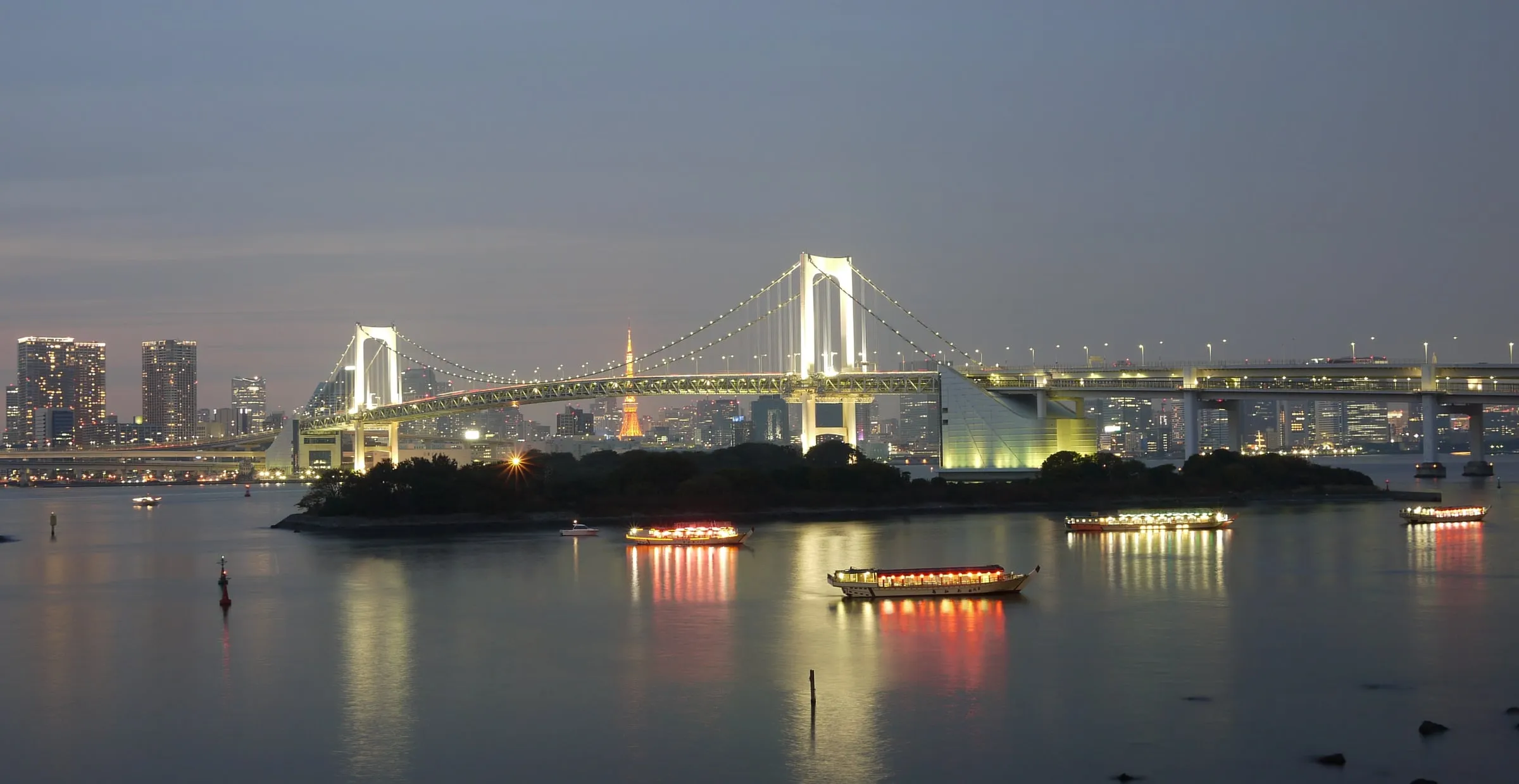
The Rainbow Bridge at dusk in November 2010, seen from Odaiba, with lantern-lit pleasure boats on the water and Tokyo Tower beyond. Photo: Jack Soma / Wikimedia Commons (CC BY 3.0).
If you go
Pick the date around the closing days: the bridge walkway shuts on the third Monday of the month and Hachitama on Mondays, and the fountain posts its maintenance pauses on its official schedule.
Then plan backward from the fountain. Walk the bridge in daylight, since from November to March the walkway closes at 6 p.m. Minato City’s tourism association names Shibaura-futo Station on the Yurikamome as the nearest stop for the Shibaura end. Spend the afternoon at Daiba Park and on the beach by the Statue of Liberty, and reach Fuji Television, 3 minutes on foot from the South Exit of Daiba Station, before Hachitama’s 5:30 p.m. last entry. Finish at the beach for the evening shows: the fountain’s site puts it 3 minutes on foot from Daiba Station and 10 from Tokyo Teleport.
From Tokyo Station, GO TOKYO’s route is the JR Yamanote Line to Shimbashi and the Yurikamome from there, about 30 minutes in all. From Shinjuku, through trains on the JR Saikyo Line reach Tokyo Teleport in 22 minutes. From Haneda Airport, GO TOKYO gives 35 minutes by limousine bus or 45 by train. Yurikamome sells a one-day pass for ¥820 (adults) as a QR mobile ticket.
Tokyo Cruise water buses stop at the Odaiba Seaside Park pier, about 5 minutes on foot from Daiba or Odaiba-kaihinkoen Station, with routes to Hinode Pier and Asakusa, according to the operator. Our Tokyo Bay cruise guide covers the boats.
The Yurikamome continues past Odaiba to Toyosu, 31 minutes end to end from Shimbashi, so Odaiba pairs easily with Toyosu Market.
The square of black pines at the foot of the bridge is what is left of the original Odaiba: a gun battery from the 1850s, a park from 1928, an air-defense post in 1944, a summer camp reached by boat in 1961, and still free to anyone who walks over.
More in Travel & Destinations
View all →
Sunshine City Ikebukuro: Aquarium, Observatory, and Tickets
Travel & Destinations · Tokyo
Imperial Palace Tokyo: Tours, East Gardens and Edo Castle
Travel & Destinations · Tokyo
Kabukiza Theatre: Single-Act Tickets, Captions and History
Travel & Destinations · Tokyo
Roppongi Hills: Observation Deck, Museum, and the 47 Ronin
Travel & Destinations · Tokyo
Related articles
Akihabara: How Tokyo's Electric Town Began, and When to Go
Travel & Destinations · Tokyo
Ebisu Garden Place: Brewery, Sky Lounge and Winter Lights
Travel & Destinations · Tokyo
Ginza, Tokyo: History, Landmarks, and Car-Free Weekends
Travel & Destinations · Tokyo


Hanayashiki Amusement Park: Rides, Tickets and 1853 Roots
Travel & Destinations · Tokyo