Hanayashiki Amusement Park: Rides, Tickets and 1853 Roots
How Hanayashiki grew from an 1853 flower garden into an amusement park, which rides run today, what tickets cost, and how to time a visit.
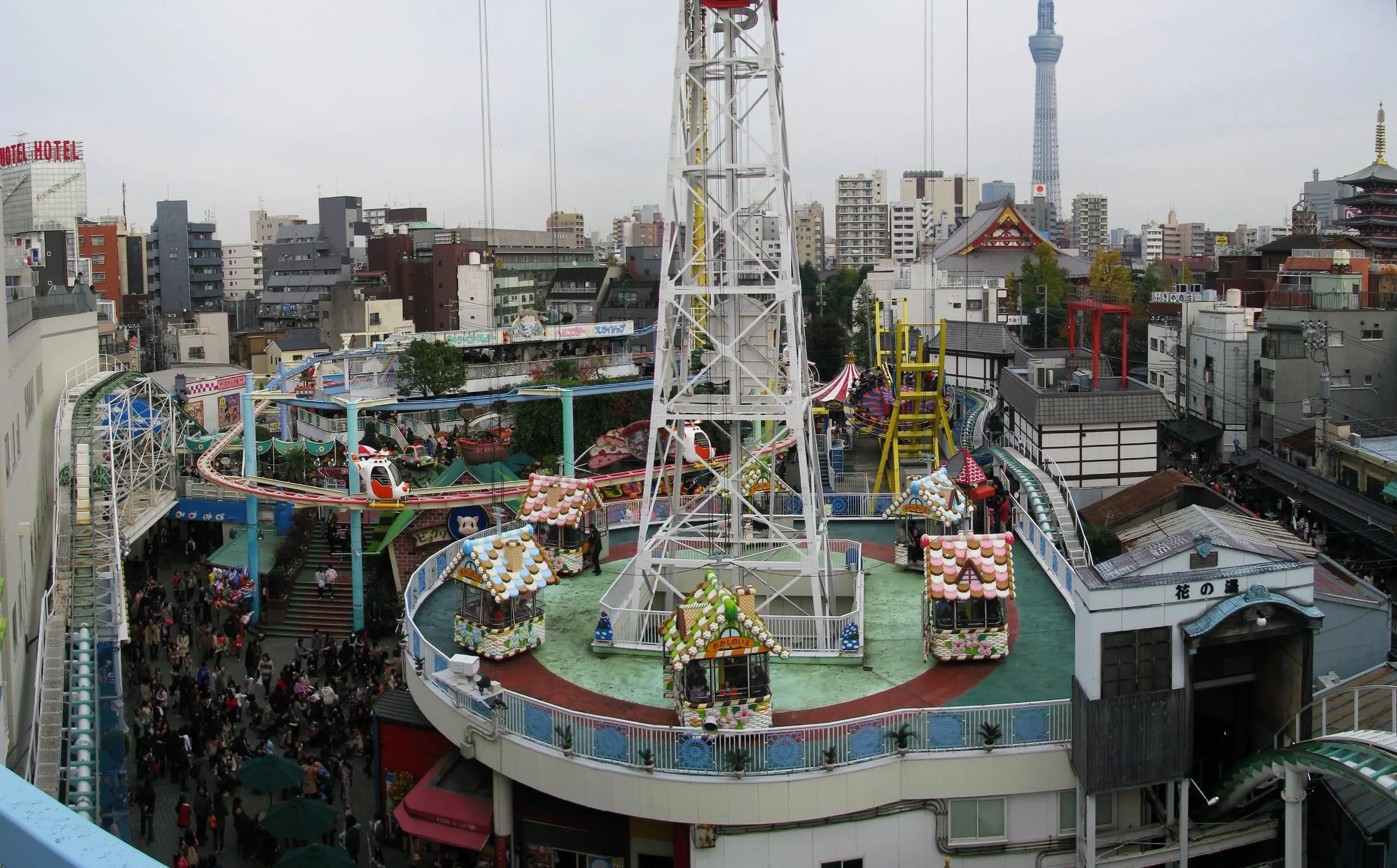
Hanayashiki’s roller coaster has been running since 1953, which makes it older than anyone allowed to ride it: the park turns away riders 65 and older. Even the coaster is a latecomer. The park counts its years from 1853, when the gardener Morita Rokusaburo laid out a flower garden on land granted by Senso-ji, its operator says.
Hanayashiki (also called Asakusa Hanayashiki) is an amusement park in Asakusa, in Tokyo’s Taito City, run by Hanayashiki Co., Ltd., a Bandai Namco Group company that calls it Japan’s oldest amusement park. Adults pay ¥1,600 to enter and extra to ride, and the park is usually open 10 a.m.–6 p.m., closing on scattered days listed on its calendar. It is five minutes on foot from Asakusa Station on the Tsukuba Express, and ten from the Ginza, Toei Asakusa and Tobu Skytree lines, the park says.
At a glance
| Where | 2-28-1 Asakusa, Taito City. 5 minutes on foot from Asakusa Station on the Tsukuba Express (Exit A1, per GO TOKYO); 10 minutes from Asakusa Station on the Ginza, Toei Asakusa and Tobu Skytree lines. The only entrance, the Asakusa Gate, is on the Senso-ji side |
| Hours | Usually 10 a.m.–6 p.m.; last entry 30 minutes before closing. Some winter weekdays close at 5 p.m. |
| Closed | Scattered days, most often Tuesdays; check the business calendar |
| Admission | ¥1,600 for adults (junior high school age to 64); ¥800 for children (age 5 through elementary school) and seniors (65 and older); free under 5 |
| Rides | Extra. Unlimited ride pass ¥3,000 (children and seniors ¥2,600). Ride tickets ¥100 each or 11 for ¥1,000; most rides take 5 and four take 8. One Day Pass (entry plus unlimited rides) ¥4,600 (children and seniors ¥3,400) |
| Roller coaster | Running since 1953. Riders must be at least 110 cm tall and under 65. Inspection closures are posted on the attractions page |
| Rules | Re-entry allowed; your own lunch is welcome; no pets except guide, hearing and service dogs; no parking |
| Official site | hanayashiki.net, in Japanese, with English, Korean and Chinese versions in its language menu (fees, attractions) |
Checked Nov 16, 2026, against Hanayashiki’s official Japanese pages (fees, attractions, business calendar, access, FAQ and notices). Hours vary with the season and the weather, the park says.
Is Hanayashiki really Japan’s oldest amusement park?
That is its operator’s claim, and it counts from 1853, when Hanayashiki, literally “flower estate,” was a garden; the rides came later. According to the company’s history, the gardener Morita Rokusaburo received 2,400 tsubo of land from Senso-ji (a tsubo is about 3.3 square meters, so roughly 7,900 square meters) and planted it with peonies and chrysanthemum craftwork. In 1856 it drew crowds with a show of more than 80 varieties of large chrysanthemums.
Utagawa Hiroshige made a three-sheet woodblock print of the garden, dated 1853 in the National Diet Library’s catalog. The library has put it online in its Digital Collections, where you can zoom in on the visitors strolling among the trees.
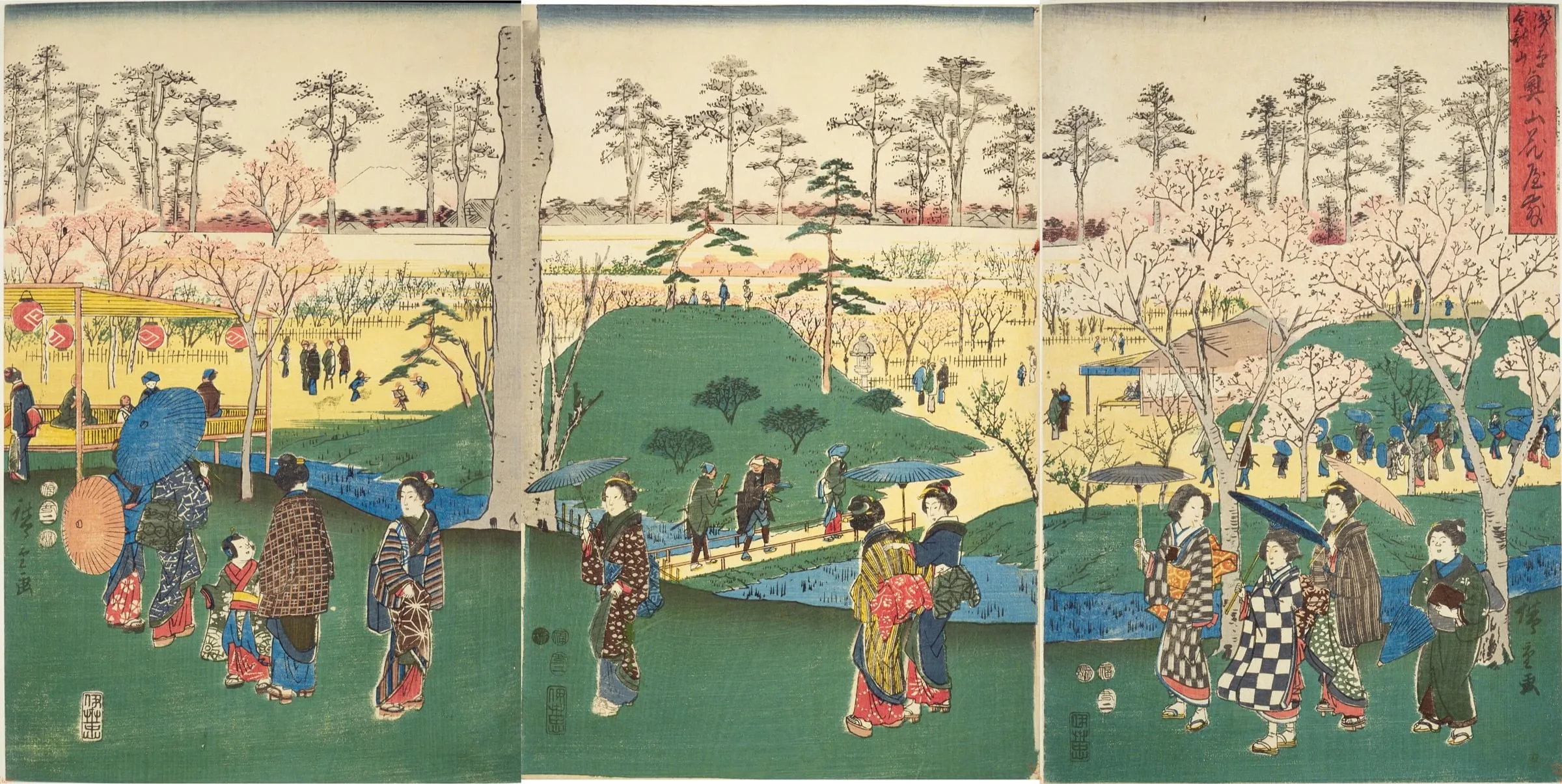
Utagawa Hiroshige’s triptych of the Hanayashiki flower garden in Asakusa, published in 1853, the year the garden opened. Print: Utagawa Hiroshige / Wikimedia Commons (public domain). Resized.
Play equipment arrived around 1872, the history says, along with displays of rare birds, and animals went on show from 1886. The garden kept wild animals and trained varied tits (yamagara, a small songbird) that performed tricks, and in 1904 it bought animals that had been exhibited at the Fifth National Industrial Exhibition in Osaka. It became popular enough, the company says, for Emperor Taisho to visit incognito.
Its timeline records tiger quintuplets born in 1923, the year the Great Kanto Earthquake also struck the garden’s animals. In 1941, with money from Otani Takejiro of Shochiku, the kabuki and film company, it took a new name as a “theater amusement park” and added stage comedies, films, a pony-drawn carriage, a miniature train and a merry-go-round.
In 1944, under a building-evacuation order issued to prepare for air raids, every wooden building was torn down and the garden closed.
It reopened as an amusement park in 1947. When it was rebuilt under a single operator in 1949, it started small, with a Bikkuri House (“surprise house”), a miniature train, a shooting gallery and a demon-slaying attraction, and entry was free. That lasted until February 1985, when, the company says, regulation under Japan’s amusement business law left it no choice but to charge admission. The current operator, Hanayashiki Co., took over in 2004.
How old is the Hanayashiki roller coaster?
It started running in 1953 as the Yomiuri Rocket Coaster, and the operator calls it the oldest surviving roller coaster in Japan. Its page puts the top speed at “just 42 km/h” and jokes that it has dropped countless bolts, then labels that line a lie.
To ride, you must be at least 110 cm tall and younger than 65, and a shorter child cannot ride even with an adult. A ride costs eight tickets or the unlimited pass, and although most rides are free for children 4 and under, the coaster charges them if they meet the height limit.
The coaster closes for periodic inspection, and the park posts the dates at the top of its attractions page, so check there if the coaster is the reason for your trip.
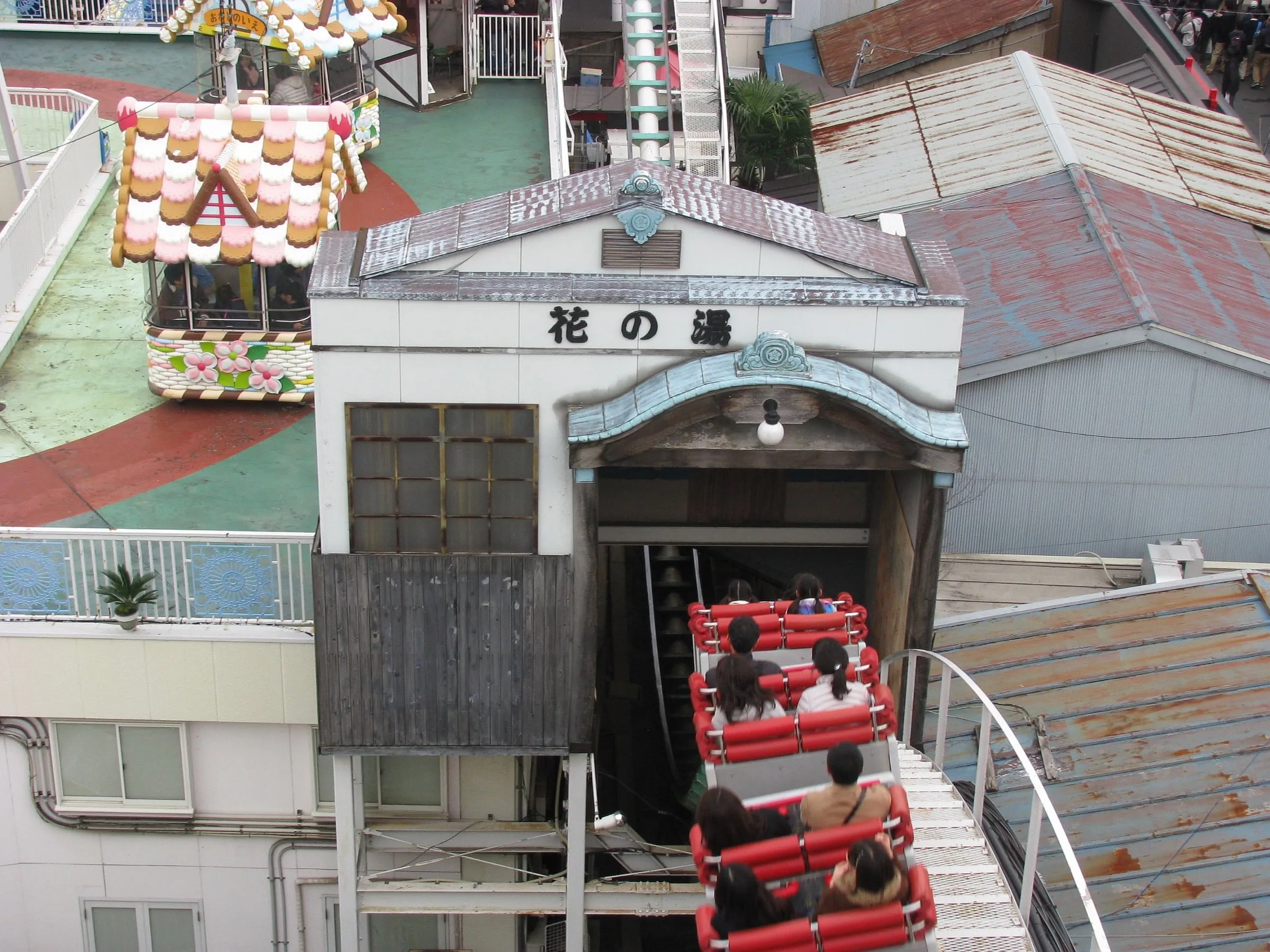
The coaster’s red train running through a building signed Hana no Yu, in November 2011. Photo: Aimaimyi / Wikimedia Commons (CC BY-SA 3.0). Resized.
What happened to the Bee Tower?
It retired in September 2016, so guides that still send you up it are out of date. The tower, about 40 meters tall, opened in 1960 as the Artificial Satellite Tower and was later renamed the Bee Tower. The company says it and the 1953 coaster both became fixtures of Asakusa.
On the tower’s site, the company opened Asakusa Kagekijo, a multipurpose hall whose name is written with the characters for “flower theater,” on Apr 28, 2019. The company runs it alongside the amusement park.
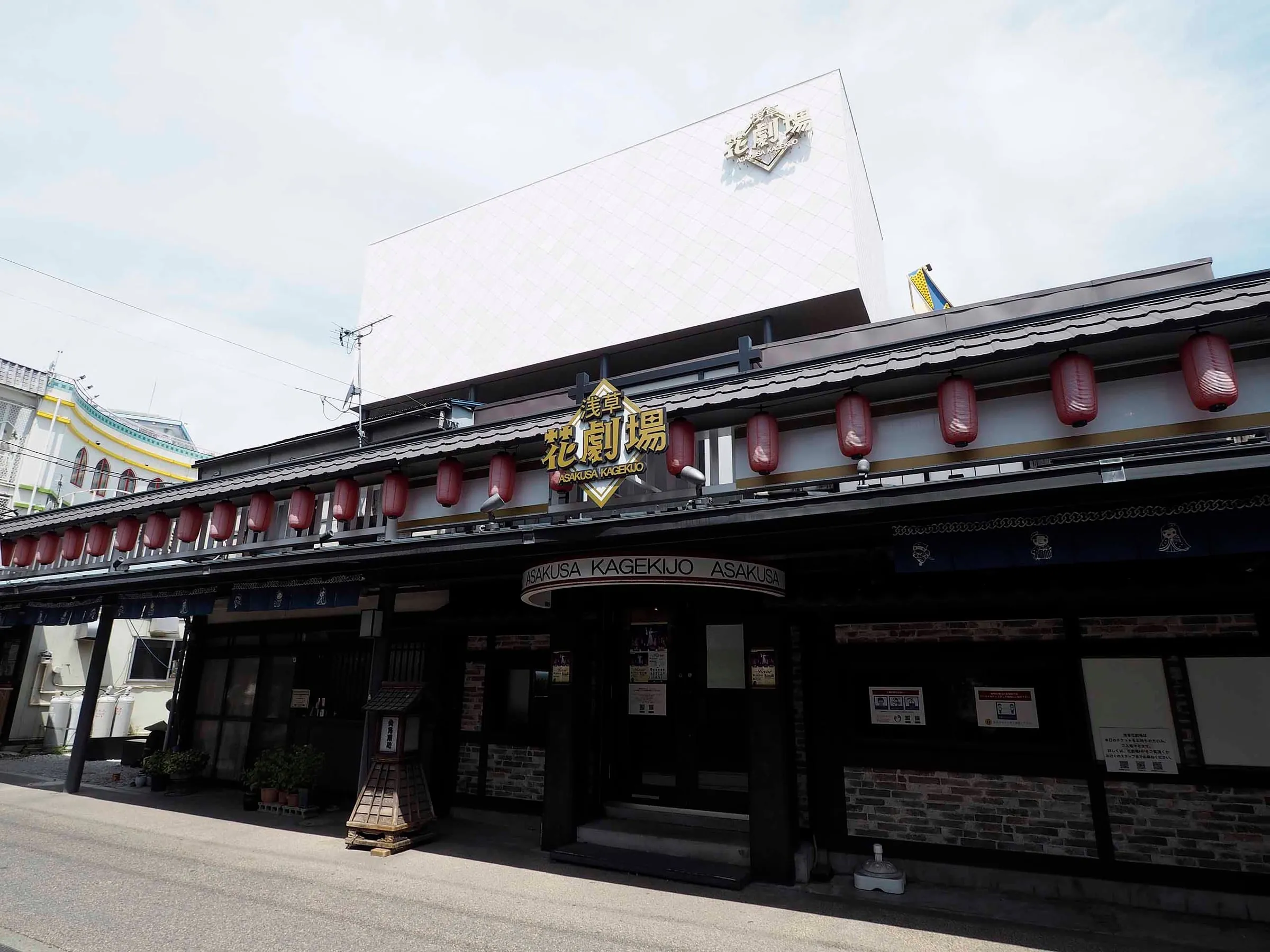
Asakusa Kagekijo, the hall built where the Bee Tower stood, in April 2021. Photo: Comyu / Wikimedia Commons (CC BY-SA 4.0). Resized.
What rides are at Hanayashiki today?
The park’s attraction page lists 17 attractions that take ride tickets or the unlimited pass, the same number the company gives in its history, plus four extras with their own fees and two free spaces. We checked the list on Nov 16, 2026.
Four rides take eight tickets. They are the roller coaster; Disk-O, which its page describes as a dizzying spin in the park’s narrow grounds, for riders 120 cm and taller; Little Star, 130 cm and up, which the park says may spin either way once it starts; and Obake Yashiki (“haunted house”), subtitled Kubizuka no Noroi, “the curse of the head mound,” with no height limit. Disk-O and Little Star, like the coaster, turn away riders 65 and older.
The other 13 take five. Thriller Car is a Western-style haunted house that, the park admits, is more funny than scary. The Bikkuri House is a registered trademark of the company, and Panorama Jikan Ryoko (“panorama time travel”) is a four-screen video flight over Asakusa past and present.
For the smallest visitors, the park’s filters show several rides open to babies under 2, including the merry-go-round. Panda Car rides (¥200) and the Game Plaza (from ¥100) take cash only, and the festival-style game stalls of Maruhana Ennichi start at ¥500; the unlimited pass does not cover them.
Hanasora Garden is free, and the park bills it as a photo spot with a view from Senso-ji to Tokyo Skytree. In rain, everything except Swan, Sky Ship and Disk-O generally runs, the park’s FAQ says, and it suggests a raincoat for the outdoor rides.
Hanayashiki tickets: admission, ride tickets or a pass?
From age 5 you pay twice: once to enter (¥1,600 for adults) and again to ride, either per ride with tickets or all day with a pass. For an adult, the pass pays off at about seven rides, sooner if the eight-ticket rides are on your list.
Ride tickets cost ¥100 each, or 11 for ¥1,000. Most rides take five tickets; four take eight. By our arithmetic, tickets for six five-ticket rides cost ¥2,800 if you buy them in sets of 11, and for seven, ¥3,200, against ¥3,000 for an adult unlimited pass; every eight-ticket ride brings that point closer. A child’s ¥2,600 pass pays off at six five-ticket rides.
The One Day Pass bundles entry and the unlimited pass for ¥4,600, the same as buying the two separately, and it is sold at the entrance. The unlimited pass alone is sold at the entrance and at the Ticket House inside; ride tickets come from the Ticket House or the ticket machines.
Children 4 and under enter free and ride most rides free, but they must ride with someone of junior high school age or older, who pays. Holders of a Japanese disability certificate also enter free, though rides are charged. Seniors 65 and older pay ¥800 to enter and ¥2,600 for the pass, though three of the four eight-ticket rides are closed to them.
Ride tickets do not expire, there is no annual pass, and the park sells web tickets for quicker entry. Besides cash, the gate, the information desk, the Ticket House and the ticket machines take credit cards, e-money and QR-code payments.
Is Hanayashiki worth visiting?
Yes, if you have small children, an interest in how Tokyo amused itself, or time to fill after Senso-ji. Skip it if you want big thrills: the park’s own figure for its roller coaster is “just 42 km/h.”
Children 4 and under ride free with a paying companion, and several rides take babies. The park’s history is in its rides: a coaster from 1953, a Bikkuri House, a name that goes back to the 1949 reopening, and a video tour of Asakusa past and present.
On the other side, the park’s own page describes its grounds as narrow, three of its bigger rides bar anyone 65 or older, and an adult who wants entry plus unlimited rides pays ¥4,600. If you want a full theme-park day instead, our Tokyo Disneyland guide covers that park, which stands in Urayasu, Chiba Prefecture, not in Tokyo.
If you go
Getting there. The Tsukuba Express’s Asakusa Station is five minutes away on foot (GO TOKYO points to Exit A1); Asakusa Station on the Ginza, Toei Asakusa and Tobu Skytree lines is ten. The park has no parking or bicycle parking and warns that nearby roads can jam during events.
In and out. The only entrance is the Asakusa Gate, on the Senso-ji side, and the exit is on the Kokusai-dori side. To come back in, ask the exit staff for a re-entry ticket.
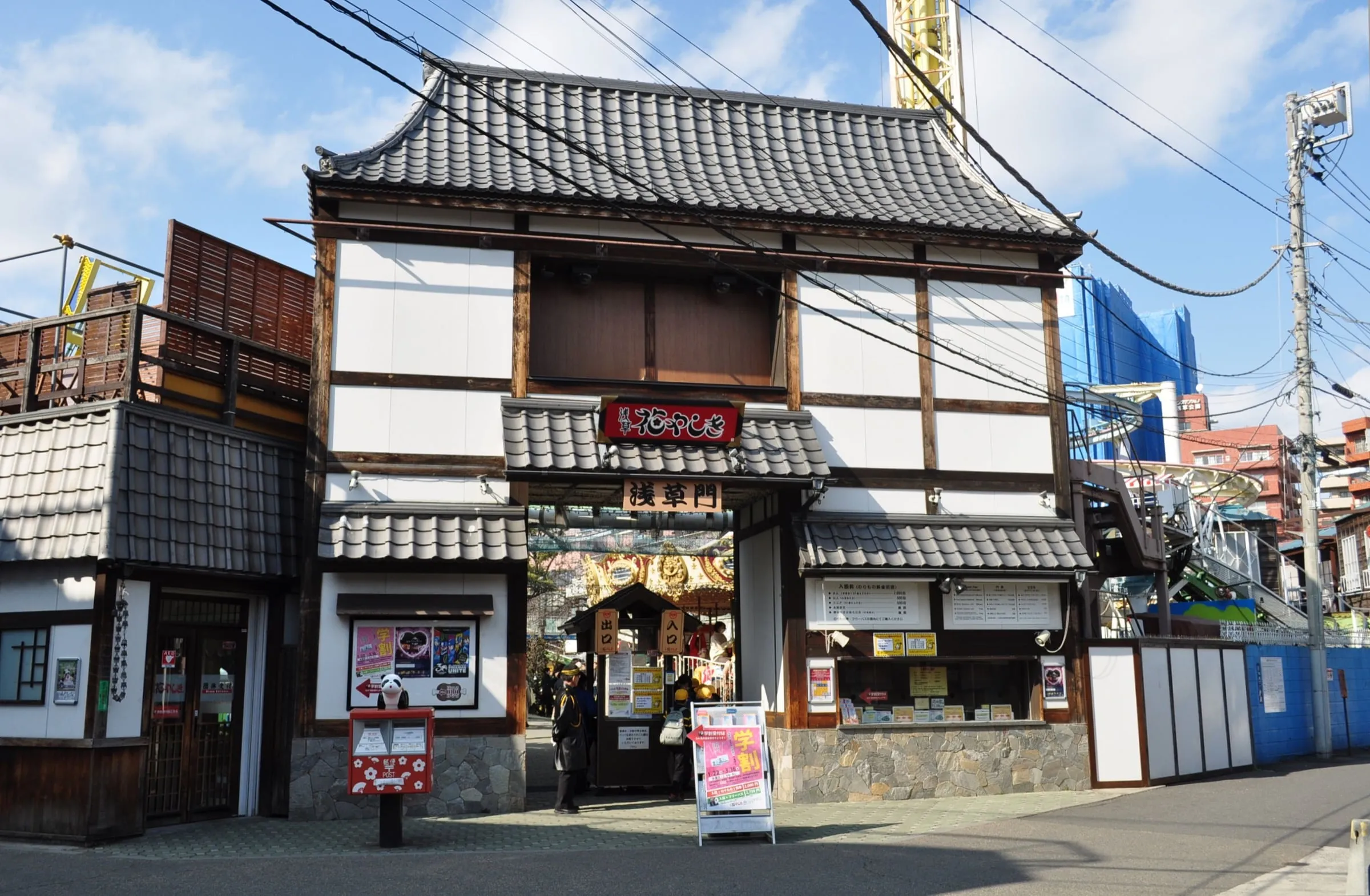
The Asakusa Gate, Hanayashiki’s only entrance, in February 2018. Photo: 江戸村のとくぞう / Wikimedia Commons (CC BY-SA 4.0). Resized.
Picking a day. Check the business calendar before you go: closed days are scattered through the year, and the hours shift with the season. Summer brings late nights; in 2026 the park stayed open until 9 p.m. from Aug 1 to 23 (2026 season, checked Nov 16, 2026).
On the day. Coin lockers stand in four places. There is no stroller rental, but the information desk will hold a folded stroller and, for a fee, bags too big for a locker. Your own lunch is welcome at the park’s tables and benches.
Nearby. With its entrance on the temple side, Hanayashiki pairs with Senso-ji, which our Senso-ji guide covers from its gates to its hours. The view from the Hanasora Garden may send you on to Tokyo Skytree. And while Hanayashiki’s animals are long gone, Ueno Zoo, in Ueno Park, still has living ones.
If you are 64, ride the coaster this year. At 65, the park will not let you on.
More in Travel & Destinations
View all →
Imperial Palace Tokyo: Tours, East Gardens and Edo Castle
Travel & Destinations · Tokyo
Kabukiza Theatre: Single-Act Tickets, Captions and History
Travel & Destinations · Tokyo
Odaiba: Sea Forts, a Rainbow Bridge Walk and What Has Closed
Travel & Destinations · Tokyo
Roppongi Hills: Observation Deck, Museum, and the 47 Ronin
Travel & Destinations · Tokyo
Related articles
Akihabara: How Tokyo's Electric Town Began, and When to Go
Travel & Destinations · Tokyo
Ebisu Garden Place: Brewery, Sky Lounge and Winter Lights
Travel & Destinations · Tokyo
Ginza, Tokyo: History, Landmarks, and Car-Free Weekends
Travel & Destinations · Tokyo


Sunshine City Ikebukuro: Aquarium, Observatory, and Tickets
Travel & Destinations · Tokyo