Sunshine City Ikebukuro: Aquarium, Observatory, and Tickets
What is inside Sunshine City, from the rooftop aquarium to the 60th-floor deck, what the tickets cost, and what stood on the Ikebukuro site before 1978.
On a rooftop in Tokyo’s Ikebukuro district, Cape penguins swim in a tank about 12 meters wide that hangs out over the people watching. Look straight ahead and they seem to fly above the city’s buildings; look up, and they pass overhead. Sunshine Aquarium calls the tank Tenku no Penguin, the Sky Penguin, and describes it as a space found nowhere else.
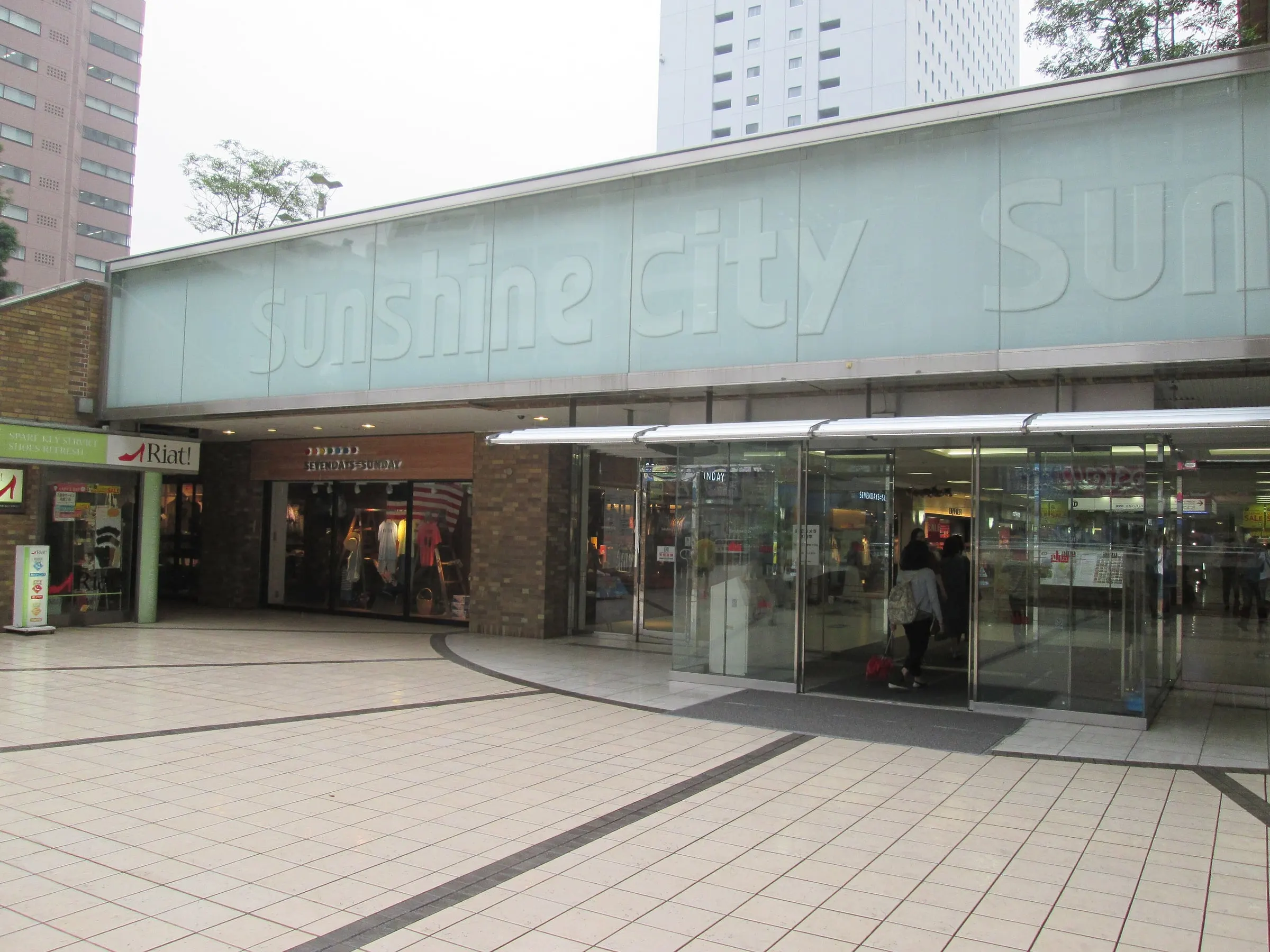
Sunshine City is a complex of five buildings in Higashi-Ikebukuro (East Ikebukuro), in Tokyo’s Toshima City, with an aquarium, an observatory, two shopping centers, offices, a hotel, a theater and a museum. It opened in 1978 on the site of the former Sugamo Prison, and its operator counts more than 30 million visitors a year. Each attraction sells its own ticket, and Ikebukuro Station is about eight minutes away on foot.
At a glance
| Where | 3-1 Higashi-Ikebukuro, Toshima City. About 8 minutes on foot from Ikebukuro Station (JR, Tokyo Metro, Seibu and Tobu lines; Exit 35), or 3 minutes by underground passage from Higashi-Ikebukuro Station (Tokyo Metro Yurakucho Line, Exits 6 and 7) |
| Observatory | Sunshine 60 Observatory Tenbou-Park, 60th floor. 11 a.m.–9 p.m., last entry 8:30 p.m. (closes at 6 p.m. on Dec 31 and Jan 1), per the deck’s own site; the complex’s English hours page shows a different opening time. Adults ¥700 on most weekdays, ¥900 on weekends and holidays, ¥1,200 on peak days |
| Aquarium | Sunshine Aquarium, on the roof of the World Import Mart Building. Autumn and winter: 10 a.m.–6 p.m. on weekdays, 9:30 a.m.–6 p.m. on weekends and holidays (longer in spring and summer); last entry 30 minutes before closing. Adults ¥2,600–¥3,200, depending on the date |
| Planetarium | Konica Minolta Planetarium Manten, on the same roof. Shows usually start from 11 a.m. to 8 p.m. Adults ¥1,600 online or ¥1,800 at the counter for a standard seat at regular shows |
| Museum | Ancient Orient Museum, 7th floor of the Bunka Kaikan Building. 10 a.m.–5 p.m., last entry 4:30 p.m. Adults ¥900 for the collection; special exhibitions cost more (¥1,500 for the one running to Dec 6, 2026) |
| Shops | Alpa shopping center: shops 10 a.m.–8 p.m., restaurants 11 a.m.–10 p.m. (some keep other hours) |
| Busy days | The observatory requires a date-and-time ticket on weekends, holidays and designated busy days; the aquarium recommends one |
| Official site | sunshinecity.jp/en (hours, access) |
Checked Nov 16, 2026, against the Japanese and English pages of Sunshine City, Sunshine 60 Observatory Tenbou-Park, Sunshine Aquarium, Konica Minolta Planetarium Manten and the Ancient Orient Museum. Children pay less.
What is Sunshine City, and is it the same as Sunshine 60?
No. Sunshine 60 is one building, the complex’s office tower, and Sunshine City is the whole five-building complex, run by Sunshine City Corporation. The operator’s guide puts the main attractions in three of its buildings:
- Sunshine 60: the observatory on the 60th floor and the Sky Restaurants on the 58th and 59th.
- World Import Mart Building: Sunshine Aquarium and the planetarium on the roof, the indoor theme park Namja Town, and a convention center.
- Bunka Kaikan (Culture Hall) Building: Sunshine Theatre, the Ancient Orient Museum and the airport bus terminal.
Two shopping centers fill the lower floors: Alpa, with about 105 shops and services and about 70 restaurants, and Sunshine City ALTA, with about 45 shops. The Sunshine City Prince Hotel has 38 floors and more than 1,000 rooms. The directory also lists a public employment office, the Tokyo Metropolitan Passport Center, clinics and a post office.
Some of the city works out of sight. Since it opened in 1978, Sunshine City has cleaned wastewater from its kitchens, hotel bathrooms and other sources and reused it to flush toilets: about 800 metric tons a day now, and once up to about 1,200 on busy days. The operator calls it the first such greywater system in Japan built for a single building.
Sunshine 60 stands directly on solid ground 24 meters down, the operator says, and in August 2016 it finished a retrofit against long-period ground motion, which can sway skyscrapers strongly. The work combined three types of dampers, a method the operator calls a first in Japan.
On the west side of the tower’s ground floor, look for The Four Seasons of Edo, a ceramic relief made from an original by Kataoka Tamako, a Nihonga (Japanese-style) painter and recipient of the Order of Culture.
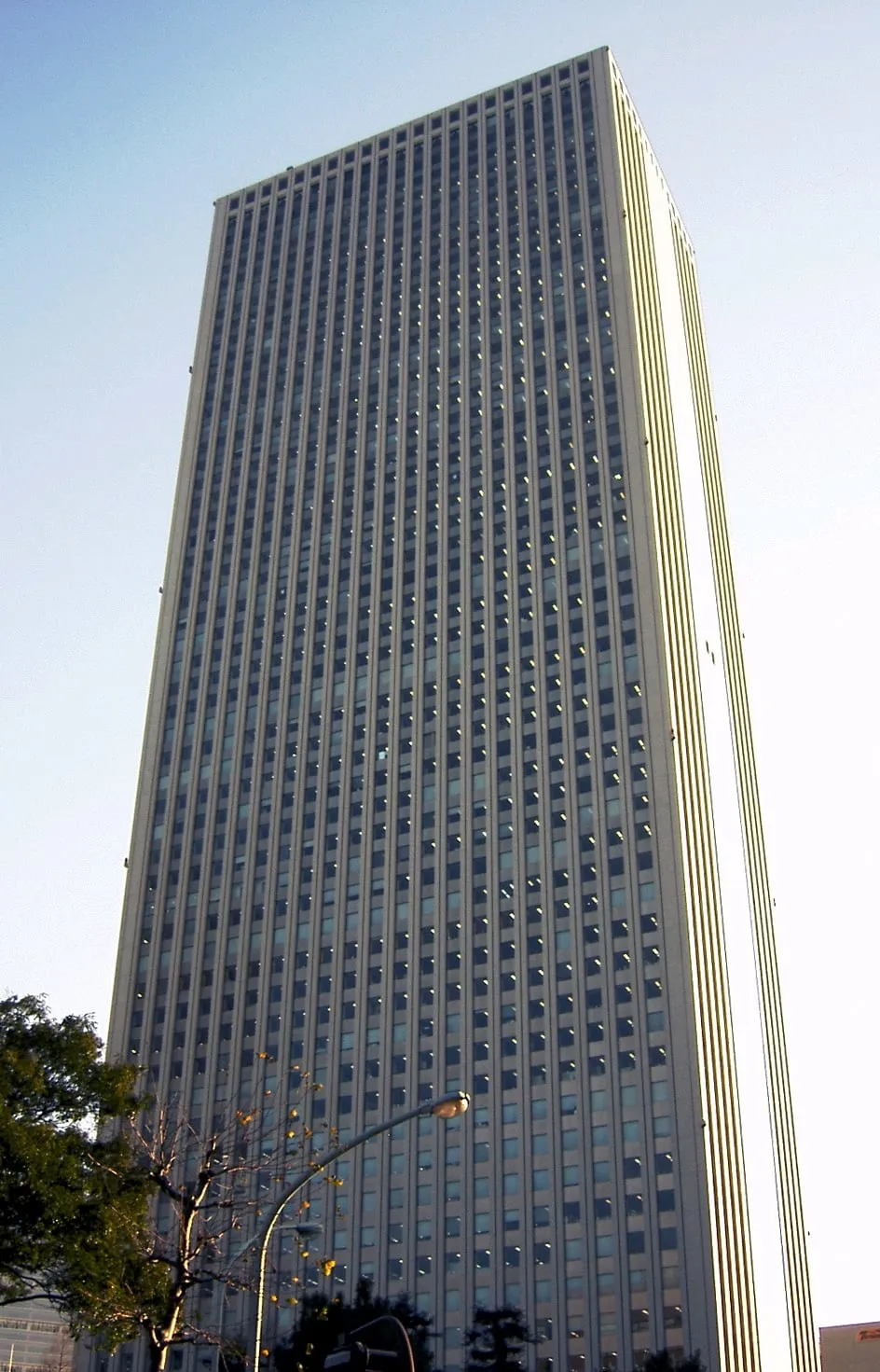
Sunshine 60, the office tower of Sunshine City, in March 2007. Photo: Kure / Wikimedia Commons (CC BY-SA 2.5).
What was here before Sunshine City?
Sugamo Prison. Toshima City’s guide to the sights along its streetcar line describes Sunshine City as a complex that opened in 1978 on the prison’s former site.
The National Diet Library’s guide to the prison’s records explains what it was. Sugamo Prison opened in November 1945 in a requisitioned detention house, to hold Class A and Class B and C war-crimes suspects and to carry out their sentences once they were final. The U.S. Eighth Army ran it until April 1952, when practical control passed to the Japanese government. Over some 13 years it held about 4,000 war-crimes suspects and convicts, until the release of all war criminals was completed on Dec 29, 1958.
The operator’s timeline tells the rest in planning terms. In February 1958, the national cabinet agreed to move the Tokyo Detention House off the site early, and in 1966 Tokyo’s metropolitan government fixed a redevelopment plan for the land. The company completed acquiring the site in April 1971 and began construction in July 1973.
The name Sunshine City was chosen from public entries in June 1977. Sunshine 60 and its observatory opened in April 1978. That October, the World Import Mart Building opened with the aquarium and a planetarium, and the Bunka Kaikan with its theater and museum.
Beside Sunshine 60, Higashi-Ikebukuro Central Park opened in June 1980; the ward’s park guide says it was laid out in the same redevelopment of the old prison site. In one corner stands a stone that Toshima City describes as a monument wishing for lasting peace.
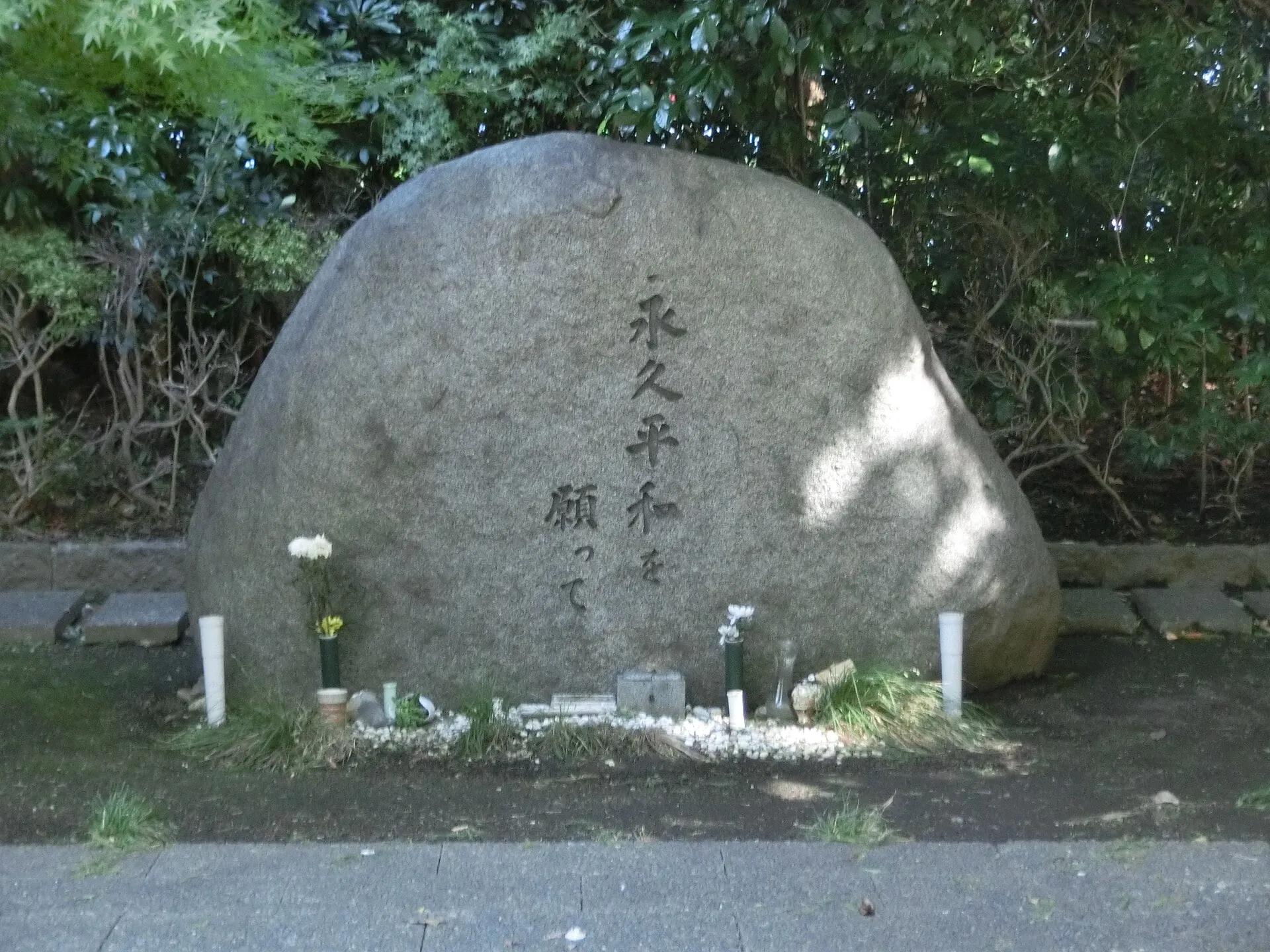
The stone in a corner of Higashi-Ikebukuro Central Park, inscribed with a wish for lasting peace, in October 2019. Photo: あばさー / Wikimedia Commons (public domain). Resized.
Is Sunshine Aquarium worth it?
It is if you want sea animals against a skyline. Sunshine Aquarium is a rooftop aquarium that takes about an hour to see, by its own estimate, and its open-air Marine Garden puts penguins and sea lions over visitors’ heads.
Adult tickets cost ¥2,600 to ¥3,200 depending on the date, with ¥2,600 on most weekdays in November and December 2026. Elementary and junior high school students pay ¥1,300, preschoolers 4 and older ¥800, and children 3 and under enter free.
The aquarium has been on this roof since the building opened in October 1978, the operator’s timeline shows. A full renovation in 2011 gave it its current name, and the Marine Garden was extensively renovated in 2017.
In the Marine Garden, the Sky Penguin tank overhangs the walkway, so Cape penguins swim above you. They are fed around 10:30–11:30 a.m. and 3:15–4:15 p.m., when fewer of them are in the tank. In the Sunshine Aqua Ring, sea lions swim overhead with Sunshine 60 behind them. The aquarium shows them there only until 4 p.m., and only when the animals’ condition and the weather allow, so see the ring early. Asian small-clawed otters and great white pelicans live up here too.
Indoors, the aquarium’s first floor, Ocean Journey, holds the big Sunshine Lagoon tank, modeled on a shallow coral reef, and a jellyfish area. Its second floor, Waterfront Journey, covers rivers, lakes and shores, including a tank that recreates the spring water of Japan’s clear streams. GO TOKYO counts about 70 tanks with 23,000 creatures of 550 species, and says the Sunshine Lagoon holds 240 tons of water.
Part of the Marine Garden has no roof, the aquarium does not lend umbrellas, and the area may close in bad weather. Re-entry is not allowed, and the next closing day is Jan 14, 2027.
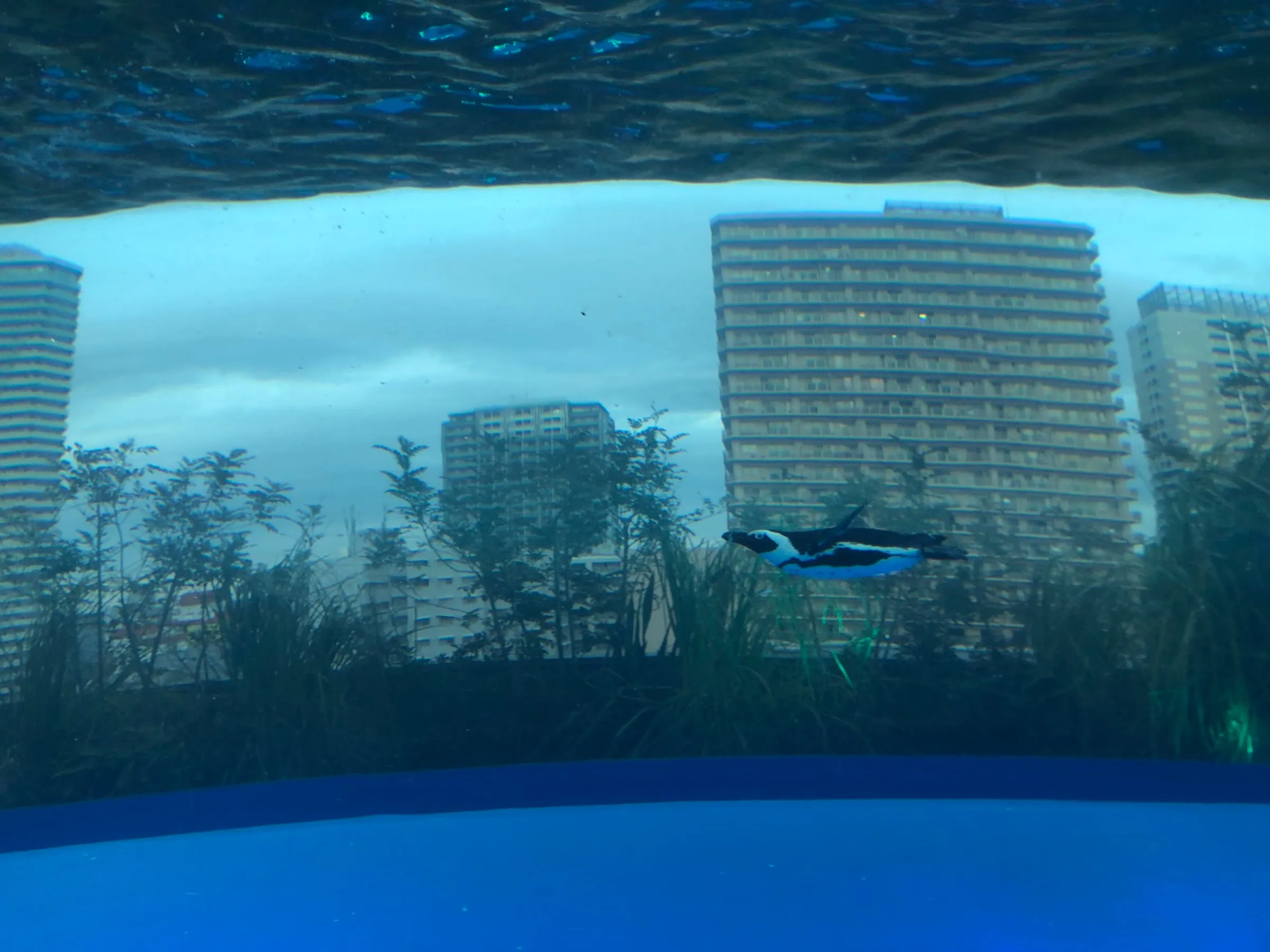
A Cape penguin in the Sky Penguin tank of the Marine Garden, with Ikebukuro’s buildings behind it, in January 2019. Photo: Totti / Wikimedia Commons (CC BY-SA 4.0). Resized.
How much is the Sunshine 60 observatory, and what can you see?
Adult tickets to Sunshine 60 Observatory Tenbou-Park cost ¥700 on most weekdays, ¥900 on weekends and holidays, and ¥1,200 on peak days, which in late 2026 include Nov 21–23, Dec 19–21 and Dec 24–31. Elementary and junior high school students pay ¥500 to ¥800, and preschoolers enter free. At the weekday price, that is less than half the ¥1,500 adult ticket for the Main Deck of Tokyo Tower.
On weekends, holidays and designated busy days, the deck limits entry and asks for a date-and-time web ticket, sold through Asoview or FamilyMart from seven days ahead. On other weekdays you can buy a same-day ticket at the 60th-floor counter. Once you leave, you cannot go back in.
An elevator from Sunshine 60’s B1 floor reaches the 60th floor in 35 seconds, GO TOKYO says. The deck stands 251 meters above sea level, and the operator points out that no tall buildings stand nearby, so the 360-degree view carries far. On clear days, according to GO TOKYO, you can pick out Mount Tsukuba, the Nikko mountains and even Mount Fuji behind the Tanzawa range.
After dark, the operator adds, the view is certified as a Japan Night View Heritage site. The deck has been renovated twice in a decade, as SKY CIRCUS in 2016 and as Tenbou-Park in April 2023, and its concept now is a park in the sky. In the Tenbou-no-Oka (observation hill) area, you can lie down on artificial turf.
You may eat food you bring in designated areas on weekdays from 11 a.m. to 2 p.m., except during Obon, the midsummer holidays. Tripods are allowed if they fold and stay out of others’ way, and there are no coin lockers or bag storage on the deck.
If height matters most, Tokyo Skytree has decks at 350 and 450 meters above the ground.
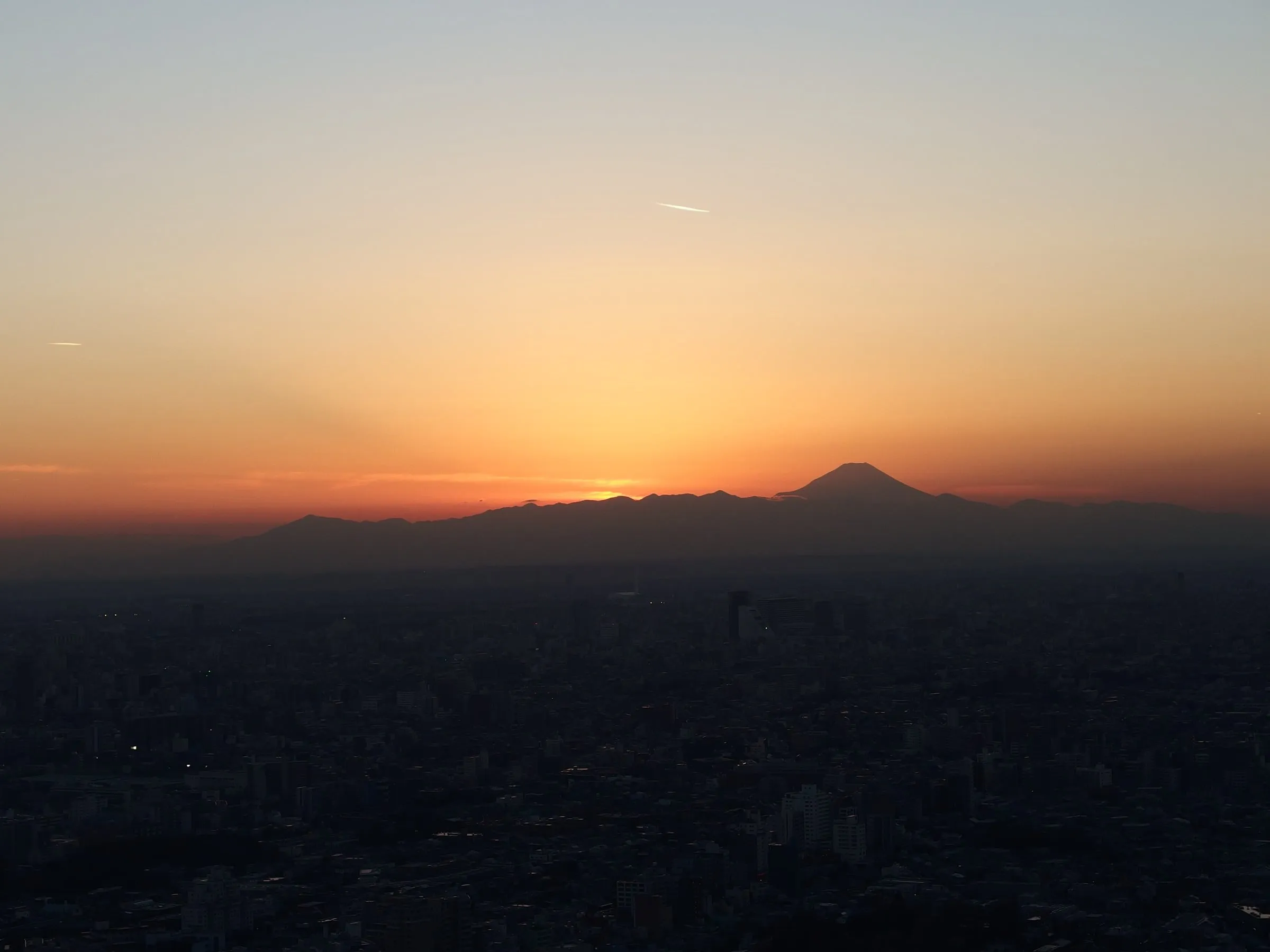
Mount Fuji at sunset, seen from the Sunshine 60 observatory on Dec 25, 2013, before the deck’s two renovations. Photo: Guilhem Vellut / Wikimedia Commons (CC BY 2.0). Resized.
What else is inside Sunshine City?
A planetarium, a museum of the ancient Orient, an indoor theme park and character shops.
Konica Minolta Planetarium Manten shares the aquarium’s roof. It opened in 2004 and has a flat dome with no tiers, which the planetarium says makes a show feel like real stargazing. Besides standard seats, it has five Cloud seats and, in the front row, three Lawn seats: premium seats for up to two people, used with your shoes off, at ¥3,200 to ¥4,600 per seat for regular shows. It says it shows programs made for adults; its Healing Planetarium shows cost more and do not admit preschoolers.
The Ancient Orient Museum, on the seventh floor of the Bunka Kaikan Building, opened on Oct 5, 1978, and calls itself Japan’s first museum devoted to the ancient Orient, the civilizations of Mesopotamia, Egypt and their neighbors. Its collection of about 5,000 objects, centered on West Asia and Egypt, runs from the Paleolithic to the Sasanian era and includes many finds from Syria, where the museum has carried out field research.
Until Dec 6, 2026, a special exhibition follows silver from the ancient Orient to Iwami Ginzan, the World Heritage silver mine in Shimane Prefecture. The museum then closes for the changeover and reopens with its collection on Dec 19.
Namja Town, on the second floor of the World Import Mart Building, is an indoor theme park that Namco opened in 1996. One of its themed streets, Fukubukuro 7-chome Shotengai (shopping street), recreates a nostalgic town of 1955 to 1964, and Sunshine City’s guide lists a Namja Gyoza Stadium for comparing regional gyoza dumplings. The park says it is open every day, 10 a.m.–8 p.m. (last entry 7:30 p.m.). Since Nov 9, 2026, both the entry-only ticket and the pass with unlimited attractions have been priced by date, so check the park’s ticket page; children under 4 enter free.
The complex also has character stores. Pokémon’s store page puts the Pokémon Center Mega Tokyo on the second floor of Alpa, and Bandai Namco Cross Store Tokyo sells the group’s character goods and runs prize machines. GO TOKYO pitches Ikebukuro as a subculture alternative to Akihabara. Tenants change, so check the operator’s floor guide for the current list.
If you go
From Ikebukuro Station, served by the JR, Tokyo Metro, Seibu and Tobu lines, take Exit 35 on the east side and walk along Sunshine 60 Street, which was completed in March 1978 as 60-kai Dori, “60th Floor Street.” On the right, beside Sunshine Vision, the Sunshine City underground entrance leads down by escalator to a passage into the complex, about eight minutes from the station in all; that entrance is open 7 a.m.–11:30 p.m.
Higashi-Ikebukuro Station on the Tokyo Metro Yurakucho Line is closer. From its West Gate, head for Exits 6 and 7 and follow the signs for the Sunshine City underground passage, about three minutes (open 7 a.m.–11 p.m.). The Toden Arakawa Line streetcar stops at Higashi-Ikebukuro-yonchome, about four minutes away on foot.
Expect detours. Sunshine City is replacing escalators in stages: its notice of Oct 14, 2026, puts the work on the three escalators at the Sunshine City underground entrance (B1 to 1F) through the end of December 2026, and on banks in Alpa and Sunshine 60 into 2028, all dates planned. Some escalators are out of service while the work goes on, and signs on site show the detours.
Plan the day by closing times. The sea lions are in the Aqua Ring until 4 p.m., the museum closes at 5 p.m., and in autumn and winter the aquarium closes at 6 p.m. The planetarium’s last show usually starts at 8 p.m. and the observatory stays open until 9 p.m., so the deck can come last, for the night view. On weekends and holidays, book the observatory’s timed ticket first.
Before or after, walk next door to Higashi-Ikebukuro Central Park, where the peace stone stands; the ward’s park guide, last updated in 2015, singles out the 24 bald cypresses near its main entrance for their autumn color. For another of Tokyo’s big entertainment complexes, see our guide to Tokyo Dome City.
FAQ
How do you get to Sunshine City from the airports? Airport Limousine buses stop at an indoor terminal on the first floor of the Bunka Kaikan Building and in front of the Prince Hotel. Sunshine City puts the ride at 60–70 minutes from Haneda and 90–120 minutes from Narita. By train, it lists 41 minutes from Haneda and 48 from Narita to Ikebukuro, not counting transfers.
Is Sunshine City open every day? Most of it, but each part has its own days off. The aquarium’s next closing day is Jan 14, 2027, and Alpa and ALTA close for inspection on Feb 24, 2027, though some shops stay open. The Ancient Orient Museum closes Dec 7–18 and from Dec 27, 2026, to Jan 3, 2027; Namja Town says it is open year-round.
Where can you leave luggage? Not at the observatory, which has no coin lockers and cannot hold suitcases; it points visitors to the coin lockers elsewhere in Sunshine City. Sunshine Aquarium has coin lockers at its entrance, to use before you go in.
More in Travel & Destinations
View all →
Imperial Palace Tokyo: Tours, East Gardens and Edo Castle
Travel & Destinations · Tokyo
Kabukiza Theatre: Single-Act Tickets, Captions and History
Travel & Destinations · Tokyo
Odaiba: Sea Forts, a Rainbow Bridge Walk and What Has Closed
Travel & Destinations · Tokyo
Roppongi Hills: Observation Deck, Museum, and the 47 Ronin
Travel & Destinations · Tokyo
Related articles
Akihabara: How Tokyo's Electric Town Began, and When to Go
Travel & Destinations · Tokyo
Ebisu Garden Place: Brewery, Sky Lounge and Winter Lights
Travel & Destinations · Tokyo
Ginza, Tokyo: History, Landmarks, and Car-Free Weekends
Travel & Destinations · Tokyo


Hanayashiki Amusement Park: Rides, Tickets and 1853 Roots
Travel & Destinations · Tokyo