Tokyo Skytree: Tickets, Decks, and Why It Is 634 Meters
What Tokyo Skytree's two decks cost under 2026's date-based prices, why the tower stands 634 meters tall, and when to go up for a view of Mount Fuji.
The emergency stairs inside Tokyo Skytree climb a concrete cylinder that is structurally separate from the steel tower around it. In a strong earthquake, the top of that cylinder sways out of step with the tower and cancels part of the shaking. Its designers named the system after the central pillar of a five-story pagoda.
Tokyo Skytree is a 634-meter broadcasting tower in Oshiage, in Tokyo’s Sumida City, with two observation decks: the Tembo Deck at 350 meters and the Tembo Galleria at 450 meters. Its operator calls it the world’s tallest tower. Adult tickets bought online start at ¥1,800 for the Tembo Deck and ¥3,000 for both decks, prices change with the date, and the tower is a minute’s walk from two stations.
At a glance
| Where | 1-1-2 Oshiage, Sumida City. 1 minute on foot from Tokyo Skytree Station (Tobu Skytree Line) and from Oshiage (Skytree-mae) Station (Tokyo Metro Hanzomon, Toei Asakusa, Keisei Oshiage and Tobu Skytree lines). Entrance on the 4th floor |
| Heights | Tower 634 m (about 2,080 ft). Tembo Deck 340–350 m (Floors 340, 345 and 350). Tembo Galleria 445–450 m; highest point 451.2 m |
| Hours | Weekdays 10 a.m.–10 p.m.; weekends and holidays 9 a.m.–10 p.m., to 10:30 p.m. on some dates (official calendar for Nov 2026 to Jan 2027). Last entry 1 hour before closing; hours can change without notice |
| Tickets (adults) | Online: Tembo Deck from ¥1,800; Tembo Deck and Tembo Galleria from ¥3,000. The price depends on the date. ¥500 more per ticket at the 4th-floor counter or ticket machines |
| Time needed | About 1 hour for the Tembo Deck; 1 to 1.5 hours with the Tembo Galleria (the operator’s rough estimate for a family visit) |
| Best time | The first hour after opening for space; November to February for clear air and Mount Fuji |
| Rules | No re-entry. Tickets are valid only on their date, and there are no refunds for poor visibility |
| Official site | tokyo-skytree.jp (English: en.tokyo-skytree.jp) |
Checked Nov 13, 2026, against Tokyo Skytree’s official Japanese pages (tickets, hours calendar, access, FAQ and floor guide) and GO TOKYO. Children aged 6 to 14 pay from ¥900 (Tembo Deck) or ¥1,500 (both decks); children under 6, and 6-year-olds not yet in elementary school, enter free.
How tall is Tokyo Skytree, and why 634 meters?
Tokyo Skytree is 634 meters tall, about 2,080 feet, and the exact number was picked to be memorable. When the project began, the tower was announced at about 610 meters, its operator says, though the structure was planned with a world record in mind. The final figure was set on Oct 16, 2009.
Read digit by digit in Japanese, 6-3-4 can be pronounced mu-sa-shi. Musashi was an old province that, the operator notes, covered a wide area taking in parts of today’s Tokyo, Saitama and Kanagawa, the tower’s own ground among it. The operator’s timeline records that Guinness World Records certified Skytree as the world’s tallest tower on Nov 17, 2011, and its pages still call it both the tallest tower in the world and the tallest self-supporting broadcast tower.
The height has a job. Digital terrestrial television began in the Kanto region in December 2003, and its signals risked interference from the growing number of 200-meter skyscrapers in central Tokyo, the operator explains.
A 600-meter-class tower would roughly double the height of transmission. The six Tokyo broadcasters, NHK and five commercial networks, began full broadcasts from Skytree on May 31, 2013.
When Skytree’s site in Oshiage was chosen in 2006, Japan’s tallest structure was still Tokyo Tower, at about 333 meters, and Skytree’s official pages credit the same firm, Nikken Sekkei, with both towers. Our Tokyo Tower guide compares their decks, prices and hours.
Construction began on July 14, 2008, the tower reached its full height in March 2011, and it opened on May 22, 2012. Even the name went to a national vote in 2008, in which Tokyo Skytree beat five shortlisted rivals, among them Tokyo EDO Tower.
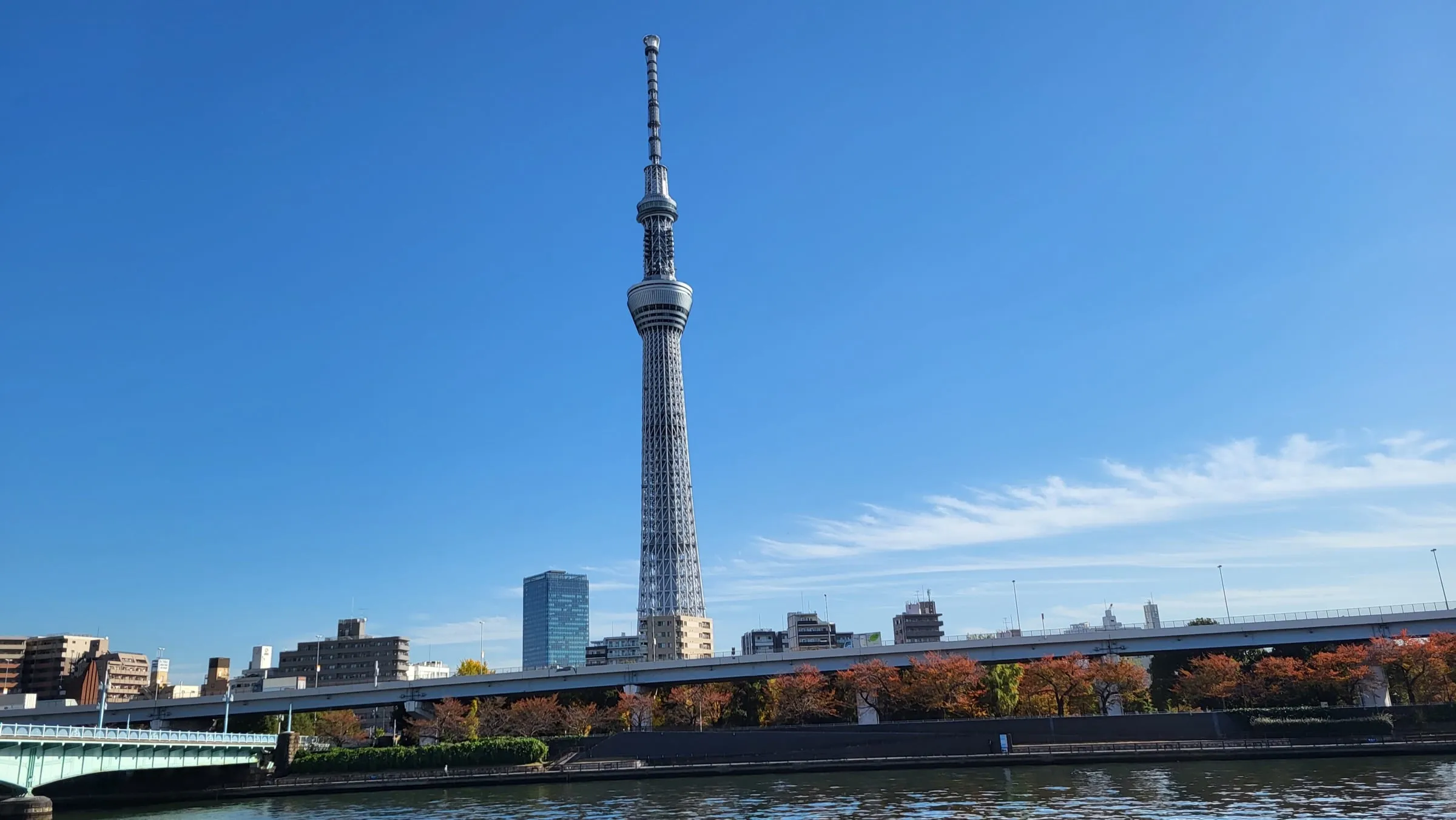
Tokyo Skytree seen across the Sumida River from Sumida Park in Asakusa, on a clear day in late November 2023, with autumn trees along the far bank. Photo: VaneTrz20 / Wikimedia Commons (CC0). Resized.
How does Tokyo Skytree stand up to earthquakes?
With the stairwell core described above, which works as a counterweight, and with foundations and a footprint planned for the site. The core applies a modern damping principle called a mass-addition mechanism: a weight that moves out of step with a structure offsets part of its sway.
Using a stairwell as that weight was a world first, according to the tower’s designers, Nikken Sekkei, in their notes on the official site. In a major earthquake, they write, the system reduces the sideways force on the tower (the response shear force, in engineering terms) by about 40%.
The name, shinbashira seishin (central-pillar vibration control), pays tribute to the shinbashira at the heart of a five-story pagoda. No five-story pagoda is recorded as having collapsed in an earthquake, the designers note, although typhoons and fires have brought some down. Theories differ on why, and the central pillar is thought to play a large part.
Other measures were planned around the site itself. To learn what wind blows 600 meters up, the team flew radiosonde weather balloons, and a survey method not normally used mapped the ground about 3 kilometers down, so that the shaking of this exact spot could be simulated more precisely.
The foundation piles are ridged walls, like the sole of a spiked shoe, spread out in a radiating pattern so that they grip the ground like roots. Seen from above, the footprint is a triangle about 68 meters on a side.
Three is the smallest number of supports that stands steady, like a tripod, the operator explains, and the triangle also echoes the area around the site, framed by the Sumida and Arakawa rivers and an east-west transport axis.
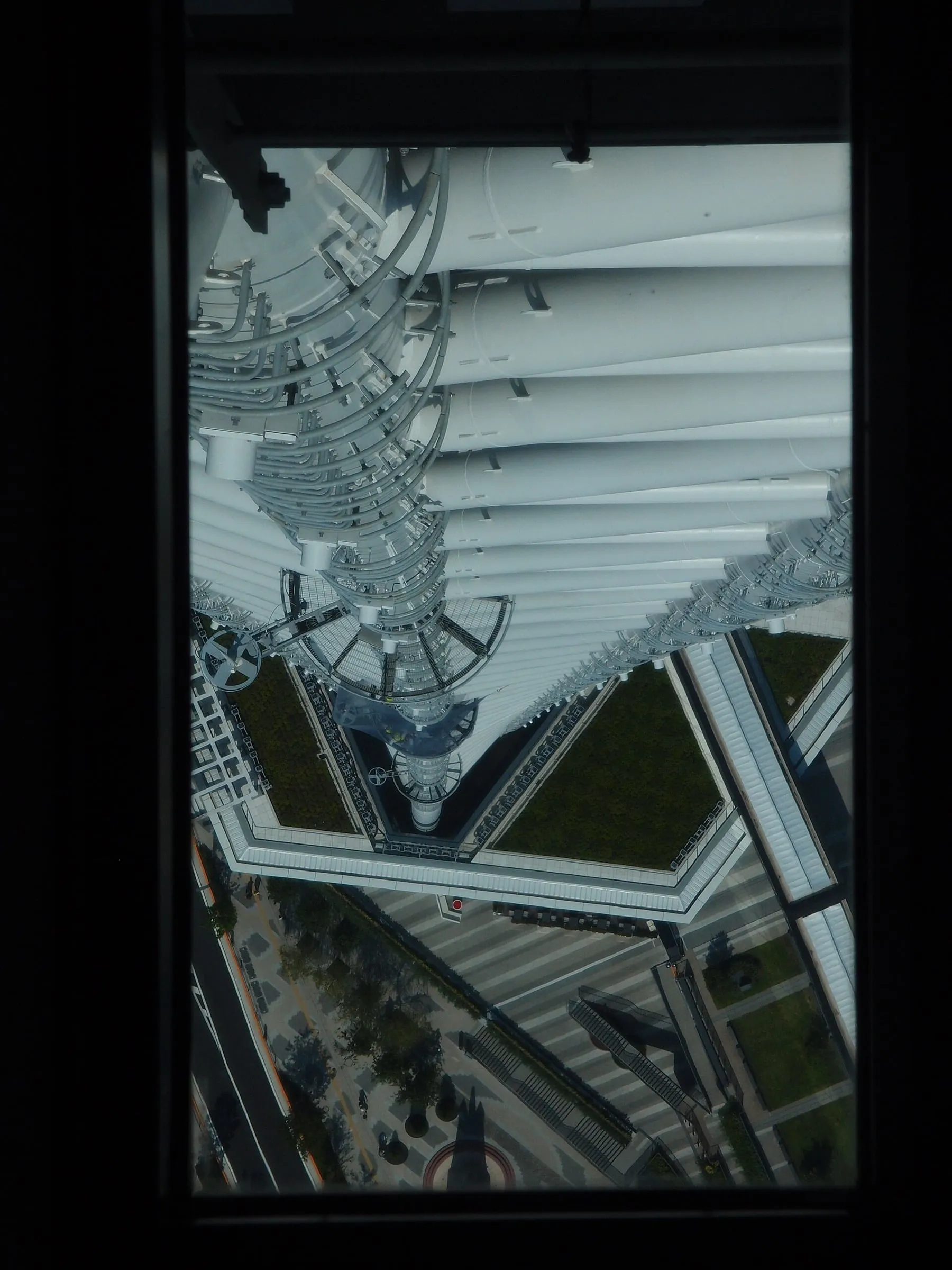
Looking down through the glass floor of the Tembo Deck at the tower’s white steel pipes and the roofs at its base, in August 2013. Photo: Guilhem Vellut / Wikimedia Commons (CC BY 2.0). Resized.
Which Tokyo Skytree tickets should you buy?
Buy online, and choose between the Tembo Deck alone and a ticket for both decks. Since April 1, 2026, individual tickets have been priced by date.
Online, adults pay from ¥1,800 for the Tembo Deck and from ¥3,000 for the Tembo Deck and Tembo Galleria together, and children aged 6 to 14 pay from ¥900 and ¥1,500 (checked Nov 13, 2026). The official booking site shows the price for each day.
An online ticket reserves a date and time and uses a separate lane for advance buyers. Tickets bought at the 4th-floor counter or the ticket machines cost ¥500 more each, and on busy days the counter may stop selling admission. Every ticket is valid only on its date, and dates cannot be changed: you cancel and buy again, and canceling within 30 days of the visit costs a fee.
If you decide on the day to go higher, machines on Floor 350 sell a Tembo Galleria ticket for ¥1,400 (children ¥700), with no counter fee. Only Tembo Deck ticket holders can buy it, and sales may stop when the upper deck is crowded. At the lowest listed prices, that route costs ¥200 more than buying both decks at once.
One older option is gone. The Fast Skytree Ticket, a ticket for overseas visitors launched in 2015, is no longer sold, and the operator says it offers no priority entry service.
Check where you buy, too. In July 2026, the operator warned about unofficial sites that imitate its pages and charge more, and tickets bought there may not get you in.
By its own account, its tickets cost ¥1,800 to ¥3,600 for the Tembo Deck and ¥3,000 to ¥4,800 for both decks, depending on the ticket type, the date and how you buy, so a higher price is a warning sign. Every official site, ticket shop included, uses the tokyo-skytree.jp domain.
What can you see from the Tembo Deck and the Tembo Galleria?
Tokyo in every direction: the operator’s FAQ points to the Sumida River and Asakusa below and, on clear days, Tokyo Bay and the mountains around the Kanto region, Mount Fuji among them. The Tembo Deck wraps the tower in glass across three floors, from 340 to 350 meters up, and the Tembo Galleria adds a sloping glass tube that ends at 451.2 meters.
In Japanese, tembo is written 天望. It sounds like tenbō (展望), the everyday word for a view, but its first character means sky.
Four elevators, the Tembo Shuttles, climb to the deck at 600 meters a minute in about 50 seconds. You arrive on Floor 350, which has a standing cafe, 8K screens in seven spots showing time-lapse footage of the view, and, on some evenings, films projected onto its 2-meter-tall windows.
Floor 345 has a restaurant, the only official shop inside the decks and, usually, the Skytree Post, a mailbox whose letters get a commemorative stamp. On Floor 340, a glass panel 2 meters by 3 meters set into the floor lets you look straight down the tower; the Tembo Deck ticket covers it.
The Tembo Galleria starts on Floor 445, reached in about 30 seconds by two more elevators from Floor 350; no elevator runs there directly from the ground. From there, a glass-walled tube slopes up to Floor 450 and Sorakara Point, at 451.2 meters the highest place visitors can reach.
The Tembo Deck holds about 2,000 people at once and the Tembo Galleria about 900. On the way back, you ride from Floor 450 down to Floor 345, take an escalator to Floor 340, then a last elevator to the exit on the 5th floor.
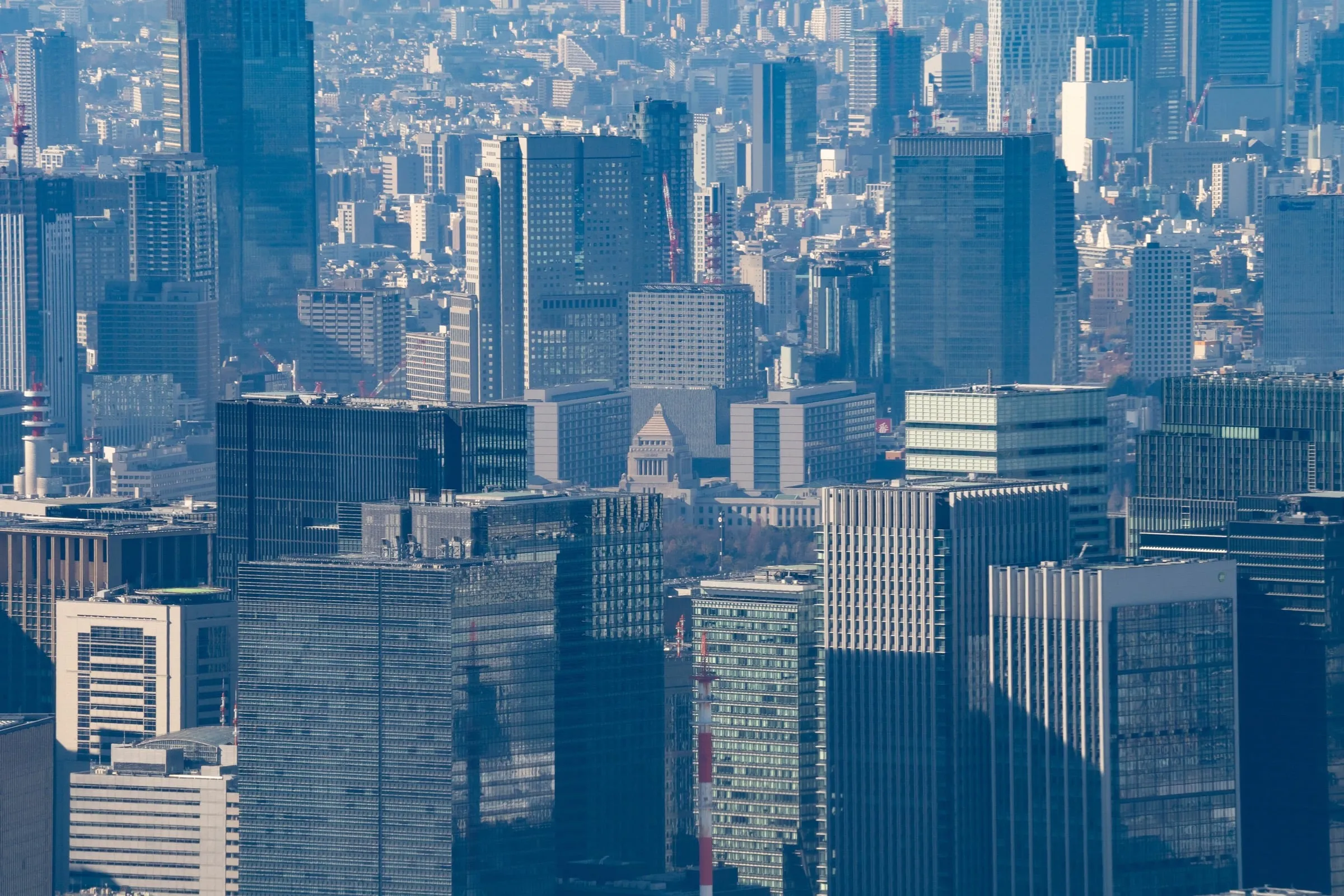
Tokyo’s high-rise towers, compressed by a telephoto lens, from the Tembo Galleria on Jan 1, 2023. Photo: Dick Thomas Johnson / Wikimedia Commons (CC BY 2.0). Resized.
When is the best time to visit Tokyo Skytree?
Go early for space, on a clear winter day for distance, and around sunset for the lights, if you do not mind company. The operator suggests the first hour after opening (10 a.m. on weekdays, 9 a.m. on weekends and holidays) as relatively quiet, and says 4 to 7 p.m., when daylight turns to night view, tends to be crowded; the crowds thin again as closing time nears.
Plenty of that company comes from abroad: in the year to March 2024, about 1.27 million overseas visitors came, the first year above a million.
Mount Fuji is visible when the weather allows, the operator says, with the best odds in the cold months and early in the day; it calls November to February the season for the longest views. Twice a year, weather permitting, the sun sets into Fuji’s summit as seen from the decks, a sight called Diamond Fuji. The operator’s dates in 2026 were Feb 3, around 5 p.m., and Nov 8, around 4:30 p.m. (checked Nov 13, 2026).
Cloud can erase the view completely, and the operator does not refund tickets for poor visibility. Check the sky before you book, and plan around early winter sunsets: the official hours page listed sunset at 4:35 p.m. on Nov 13, 2026.
On New Year’s Day, the tower opens early for the first sunrise. The 2026 edition admitted up to 800 people from 5:30 a.m., and the official calendar lists a special opening from 5:30 a.m. on Jan 1, 2027 (checked Nov 13, 2026).
Why is Tokyo Skytree white, and what do its lights mean?
The white is borrowed from indigo dyeing. The tower is painted Skytree White, an original color based on aijiro, the palest shade of traditional indigo dye. Following the dyers’ technique, a little blue was added to the white, which the operator likens to white porcelain.
The sculptor Kiichi Sumikawa, a former president of Tokyo University of the Arts, supervised the color and wrote that the tower’s design took the five-story pagoda as a reference.
The shape is meant to suggest a great tree reaching for the sky. Its outline draws on sori and mukuri, the concave and convex curves found in traditional Japanese architecture, and its plan changes from a triangle at the foot to a circle higher up, so the tower looks different from each direction.
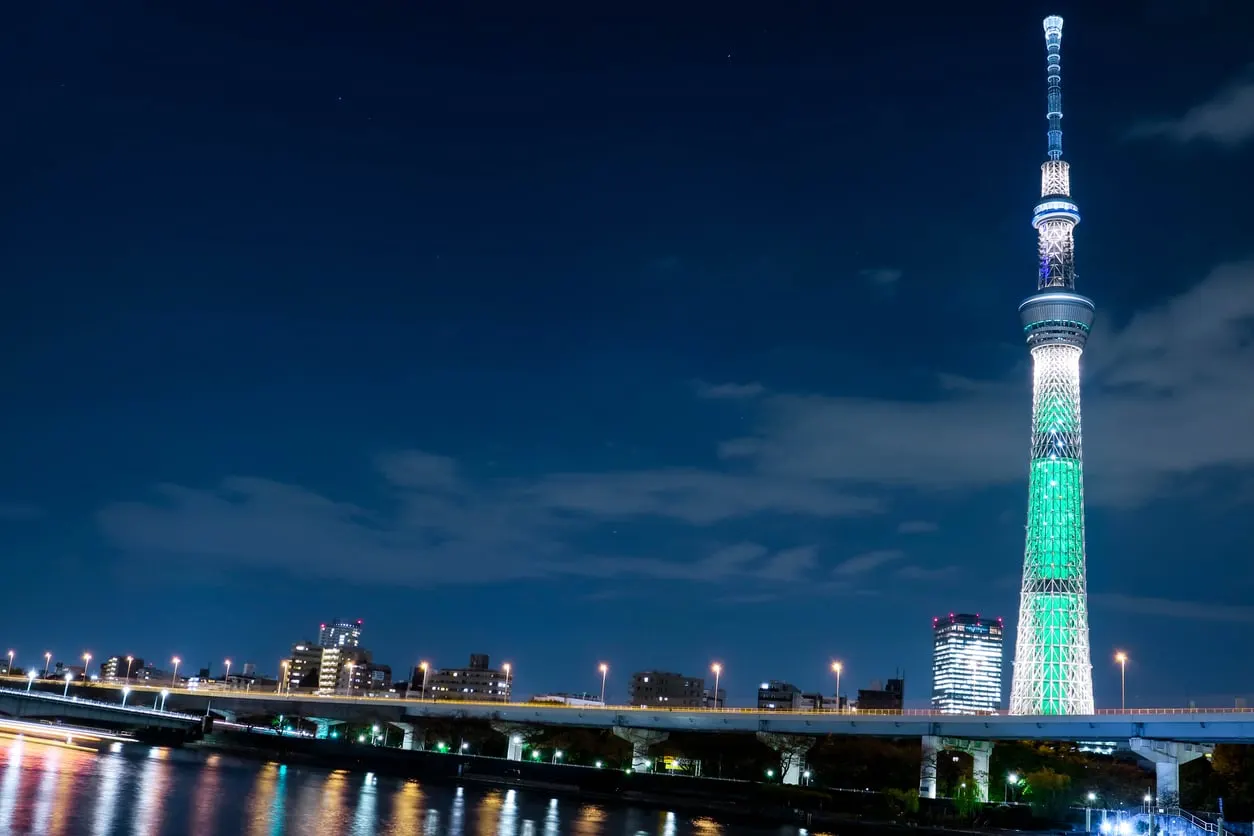
After dark, three standard lighting schemes take turns, one per day. Iki is a pale blue meant to recall the water of the Sumida River.
Miyabi is Edo purple, a traditional Japanese color. Nobori, added in 2017, is an orange-based scheme that moves like festival banners in the wind.
Special lighting marks events and seasons. A row of sparkling lights above the observation deck, called the clock light, circles at a steady pace to mark time. The lighting consultant Hirohito Totsune designed the all-LED scheme, and the official site posts each day’s lighting.
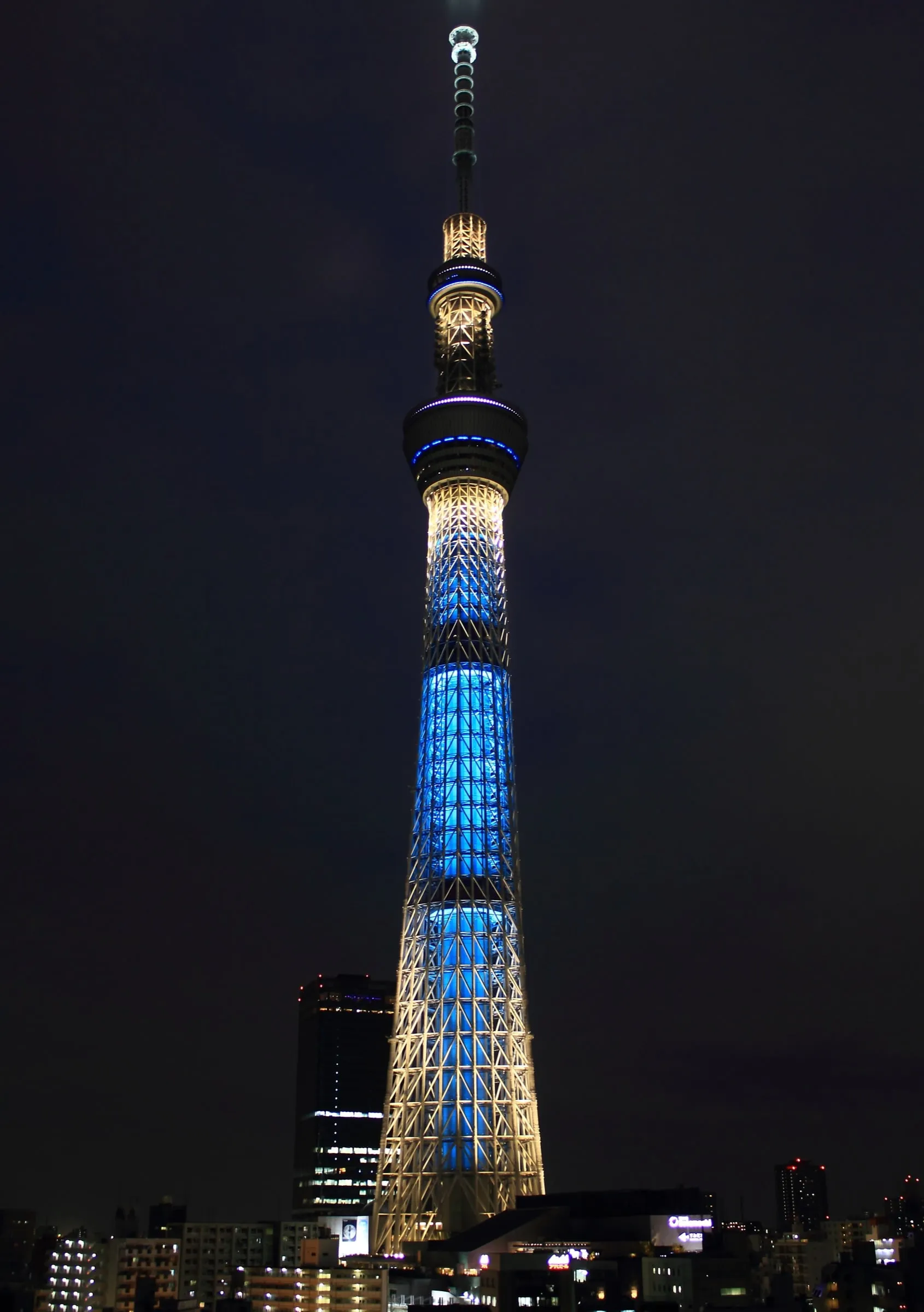
Tokyo Skytree in its pale blue Iki lighting on May 23, 2012, the day after it opened. Fixtures were added in 2015 and 2020, and the three standard designs were renewed in 2020, so today’s Iki may look different. Photo: Kakidai / Wikimedia Commons (CC BY-SA 3.0). Resized.
If you go
Tokyo Skytree is not in Asakusa, though it is close. It stands in Oshiage, in Sumida City, on the east side of the Sumida River, while Asakusa Station and Senso-ji lie on the west side, as GO TOKYO puts it. The Tobu Skytree Line runs from Asakusa to Tokyo Skytree Station in about 3 minutes; the station was called Narihirabashi until it was renamed on March 17, 2012.
To walk, cross the Sumida River Walk, a footbridge of about 160 meters that is open 7 a.m.–10 p.m. GO TOKYO calls it the shortest walking route from Senso-ji to Skytree. Glass panels in its deck look down on the river, it is painted Skytree White, and after sunset its lights change in step with the tower’s.
From Tokyo Station, take the JR Sobu Line rapid service to Kinshicho (about 8 minutes) and the Hanzomon Line to Oshiage (about 3). From Haneda Airport, Keikyu and Toei Asakusa line trains reach Oshiage in about 39 minutes; from Narita Airport, the Keisei Narita Sky Access Line takes about 49. From Ueno, the Ginza Line reaches Asakusa in about 5 minutes, which makes Ueno Park an easy pairing.
The entrance is on the 4th floor. From Oshiage Station, ride the escalators up from the B3 level; from Tokyo Skytree Station, follow the signs from the west or east exit. The same floor has SKYTREE ARCHIVES, a permanent exhibit on the history of Oshiage and the tower’s broadcasting role.
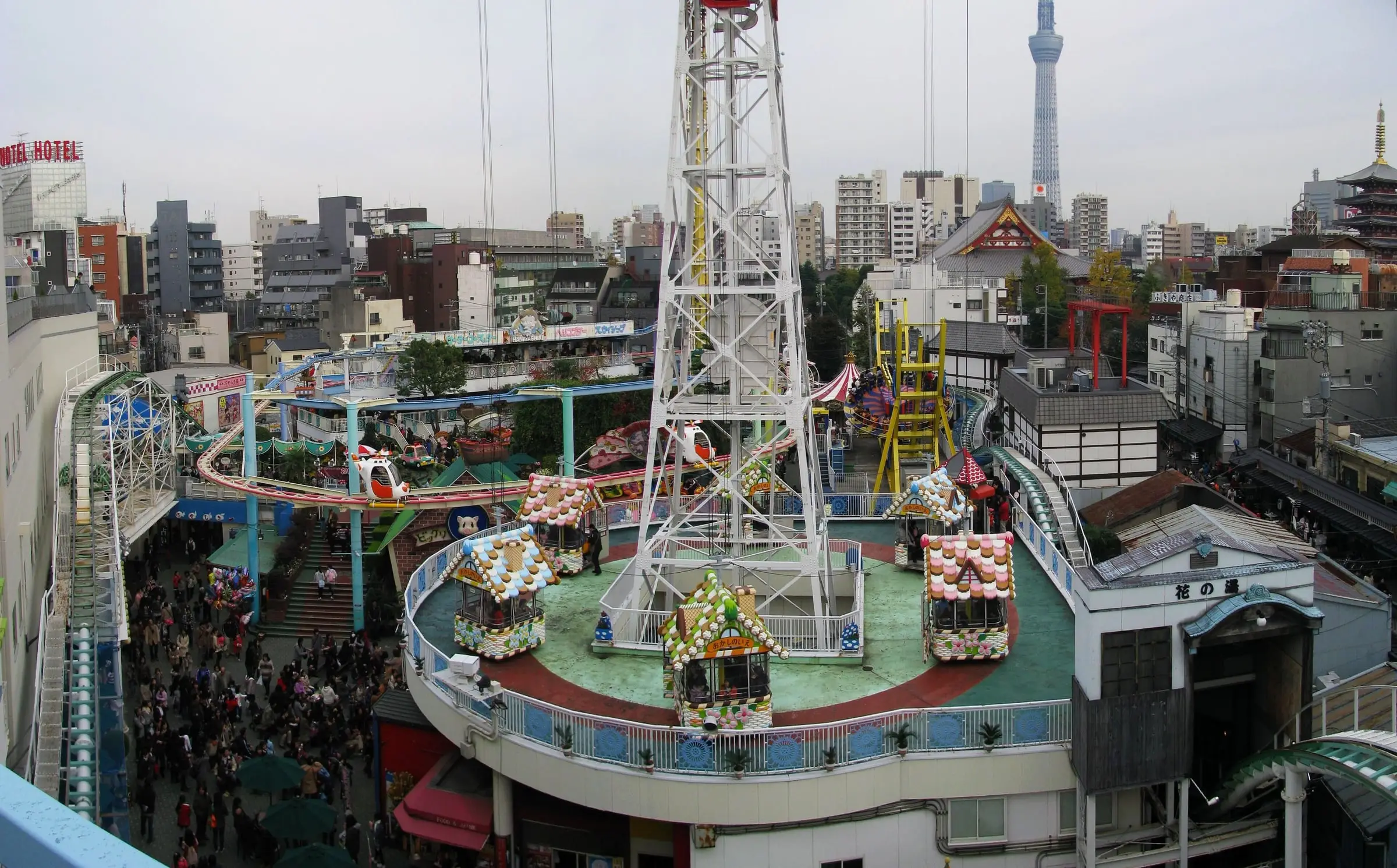
The tower is part of Tokyo Skytree Town, which also holds the Sumida Aquarium and Tokyo Solamachi, a complex of more than 300 shops. Back across the river, you can add the amusement park Hanayashiki to a Senso-ji visit.
On the way down you will ride the elevators: the stairs are off-limits except in an emergency, and the concrete around them already has a job.
FAQ
How many floors does Tokyo Skytree have?
There is no floor count in the usual sense. Visitors use the 1st, 4th and 5th floors of the base, and decks numbered by their height in meters: Floors 340, 345 and 350 on the Tembo Deck, and Floors 445 and 450 on the Tembo Galleria.
Is there a time limit on the decks?
No set limit, the operator says, though staff may guide people along when it is crowded. There is no re-entry: once you leave the Tembo Galleria, or go back down to the ground, you cannot return.
Can children go up without an adult?
Yes, from elementary school age (6) and up, according to the operator’s FAQ.
More in Travel & Destinations
View all →
Sunshine City Ikebukuro: Aquarium, Observatory, and Tickets
Travel & Destinations · Tokyo
Imperial Palace Tokyo: Tours, East Gardens and Edo Castle
Travel & Destinations · Tokyo
Kabukiza Theatre: Single-Act Tickets, Captions and History
Travel & Destinations · Tokyo
Odaiba: Sea Forts, a Rainbow Bridge Walk and What Has Closed
Travel & Destinations · Tokyo
Related articles
Akihabara: How Tokyo's Electric Town Began, and When to Go
Travel & Destinations · Tokyo
Ebisu Garden Place: Brewery, Sky Lounge and Winter Lights
Travel & Destinations · Tokyo
Ginza, Tokyo: History, Landmarks, and Car-Free Weekends
Travel & Destinations · Tokyo


Hanayashiki Amusement Park: Rides, Tickets and 1853 Roots
Travel & Destinations · Tokyo