Tokyo Dome City: Rides, Baseball and a Roof Held Up by Air
What the rides and Spa LaQua cost at Tokyo Dome City, how to get Giants or concert tickets the official way, and what holds up the dome's roof.
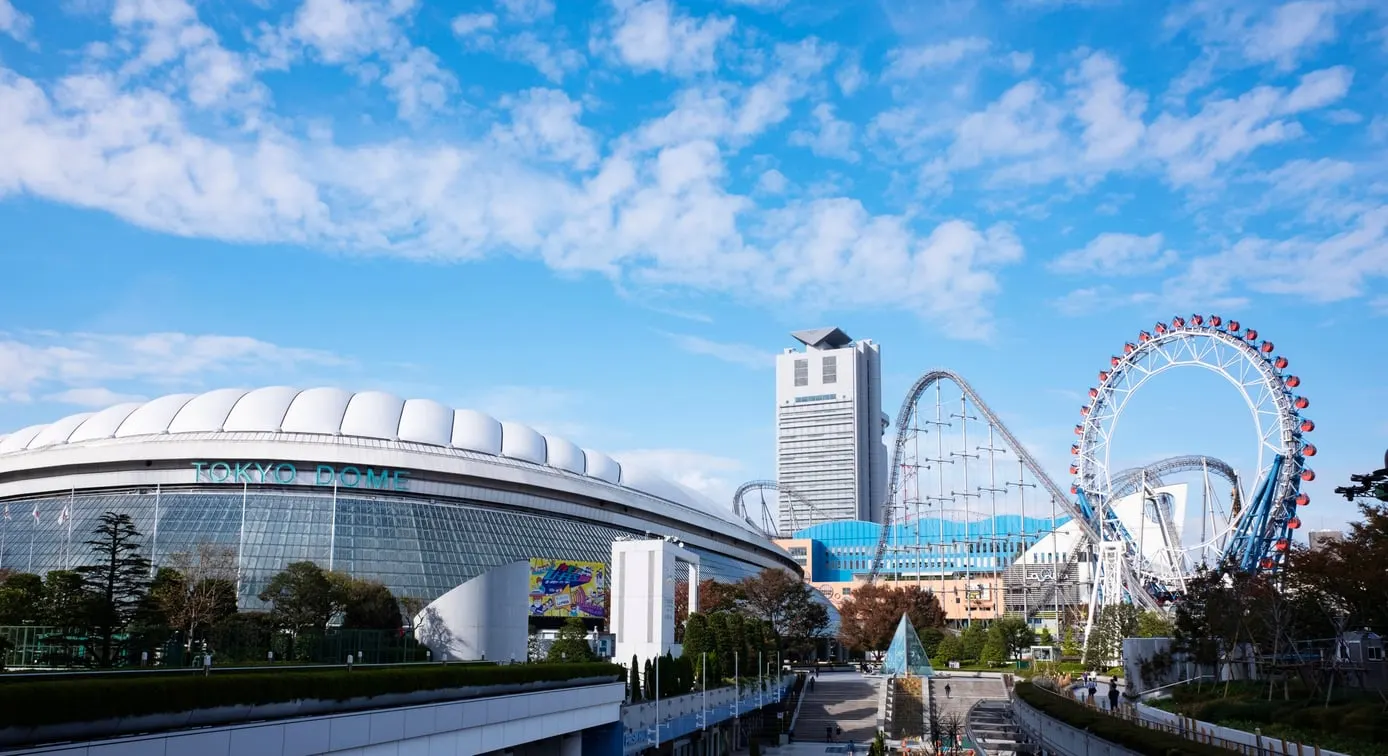
Tokyo Dome’s roof weighs about 400 tons, and air holds it up. Fans keep the pressure inside 0.3% above the pressure outside, so the entrances are revolving doors. When the exit doors open after an event, the operator says, a strong wind pushes you out.
Tokyo Dome City is an entertainment district in Bunkyo City, central Tokyo, built around Tokyo Dome, the home stadium of the Yomiuri Giants baseball team. It packs in an amusement park with more than 20 rides, the Spa LaQua hot spring, shops and restaurants, event halls, a hotel and, inside the dome, a baseball museum. Walking in is free; you pay ride by ride or facility by facility, and Korakuen Station is one minute away on foot, according to GO TOKYO.
At a glance
| Where | 1-3-61 Koraku, Bunkyo City. Korakuen Station (Tokyo Metro Marunouchi and Namboku lines), 1 minute on foot. Also Suidobashi Station (JR Chuo-Sobu local line, West and East exits; Toei Mita Line, Exit A2) and Kasuga Station (Toei Oedo Line) |
| Entry and rides | Free entry. One-Day Passport for adults ¥4,900–¥5,800, depending on the date. Single rides ¥600–¥1,800: Big O ¥1,000, Thunder Dolphin ¥1,800 |
| Ride hours | Set by date: 10 a.m.–8 p.m. on most days in November 2026, and until 9 p.m. on Nov 1, 21 and 22. Calendar |
| Spa LaQua | 11 a.m.–9 a.m. the next morning. Adults ¥3,500–¥4,700, depending on the date. No tattoos; no children under 6 |
| Tokyo Dome | Home of the Yomiuri Giants. Up to 55,000 people, about 43,500 for baseball. Cashless inside |
| Baseball museum | Beside Gate 21. 10 a.m.–5 p.m. (6 p.m. on pro baseball days at the dome); closed most Mondays; adults ¥800 |
| Time needed | GO TOKYO suggests two to three hours for the area around the stadium |
| Official site | tokyo-dome.co.jp/en |
Checked Nov 16, 2026, against Tokyo Dome City’s official English and Japanese pages, the Baseball Hall of Fame and Museum’s site and GO TOKYO. Ride passports follow the price categories A, B and C on the operator’s calendar; the spa uses A to D.
Tokyo Dome City Attractions: which rides, and what do they cost?
Tokyo Dome City Attractions, the amusement park, charges nothing to enter. You pay ¥600–¥1,800 per ride, with the Thunder Dolphin roller coaster at the top of the range, or buy a One-Day Passport that costs adults ¥4,900–¥5,800, depending on the date. There is no gate to clear, unlike Tokyo Disneyland in Urayasu, Chiba, where a 1-Day Passport is bought for a set date.
The passport price follows the operator’s calendar, which gives each day a category, A, B or C. On Nov 16, 2026, a B day, adults paid ¥5,300. Seniors 60 and older and junior and senior high school students pay ¥4,300–¥5,200; younger children pay from ¥2,600.
On days the park stays open until 9 or 10 p.m., a Night Discount Passport (adults ¥3,900–¥4,800) covers rides from 5 p.m. Both are sold at ticket machines and at the Attractions Ticket Counter, opposite Gate 21 of the dome.
The park is older than the dome. It opened on July 9, 1955, as Korakuen Yuenchi (yuenchi means amusement park). At the time, the company’s history says, nearly all amusement parks stood in the suburbs, so a children’s playground in the city center seemed sure to draw crowds.
A roller coaster that opened with the park was named the Jet Coaster. According to the operator, that ride is how jetto kosuta, “jet coaster,” became the everyday Japanese word for a roller coaster.
Today’s names came later. The company renamed the Suidobashi area Tokyo Dome City on Jan 1, 2000. In 2003, the year the LaQua complex opened, the park became Tokyo Dome City Attractions and gained its two landmarks, Thunder Dolphin and the Big O.
Thunder Dolphin weaves between buildings, cutting through a wall of LaQua and through the empty middle of the Big O, the operator says. A ride takes about two minutes, and riders must be 8 to 64 years old and at least 130 cm tall.
The Big O, which the operator calls the world’s first centerless Ferris wheel, costs ¥1,000 and takes about 15 minutes to go around. Babies may ride, children up to age 7 need a companion, and all 40 gondolas have karaoke.
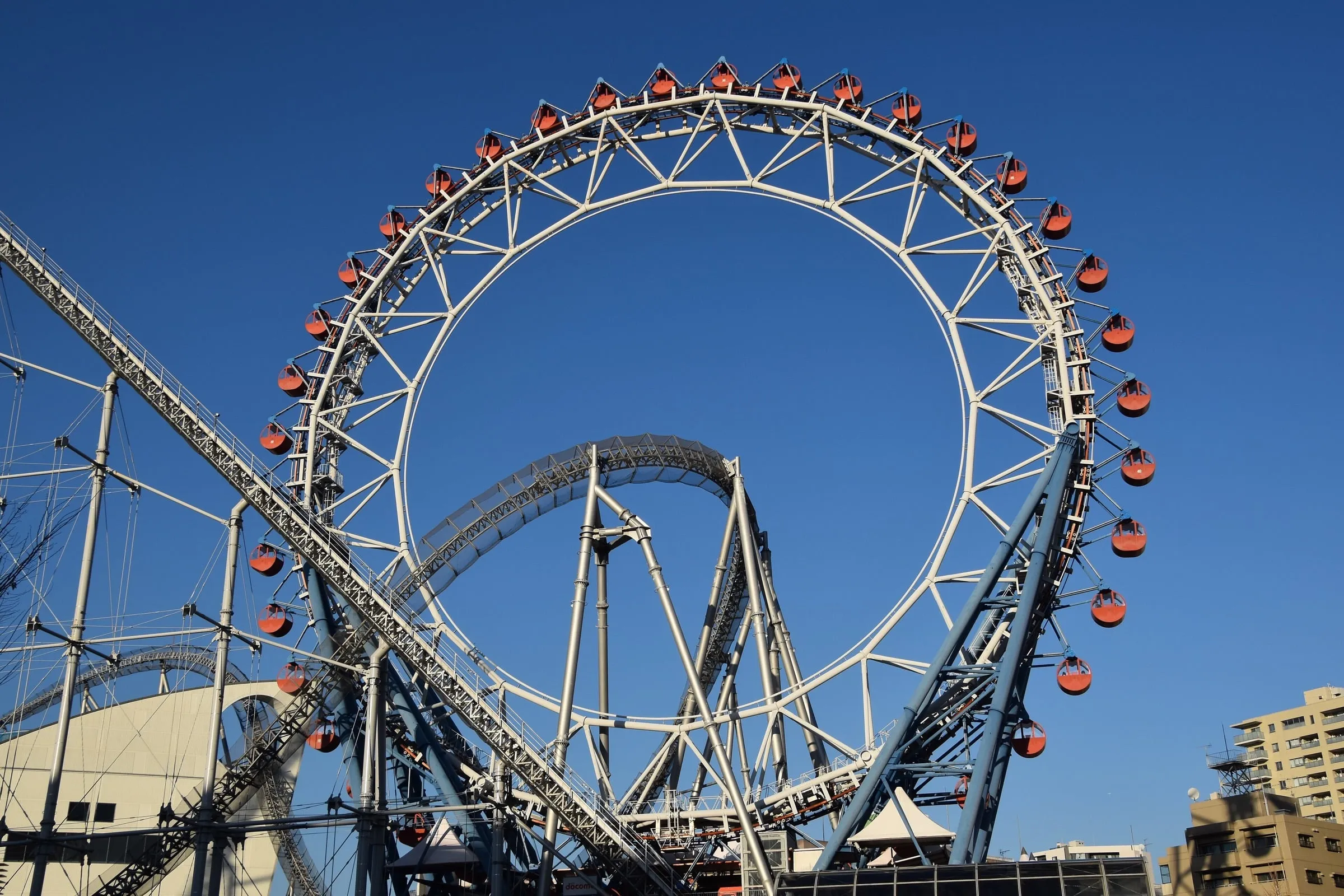
The Big O Ferris wheel, with no hub at its center and the Thunder Dolphin track running through it, in January 2024. Photo: Fred Cherrygarden / Wikimedia Commons (CC BY-SA 4.0). Resized.
More than 20 rides are spread over five zones, from Wonder Drop, which GO TOKYO says plunges three stories into a pool, to a haunted house and rides for small children.
Rides stop for scheduled safety checks, sometimes for a morning and sometimes for a whole day; Thunder Dolphin, for one, is listed as closed all day from Dec 14 to 16, 2026. The operator posts these on its suspension page, warns that they can change without notice and does not refund passports when a ride is down, so check before you buy.
How does Tokyo Dome’s roof stay up?
Air pressure does the work. Tokyo Dome is an “air-supported dome,” in the operator’s words: fans blow air in nonstop, and the slightly higher pressure inside holds the roof membrane up. The operator compares the 0.3% difference to the change between the first and ninth floors of a building, which people barely feel.
Thirty-six pressurizing fans ring the top of the stands. Ten to 18 of them run during an event and two are enough when the dome is closed, while 54 revolving doors at the entrances keep the air in.
The roof is a double membrane of glass-fiber fabric coated with fluororesin, 0.35 mm thick on the inside and 0.8 mm on the outside. Held by 28 cables, the 400-ton roof lets through roughly 5% of the sunlight.
It was raised into place on June 28, 1987, and the stadium opened on March 17, 1988, as what the operator calls Japan’s first all-weather multipurpose stadium. GO TOKYO notes the nickname its white roof earned: the Big Egg. In 2000, the operator’s history adds, it hosted the first Major League Baseball season opener played outside North America.
In a typhoon, the fans push in extra air to keep the roof taut against the wind, and two basement generators keep them turning in a power cut, because without them the roof would sag.
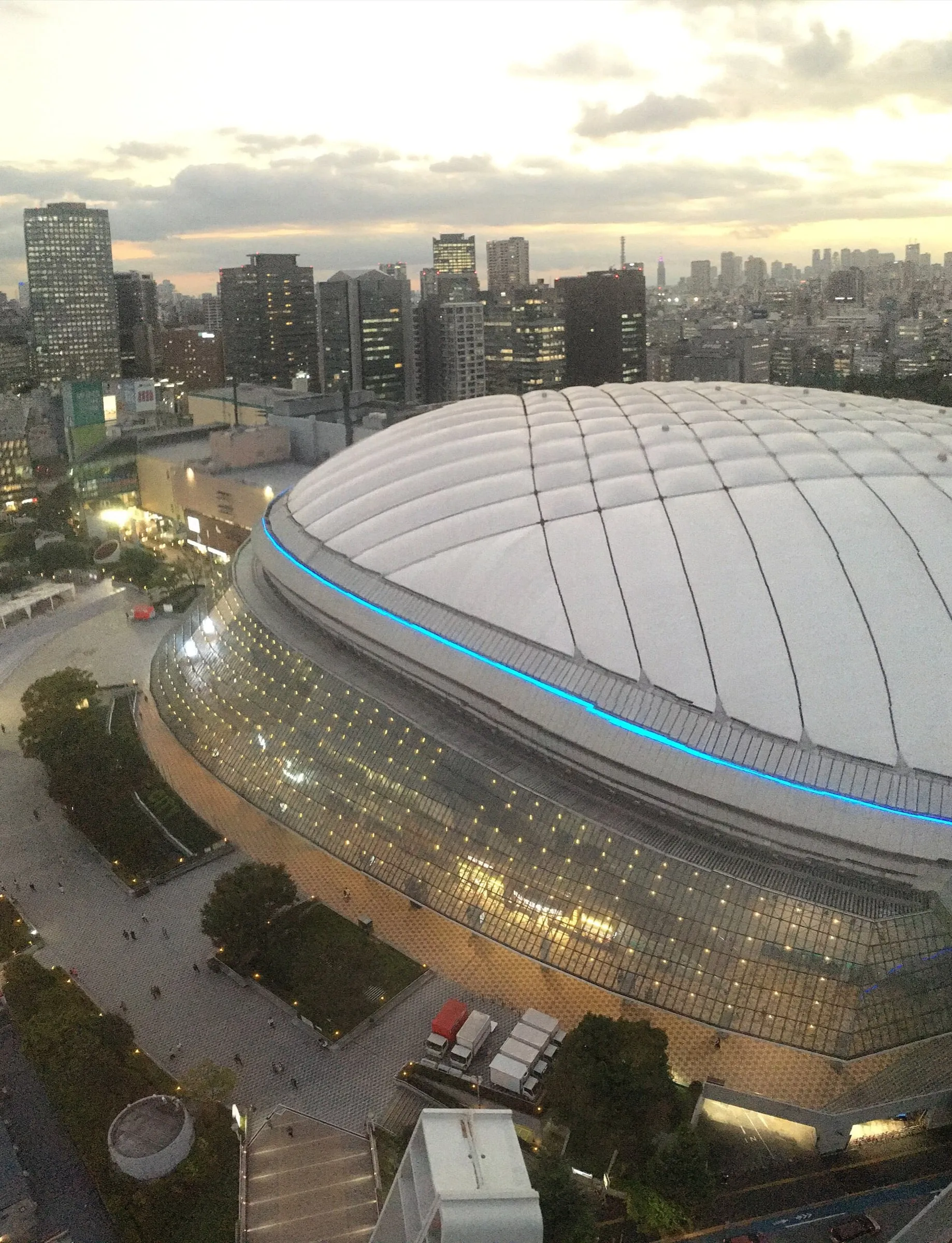
Tokyo Dome’s membrane roof seen from above at dusk, in October 2021. Photo: Nesnad / Wikimedia Commons (CC BY 4.0). Resized.
The dome is also a unit of measure. Its footprint, 46,755 square meters, is the area people mean when something in Japan is described as so many “Tokyo Domes” in size, the operator’s fact page says. GO TOKYO gives the example of a new shopping complex said to be several times the size of Tokyo Dome.
The building encloses about 1.24 million cubic meters and holds up to 55,000 people, or about 43,500 for baseball.
The roof’s height came from baseball, too. The operator says it was set by analyzing the flight of home runs by Sadaharu Oh and other sluggers of the Showa era (1926–1989), and today’s hitters sometimes reach it anyway.
Under Tokyo Dome’s ground rules, a ball that hits the ceiling in fair territory stays in play and is ruled fair or foul where it comes down. One that sticks in the roof is dead, and if that happens over fair territory, the batter and runners get two bases.
One more design choice faces the neighbors. The roof slopes down only on the side facing Koishikawa Korakuen, a 17th-century garden designated a national Special Historic Site and Special Place of Scenic Beauty, so that sunlight still reaches its plants, the operator explains.
How do you get tickets for a Giants game or a concert?
Use the official channels: the Yomiuri Giants for their home games, Tokyo Dome’s own counter for leftover seats, and each show’s organizer for concerts. For visitors from abroad, Tokyo Dome’s ticket guide points to the TOKYO GIANTS Official Website.
The counter, beside the information desk in front of Gate 22, sells seats left unsold by the ticket agencies: up to eight per person for a game, or four on the counter’s first day of advance sales. It takes cash, cards, e-money and QR-code payments, and depending on how presales go, the dome says, some seat types or game dates may not be sold there at all.
At Giants games, children need a ticket from elementary school age, and one preschooler per adult may watch from the adult’s lap.
Skip resale sites. Tokyo Dome warns that tickets to Giants home games fall under Japan’s Ticket Resale Prohibition Act. Reselling them without the organizer’s permission, or buying them in order to resell, can bring up to a year in prison, a fine of up to ¥1 million, or both.
For concerts, Tokyo Dome’s event schedule lists each show with its organizer as the contact for inquiries. Noise rules generally mean concerts start and finish early in the evening, GO TOKYO notes.
Inside, the dome is fully cashless: its visitor guidelines say cash cannot be used. You may bring food and drinks, GO TOKYO notes, but the dome’s list of banned items includes alcohol, cans, glass bottles, and plastic bottles that are frozen or hold more than a liter.
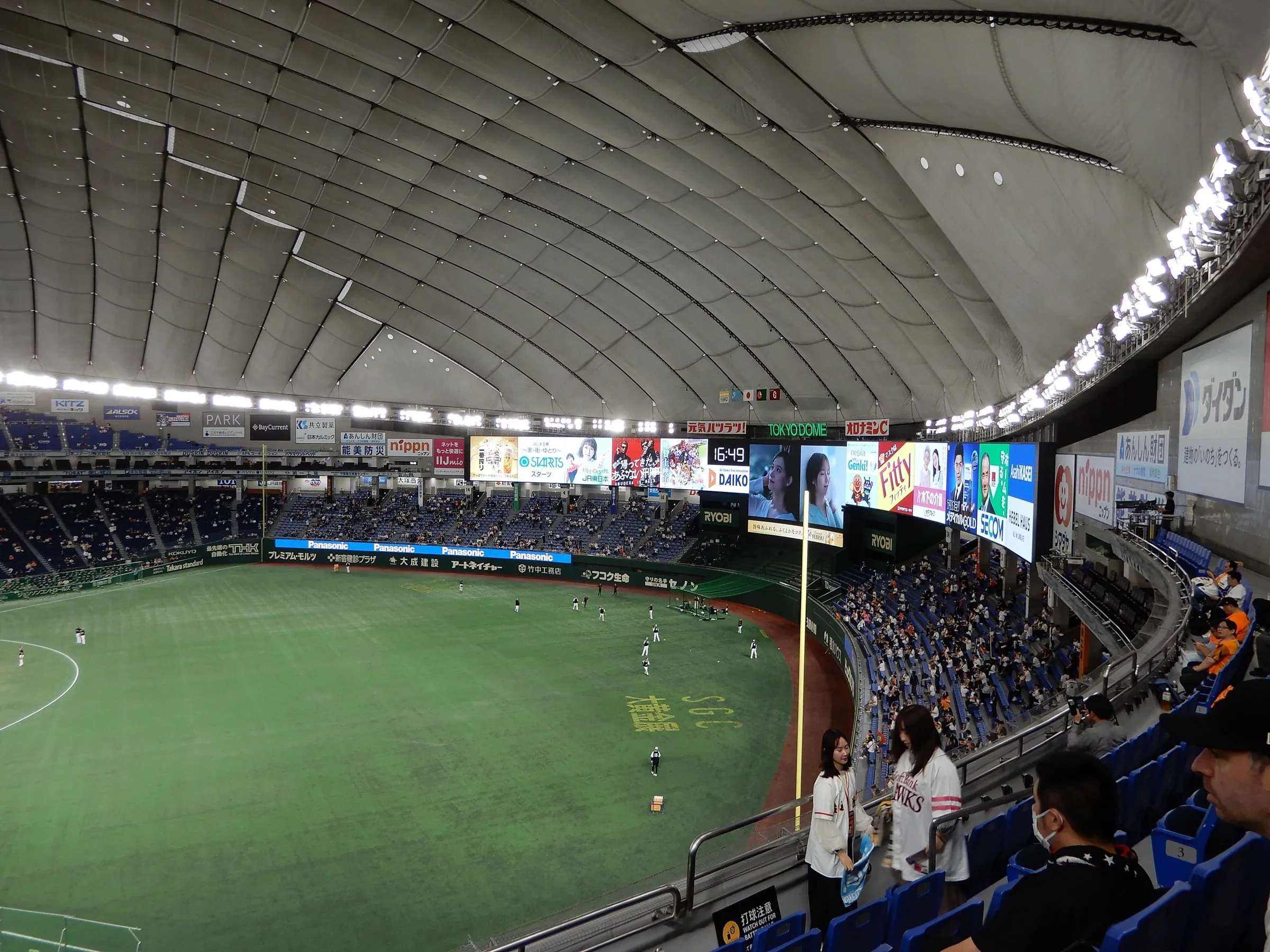
Tokyo Dome under its membrane roof during an interleague game between the Yomiuri Giants and the Fukuoka SoftBank Hawks on May 28, 2024. Photo: ウィ貴公子 / Wikimedia Commons (CC BY-SA 4.0). Resized.
On selected mornings in season, the stadium also runs a guided TOKYO DOME TOUR onto the field, into VIP areas or backstage. This season’s tours have ended, and the operator plans to post next season’s dates around February. The hour-long tour cost adults ¥3,500, or ¥500 more on weekends, holidays and in August (2026 season, checked Nov 16, 2026).
Spa LaQua: what does it cost, and can you go with tattoos?
You cannot go with tattoos: Spa LaQua turns away anyone with tattoos or body art, and its rules name paint and stickers as well as ink. Adults without tattoos pay ¥3,500–¥4,700, depending on the date, for a spa that runs from 11 a.m. to 9 a.m. the next morning.
The spa’s calendar sorts days into four price categories, A to D; Nov 16, 2026, was an A day, at ¥3,500. Checking in after 7 p.m. takes ¥1,000 off (except on Dec 31), and staying between 1 a.m. and 6 a.m. adds a late-night charge of ¥2,500.
The water comes from 1,700 meters underground. It is an amber, strongly salty sodium chloride spring, and it fills an open-air bath and a large bath, alongside several saunas.
Admission includes a towel set and loungewear, and a wristband opens your locker and pays for purchases inside, so you can leave your wallet behind. The baths close at 8:30 a.m., the open-air bath at 7:30 a.m., and the last entry is at 8 a.m.
Children under 6 cannot enter. Guests aged 6 to 17 need a guardian, of the same sex for ages 6 to 11, and must leave by 6 p.m.; their last entry is at 3 p.m.
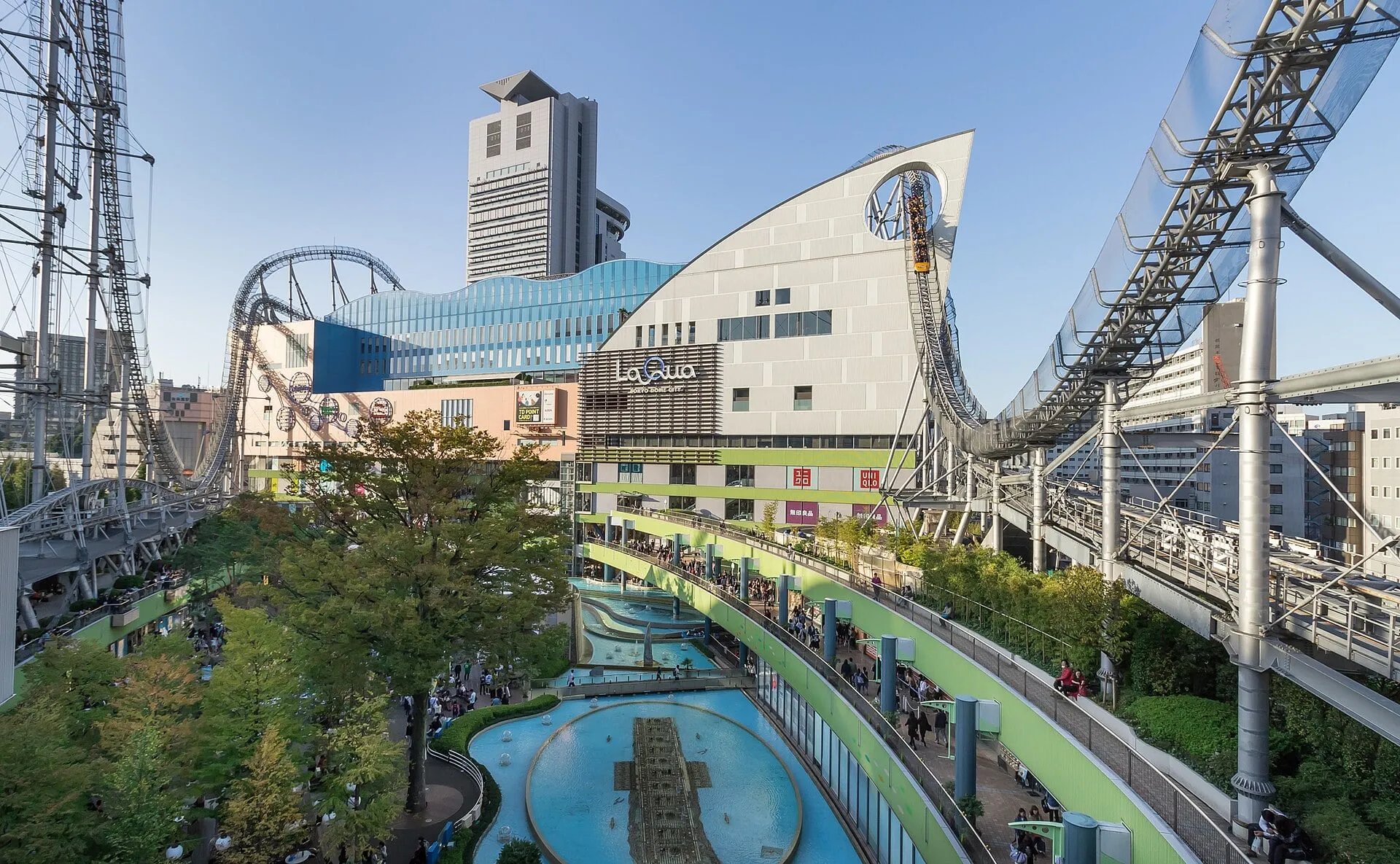
LaQua, the complex that houses Spa LaQua, with the Big O and the Thunder Dolphin track beside it, in October 2018. Photo: Kakidai / Wikimedia Commons (CC BY-SA 4.0). Resized.
What is in the Baseball Hall of Fame and Museum?
It holds about 50,000 items, from objects to photographs, and the portrait plaques of the 223 people inducted into Japan’s Baseball Hall of Fame as of 2026. The museum opened on June 12, 1959, beside Korakuen Stadium, as what it calls Japan’s first museum devoted to baseball, and moved into Tokyo Dome when the dome opened on March 17, 1988, with twice the space.
The museum’s English page notes that its Hall of Fame was founded in 1959, exactly 20 years after the National Baseball Hall of Fame in Cooperstown, New York.
Its zones cover professional baseball, the amateur game and the sport’s history, from equipment of the Meiji era (1868–1912) to material from international tournaments such as the World Baseball Classic. A video theater shows footage of pro baseball and the national team on a 150-inch screen.
The old ballpark left its own story. Korakuen Stadium opened on Sept 11, 1937, and during World War II, an essay by Jun Ikushima on the operator’s site recalls, it became an anti-aircraft gun position while its field was turned into a vegetable garden. A monument at the museum, first erected in 1981, remembers baseball players who were sent to the front and never came back.
The museum is to the right of Gate 21 and opens 10 a.m.–5 p.m., or until 6 p.m. on days with pro baseball at the dome; the last entry is 30 minutes before closing. Adults pay ¥800, and there is no re-entry.
It closes on Mondays, except holidays, Tokyo Dome game days and the school spring and summer breaks, and from Dec 28, 2026, to Jan 1, 2027. It has also announced closures on Jan 20, 2027, and from Feb 8 to 22, 2027, and a 1 p.m. opening on Dec 4, 2026, and Jan 6 and 8, 2027.
If you go
Korakuen Station, on the Tokyo Metro Marunouchi and Namboku lines, is one minute away on foot, GO TOKYO says. It times the trip at about 10 minutes from Tokyo Station on the Marunouchi Line, and about 15 minutes from Shinjuku to Suidobashi on the JR Sobu Line.
The operator’s directions all end at the information desk in front of Gate 22. From JR Suidobashi’s West Exit, turn right, cross the Koraku Bridge footbridge in front of you and keep going until the TOKYO DOME letters are above you.
On either side of Gate 22, the Nagashima Gate and the Oh Gate honor Giants stars Shigeo Nagashima and Sadaharu Oh, with reliefs about 3 meters tall added in a 2014 renewal. Free Wi-Fi is available at Tokyo Dome City under the network name .FREE_TokyoDomeCity.
Korakuen Hall has hosted boxing and pro wrestling since 1962, and the operator calls it a “holy ground” for martial arts. Kanadevia Hall, which holds up to 3,000 people under the MEETS PORT complex, was TOKYO DOME CITY HALL until a naming-rights deal renamed it on April 1, 2025, Stage Natalie reported.
From Nov 19, 2026, to Feb 28, 2027, the district’s 22nd winter illumination lights more than a million bulbs from 5 p.m. to midnight; on the first night it starts at 6 p.m.
Next door, Koishikawa Korakuen began in 1629 as the garden of an Edo residence of Yorifusa, founder of the Mito Tokugawa family, and was completed under the second lord, Mitsukuni, says the Tokyo Metropolitan Park Association. The stroll garden opens 9 a.m.–5 p.m. (last entry 4:30 p.m.), costs ¥300 to enter (¥150 at 65 and older) and is two minutes on foot from Iidabashi Station on the Toei Oedo Line.
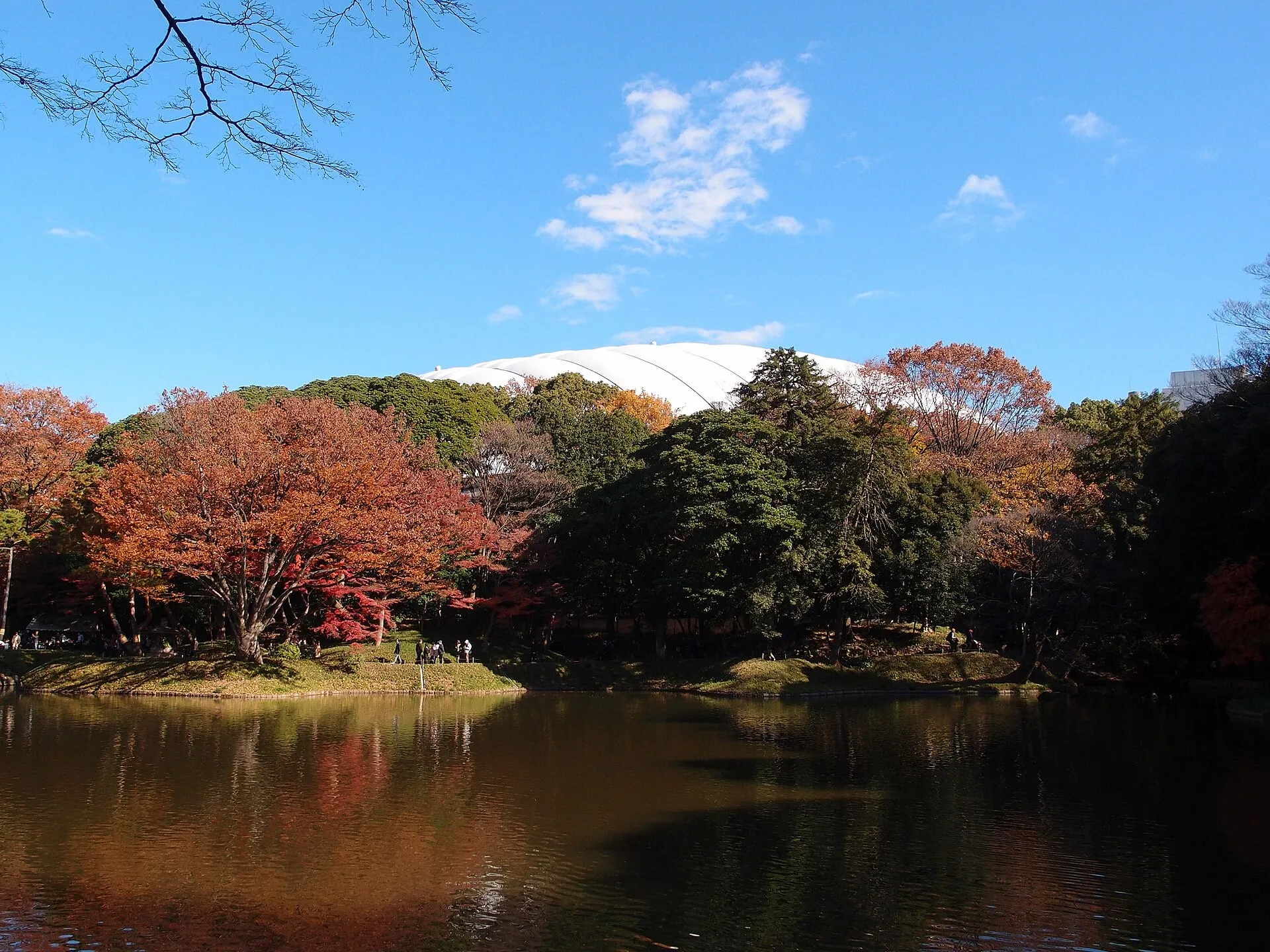
Autumn leaves around the pond at Koishikawa Korakuen, with Tokyo Dome’s roof beyond the trees, in November 2013. Photo: Guilhem Vellut / Wikimedia Commons (CC BY 2.0). Resized.
From Suidobashi, the JR Chuo-Sobu local line runs east through Ochanomizu, the station for Kanda Myojin, to Akihabara.
When the last out or the last encore is over and the exit doors open, the air that held up the roof all evening will push you out into the night.
More in Travel & Destinations
View all →
Sunshine City Ikebukuro: Aquarium, Observatory, and Tickets
Travel & Destinations · Tokyo
Imperial Palace Tokyo: Tours, East Gardens and Edo Castle
Travel & Destinations · Tokyo
Kabukiza Theatre: Single-Act Tickets, Captions and History
Travel & Destinations · Tokyo
Odaiba: Sea Forts, a Rainbow Bridge Walk and What Has Closed
Travel & Destinations · Tokyo
Related articles
Akihabara: How Tokyo's Electric Town Began, and When to Go
Travel & Destinations · Tokyo
Ebisu Garden Place: Brewery, Sky Lounge and Winter Lights
Travel & Destinations · Tokyo
Ginza, Tokyo: History, Landmarks, and Car-Free Weekends
Travel & Destinations · Tokyo


Hanayashiki Amusement Park: Rides, Tickets and 1853 Roots
Travel & Destinations · Tokyo