Tokyo Midtown: Museums, Gardens, and Why It Was Off-Limits
What stood on Tokyo Midtown's Roppongi site for 400 years, what its museums cost, what is free, and when to see the cherry trees and Christmas lights.
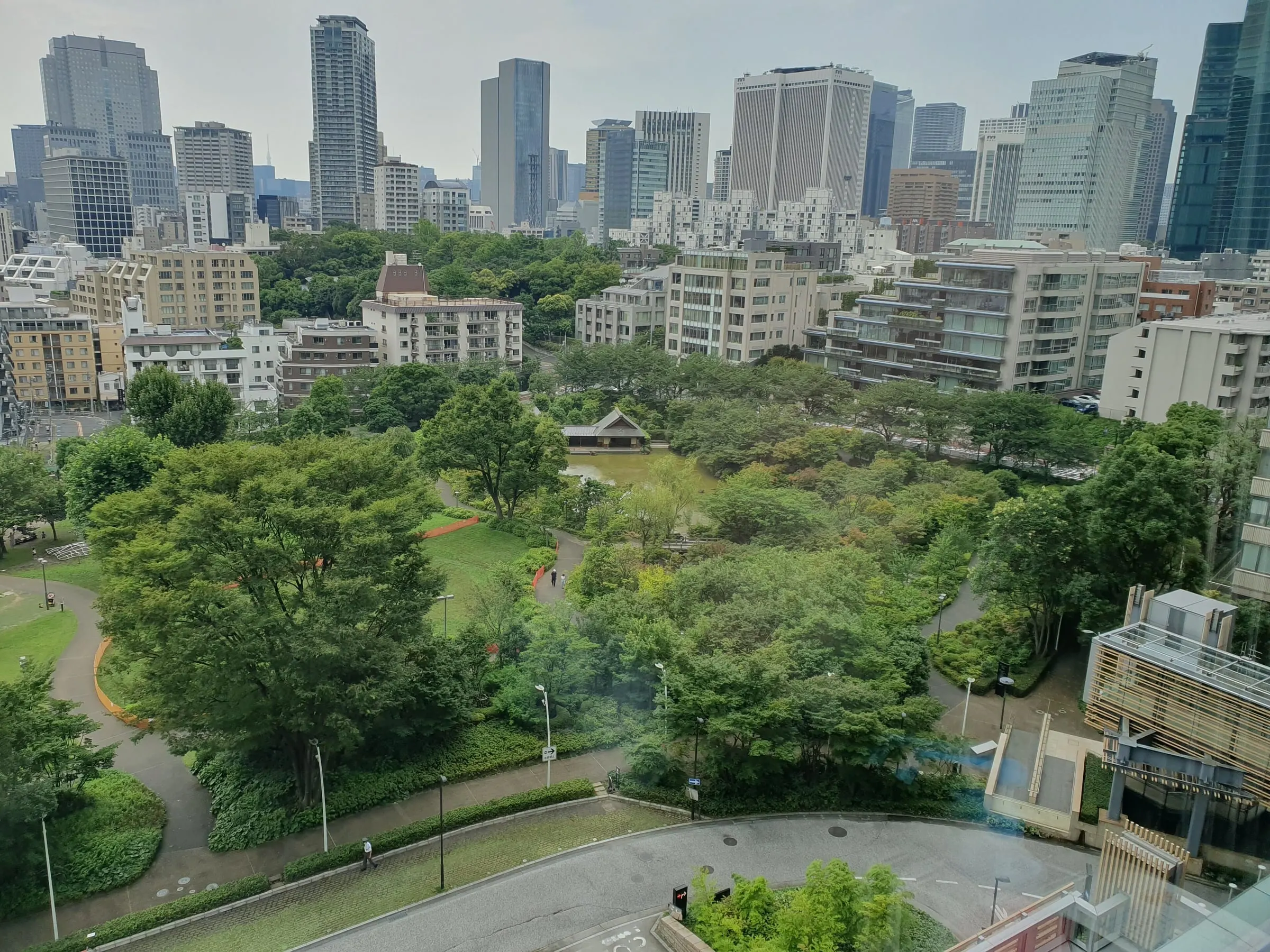
For about 400 years, according to its operator, the ground under Tokyo Midtown was closed to the public. It held a feudal lord’s residence, then an army post, then housing for US officers, and finally the Defense Agency, which moved out in 2000. About 40 cherry trees from the agency’s grounds still flower here each spring.
Tokyo Midtown is a complex of offices, apartments, a hotel, about 130 shops and restaurants, an art museum, a design exhibition space and a park in Roppongi, in Tokyo’s Minato City. It opened on Mar 30, 2007, at 9-7-1 Akasaka; shops open 11 a.m.–8 p.m., restaurants close at 11 p.m., and Roppongi Station on the Toei Oedo Line connects to it directly at Exit 8.
Two other complexes share the name, Tokyo Midtown Hibiya (1-1-2 Yurakucho, Chiyoda City) and Tokyo Midtown Yaesu (2-2-1 Yaesu, Chuo City), each with its own official site; this guide covers the one in Roppongi.
At a glance
| Where | 9-7-1 Akasaka, Minato City. Direct from Roppongi Station: Toei Oedo Line, Exit 8; Tokyo Metro Hibiya Line, by an underground passage with stairs. About 3 minutes on foot from Nogizaka Station (Tokyo Metro Chiyoda Line, Exit 3) |
| Hours | Shops 11 a.m.–8 p.m.; restaurants 11 a.m.–11 p.m.; food and cafés 11 a.m.–9 p.m.; paths through Midtown Garden 5 a.m.–11 p.m. The complex is closed on Jan 1, 2027 |
| Museums | Suntory Museum of Art: 10 a.m.–6 p.m. (8 p.m. on Fridays), closed Tuesdays and between exhibitions. 21_21 DESIGN SIGHT: 10 a.m.–7 p.m., closed Tuesdays. Fujifilm Square: 10 a.m.–7 p.m., daily except at New Year |
| Cost | Fujifilm Square and Hinokicho Park are free. 21_21 DESIGN SIGHT: adults ¥1,700 for the current exhibition. Suntory Museum of Art: prices vary by exhibition. Both museums are free for junior high students and younger |
| Seasons | About 100 cherry trees, lit up while in bloom. Christmas lights in Midtown Garden, Nov 26–Dec 25, 2026, 5–11 p.m., free |
| On the lawn | No chairs, tables, parasols or pets; no smoking; no large sheets to save space |
| Official site | tokyo-midtown.com (Japanese) and en.tokyo-midtown.com (English) |
Checked Nov 16, 2026, against Tokyo Midtown’s official Japanese and English pages (access, store hours, Green & Park, the Suntory Museum of Art, MIDTOWN CHRISTMAS 2026) and the sites of 21_21 DESIGN SIGHT and Fujifilm Square. Some shops and restaurants keep their own hours.
What was on the Tokyo Midtown site before 2007?
A lord’s garden, soldiers and a government agency, in that order. Tokyo Midtown’s history page traces the land back to the Edo period, when it was a shimo-yashiki, or secondary residence, of the Mori family, the daimyo (feudal lords) of the Hagi domain. In the Meiji era the army garrisoned it, and after World War II it housed US officers.
Once the land was returned to Japan, it became the Hinokicho office of the Defense Agency. Through all of it, the operator says, the land stayed closed to the public for some 400 years.
The change came in 2000, when the agency’s headquarters moved to Ichigaya. A consortium of six companies won the land in a public tender in September 2001, construction began in May 2004, and the complex opened on Mar 30, 2007. The operator names Mitsui Fudosan as the project’s representative company.
The Chicago-founded firm SOM drew the master plan and designed Midtown Tower, Midtown East and Midtown West, and Nikken Sekkei was the lead designer. The layout of the buildings, the operator says, borrows from the rock groupings of a traditional Japanese garden, which stand for the center of the universe.
Pieces of the site’s past survive. Stones from a stone-lined ditch on the Mori property now form a retaining wall, and about 140 trees from the agency’s grounds were saved and replanted, as the garden section below explains.
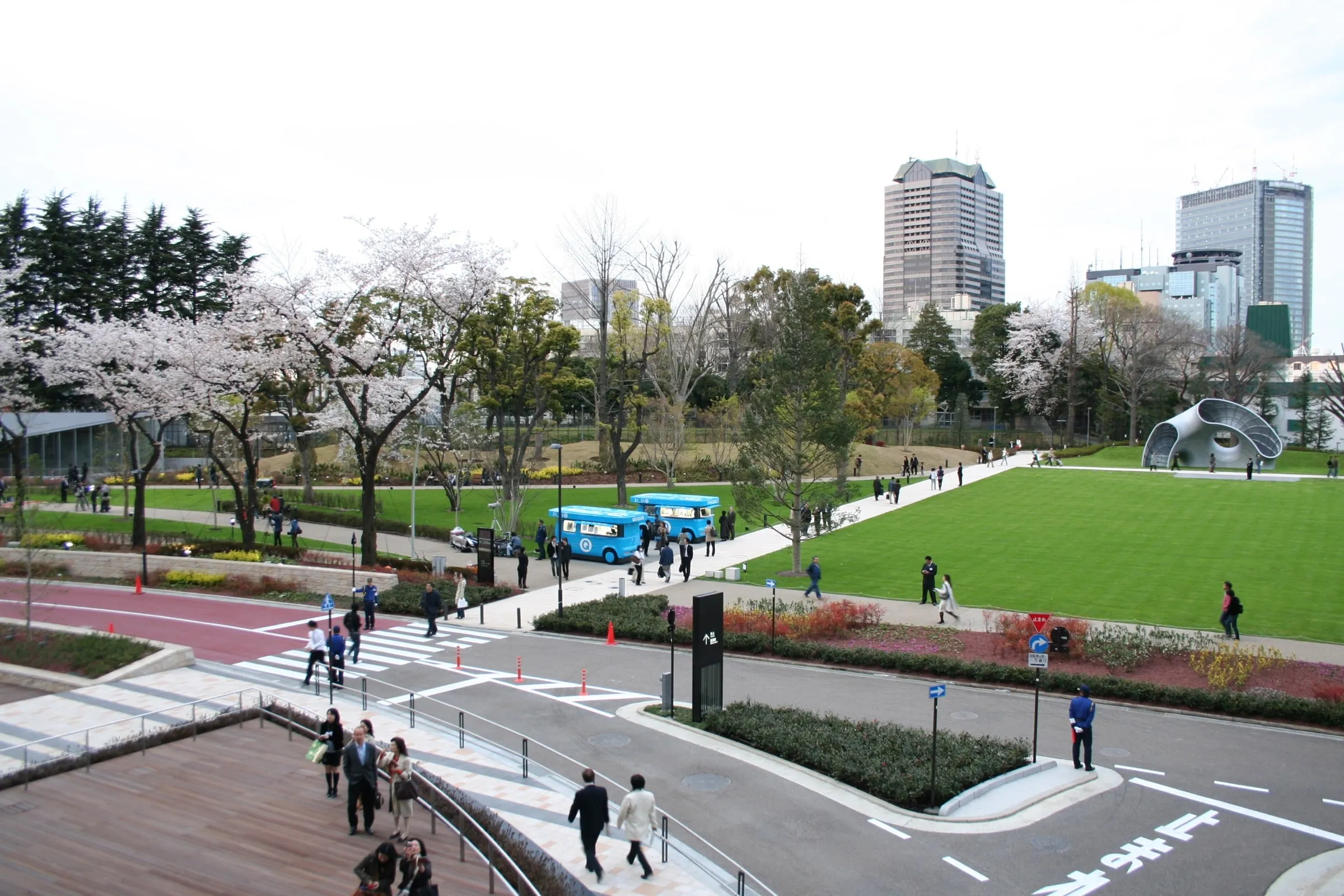
Cherry trees in bloom beside the lawn on Mar 30, 2007, the day Tokyo Midtown opened. Photo: veroyama / Wikimedia Commons (CC BY-SA 2.0). Resized.
What’s on at the Suntory Museum of Art and 21_21 DESIGN SIGHT?
Japanese art at one and design at the other, always in temporary exhibitions; both close on Tuesdays.
The Suntory Museum of Art has worked under the motto “Art in Life” since it first opened in 1961, and its current home, designed by the architect Kengo Kuma, is part of Tokyo Midtown. Its exhibitions draw on paintings, ceramics, lacquerware, glass, dyeing and weaving. It has no permanent galleries, so what you see depends entirely on the current show, and there is a tea room, Gencho-an.
Hours are 10 a.m.–6 p.m., until 8 p.m. on Fridays, with last entry 30 minutes before closing, according to Tokyo Midtown’s page on the museum. Adult prices change with each exhibition, and children up to junior high school age enter free. The museum also closes between exhibitions and over New Year, so check the museum’s website for what is on.
21_21 DESIGN SIGHT was founded by the fashion designer Issey Miyake and opened in 2007; the designers Taku Satoh and Naoto Fukasawa direct it today. Tadao Ando designed the building. Drawing on Miyake’s idea of making clothes from “a piece of cloth,” he shaped the roof like one folded sheet of steel and put 80 percent of the structure underground, around a sunken courtyard, according to Tokyo Midtown’s page on the venue.
The current exhibition, Learning from “Hōjōki”: Tiny Architecture Reweaves Life, runs until Jan 11, 2027. Its starting point is Hojoki, a 13th-century essay by Kamo no Chomei known in English as “The Ten-Foot Square Hut.” Architects, designers, artists and companies each propose their own version of his hut, all on the same footprint of about 9 square meters, and the huts fill the galleries.
Admission is ¥1,700 for adults, ¥800 for university students and ¥500 for high school students; younger visitors enter free. Besides Tuesdays, the gallery closes Dec 27–Jan 3, according to 21_21’s exhibition page.
Keep your ticket stub. 21_21 takes ¥100 off its admission for a stub from the Suntory Museum’s current exhibition, and the museum gives the same discount for a 21_21 ticket, according to 21_21’s visitor information.
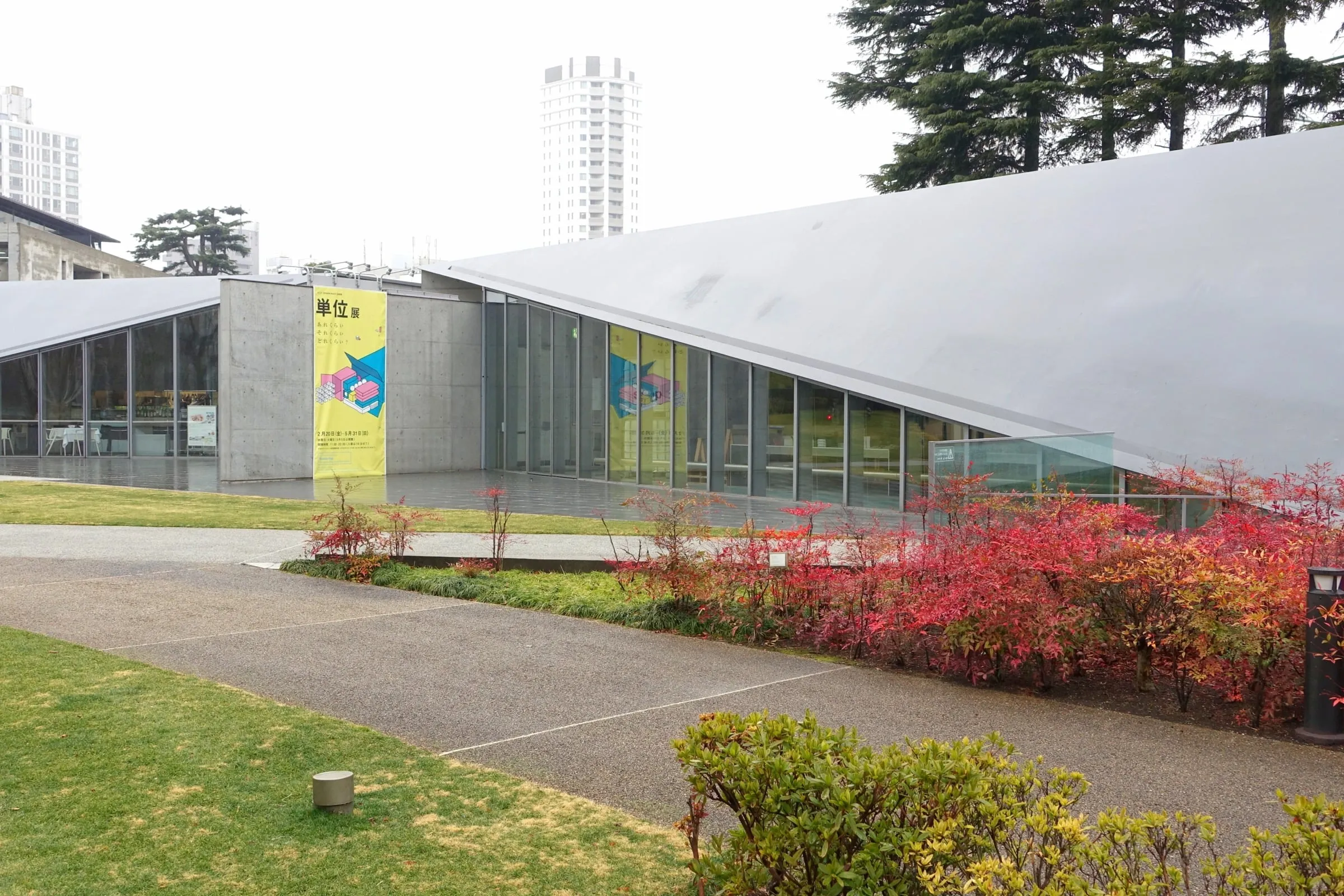
21_21 DESIGN SIGHT and the long steel roof Tadao Ando designed for it, in February 2015. Photo: Daderot / Wikimedia Commons (CC0). Resized.
What can you see at Tokyo Midtown for free?
Hinokicho Park and Fujifilm Square, the camera maker’s gallery, charge no admission, and Midtown Garden is an open space whose paths stay open from 5 a.m. to 11 p.m.
Fujifilm Square opened in Tokyo Midtown in 2007, on the first floor of Midtown West. It is open every day from 10 a.m. to 7 p.m., apart from New Year (Dec 25–Jan 3 this winter).
Its Photo History Museum is showing photographs of Japan from the end of the Edo period into the early Meiji era until Dec 24, 2026 (until 4 p.m. on the last day), chosen from the company’s own collection. They are “Yokohama photographs,” which were popular as souvenirs with foreign visitors. The show comes in two parts, the exhibition page says: about 40 views of well-known sights until Nov 26, then about 40 scenes of customs and daily life from Nov 27.
The museum traces the genre to Felice Beato, who opened a commercial studio in Yokohama in 1864 and sold albums of photographs with captions for foreigners. Japanese photographers followed. A typical album bound 50 to 100 hand-colored albumen prints between lacquered wooden covers decorated with maki-e (pictures in sprinkled gold and silver) and mother-of-pearl inlay.
From Jan 4 to Mar 31, 2027, the museum moves on to about 27 portraits by the photographer Ken Domon, taken between 1935 and 1959.
What are Midtown Garden and Hinokicho Park?
Midtown Garden is the complex’s own landscaped garden, and Hinokicho Park is a public park run by Minato City on its east side. Green open space takes up about 40 percent of Tokyo Midtown, the operator says.
The San Francisco landscape firm EDAW designed the garden around ideas from Japanese gardens, and it is laid out like water running downhill. A “highland spring” by the entrance on the avenue Gaien-higashi-dori gives way to a “mountain stream,” which becomes a tunnel of cherry blossoms in spring, then a “forest edge,” and finally the lawn. The lawn mixes several grasses to stay green all year, and in an emergency it serves as a heliport.
Many of the big trees were here before the buildings. Before construction, every tree on the Defense Agency grounds was surveyed, and about 140 taller than 14 to 15 meters, camphor and cherry among them, were moved to a nursery area on the same site. They were replanted once the building work was done, with as little cutting of branches and roots as possible, and the cherries among them were in bloom for the opening, according to the operator.
There are about 100 cherry trees in all, mostly of the Somei-yoshino variety, lit up while they bloom, and about 40 came from the Defense Agency. Somei-yoshino are generally said to live about 60 years, the operator notes, so in May 2013 it began raising successors from layered and grafted branches of the old trees, first in Koga, Ibaraki Prefecture, and now in Kisarazu, Chiba Prefecture. Two of the young trees were planted at Tokyo Midtown in March 2015.
For timing, the Japan Meteorological Agency’s average dates for Tokyo are March 24 for the first cherry blossoms and March 31 for full bloom; in 2026 they came on March 19 and March 28.
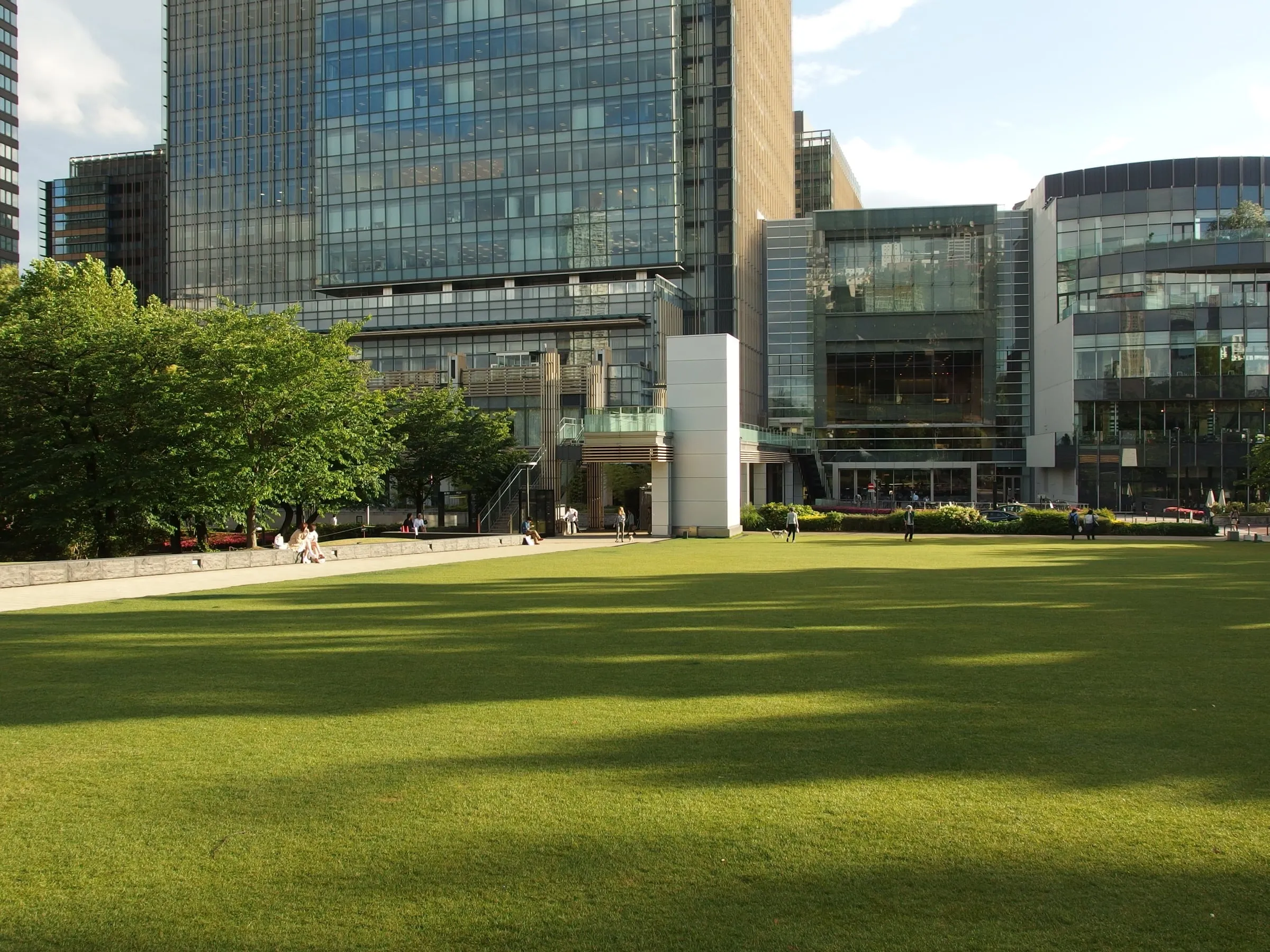
The lawn of Midtown Garden, with Tokyo Midtown’s buildings behind it, in May 2014. Photo: Guilhem Vellut / Wikimedia Commons (CC BY 2.0). Resized.
Hinokicho Park was the garden of the Mori family’s residence in Azabu, nicknamed Hinoki-yashiki, “cypress mansion,” for its many hinoki trees, and it was famous for its view over Edo, according to Tokyo Midtown’s page on the park. Today a strolling path circles a large pond that fills about half the park, and a lawn has play equipment. Minato City gives the park’s area as about 1.6 hectares (4 acres). Entry is free.
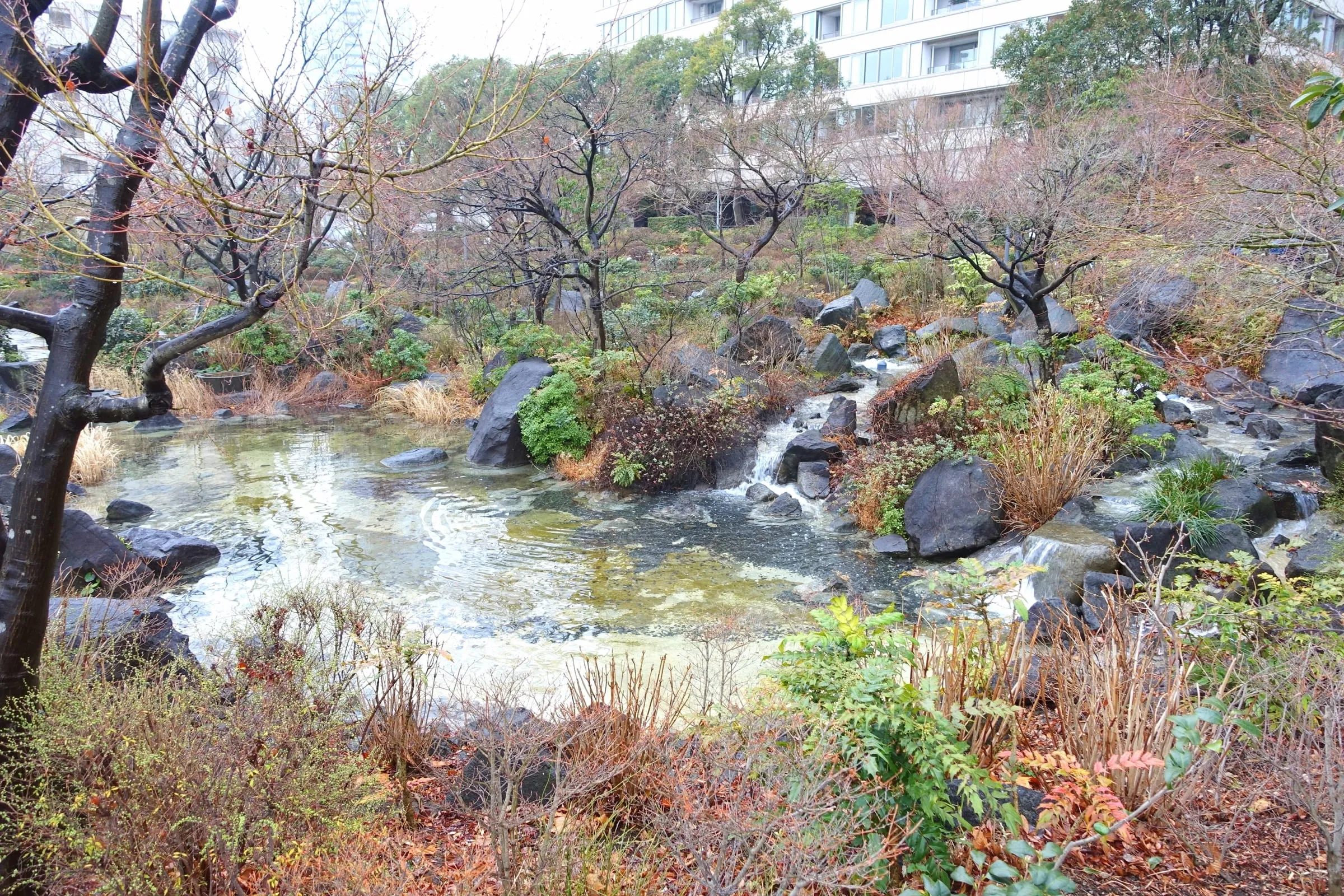
Rocks and a small cascade at a pond in Hinokicho Park, in February 2015. Photo: Daderot / Wikimedia Commons (CC0). Resized.
When are the Tokyo Midtown Christmas lights on in 2026?
From Nov 26 to Dec 25, 2026, nightly from 5 to 11 p.m., in Midtown Garden, free of charge, according to the operator’s announcement of MIDTOWN CHRISTMAS 2026.
This year’s theme is “Midwinter Night’s Dream.” Until Dec 20, soap bubbles float through the lights once every four minutes, part of a four-minute show set to original music. A real fir tree about 8.5 meters tall stands in the garden, and a path of soft gold light leads in from the garden entrance; that path stays lit until Feb 23, 2027. Tokyo Midtown expects heavy crowds on Dec 24 and 25 and recommends coming by Dec 20.
The outdoor ice rink returns to the lawn for its 18th season, from Dec 5, 2026, to Feb 23, 2027, open 11 a.m.–9 p.m. with entry until 8 p.m. At 20 by 42 meters, the operator calls it one of the largest outdoor rinks in Tokyo. Skating costs ¥2,000 for adults (high school age and up) and ¥1,400 for junior high students and younger, or ¥2,300 and ¥1,700 from Dec 12 to Jan 3; skates rent for ¥500. The rink is closed on Jan 1, when the whole complex is.
If you go
Take the Toei Oedo Line if you can: Exit 8 of Roppongi Station leads straight in. The Hibiya Line’s underground passage has stairs, so the operator recommends the Oedo Line to wheelchair and stroller users. From Nogizaka Station on the Chiyoda Line, Exit 3 is about three minutes away on foot, and Toei bus route To 01 stops at Roppongi-ekimae, about two minutes away.
Pick the day first. Both art venues close on Tuesdays, and the garden lights begin on Nov 26.
For a walk through the main sights, start at the Suntory Museum of Art, step out into Midtown Garden for 21_21 DESIGN SIGHT, which stands in the garden, and finish at the pond in Hinokicho Park. Fujifilm Square, which its site says connects directly with Exit 8, makes an easy first or last stop. 21_21 has no lockers, but its reception desk will hold large bags.
Roppongi’s other large complex, Roppongi Hills, has the Tokyo City View observation deck and the Mori Art Museum; our Roppongi Hills guide covers both. The National Art Center, Tokyo, which its own site says connects directly to Exit 6 of Nogizaka Station, is among the museums 21_21 lists within walking distance. For more Japanese art, see our Tokyo National Museum guide, and for the view from above, our Tokyo Tower guide.
When the cherry trees bloom, about 40 of them are ones the Defense Agency left behind, and some of the young ones were grown from their branches.
More in Travel & Destinations
View all →
Sunshine City Ikebukuro: Aquarium, Observatory, and Tickets
Travel & Destinations · Tokyo
Imperial Palace Tokyo: Tours, East Gardens and Edo Castle
Travel & Destinations · Tokyo
Kabukiza Theatre: Single-Act Tickets, Captions and History
Travel & Destinations · Tokyo
Odaiba: Sea Forts, a Rainbow Bridge Walk and What Has Closed
Travel & Destinations · Tokyo
Related articles
Akihabara: How Tokyo's Electric Town Began, and When to Go
Travel & Destinations · Tokyo
Ebisu Garden Place: Brewery, Sky Lounge and Winter Lights
Travel & Destinations · Tokyo
Ginza, Tokyo: History, Landmarks, and Car-Free Weekends
Travel & Destinations · Tokyo


Hanayashiki Amusement Park: Rides, Tickets and 1853 Roots
Travel & Destinations · Tokyo