Mount Takao: Trails, Cable Car, and the Tengu of Yakuoin
How to get to Mount Takao from Shinjuku, which trail or ride fits your day, and why tengu statues stand guard at Yakuoin, the mountain's temple.
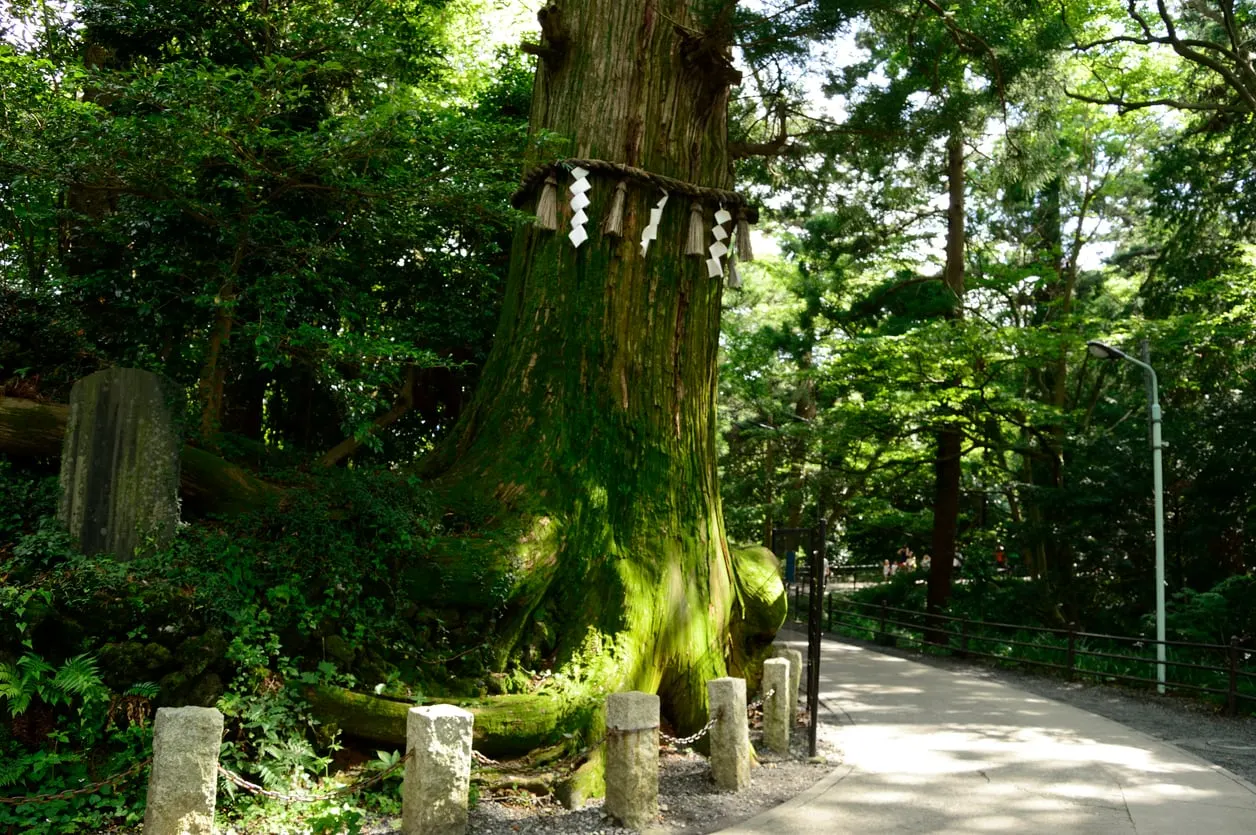
In the 16th century, Hojo Ujiyasu and his son Ujiteru, the lord of Hachioji Castle, placed Mount Takao under their protection. Its woods were later kept as temple forest, then as an imperial forest from the Meiji era, then as national forest after World War II. The Tokyo Metropolitan Government credits that long chain of custody for the fir and beech woods still growing 47 minutes by train from Shinjuku.
Mount Takao, or Takaosan (san means mountain), is a 599-meter peak in Hachioji, in western Tokyo, at the center of Meiji no Mori Takao Quasi-National Park. Its main route, Trail 1, climbs 3.8 km from Kiyotaki Station at the foot to the summit and passes Yakuoin, a Buddhist temple that dates its founding to 744. The cable car covers most of the height, from 201 to 472 meters, for ¥490 one way, and a chairlift from the foot of the mountain charges the same.
At a glance
| Where | Hachioji, Tokyo. Takaosanguchi Station on the Keio Line, about 47 minutes from Shinjuku on the fastest trains; the trailheads and the cable car’s Kiyotaki Station are about 5 minutes on foot |
| Height | Summit 599 m. The cable car rises from Kiyotaki (201 m) to Takaosan Station (472 m) |
| Trails up | Trail 1: 3.8 km, about 110 minutes on foot. Trail 6: 3.3 km, about 90 minutes. Inariyama: 3.1–3.2 km, about 90 minutes |
| Cable car and lift | Adults ¥490 one way, ¥980 round trip, on either. Cable car about 6 minutes, every 15 minutes from 8 a.m.; chairlift about 12 minutes, from 9 a.m. |
| Last cable car | September–November: 5:45 p.m. weekdays, 6 p.m. weekends and holidays; earlier in winter |
| Train and ride ticket | Keio’s Takaosan Kippu from Shinjuku: adults ¥1,450, for the round-trip train plus a round trip on the cable car or lift |
| Autumn color | Usually mid-November to early December. The 2026 Takaosan Momiji Matsuri (autumn leaves festival) runs Oct 24–Dec 13 |
| Official sites | Takaotozan Railway (cable car and lift, Japanese), Yakuoin (English), TAKAO 599 MUSEUM trail guide (English) |
Checked Nov 11, 2026, against the cable car operator’s fare, timetable and access pages, Keio’s Takaosan Kippu fare table (revised Oct 1, 2025), the Tokyo Metropolitan Government’s nature park pages, the TAKAO 599 MUSEUM’s trail guide and the Hachioji Convention and Visitors Association’s festival page.
How do you get to Mount Takao from Shinjuku?
Take the Keio Line from Shinjuku to Takaosanguchi. The fastest trains take about 47 minutes, according to the cable car operator, Takaotozan Railway. From Takaosanguchi Station, the trailheads and the cable car’s Kiyotaki Station are about five minutes on foot, the Tokyo Metropolitan Government’s park pages say.
The same pages give a JR alternative: a Chuo Line Special Rapid reaches Takao Station in about 44 minutes, and from there the Keio Line takes three minutes to Takaosanguchi.
Keio sells a combined ticket for the trip, the Takaosan Kippu (Mt. Takao Discount Ticket). From Shinjuku, adults pay ¥1,450 for the round-trip train at 20% off plus a round trip on the cable car or chairlift at 23% off; with a one-way ride instead, the ticket costs ¥1,090. Those prices come from Keio’s fare table revised on Oct 1, 2025.
With time to spare in Shinjuku, you can compare Takao’s forest with a designed landscape. The Shinjuku Gate of Shinjuku Gyoen National Garden is about 10 minutes on foot from the station’s South Exit, according to the Ministry of the Environment.
Which Mount Takao hiking trail should you take?
Take Trail 1 for the temple and a partly paved path, Trail 6 or the Inariyama Trail for a rougher climb, and Trail 4 for the mountain’s only suspension bridge. The English trail guide of the TAKAO 599 MUSEUM rates Trail 1 as normal on foot and easy if you ride up, and rates Trail 6 and Inariyama as hard.
| Trail | Length | Up / down on foot | What you will find |
|---|---|---|---|
| Trail 1 (Omotesando) | 3.8 km | 110 / 90 min | Partly paved; the 108 stone steps of Otokozaka; Yakuoin |
| Trail 4 | 1.5 km | 50 / 40 min | A forest path from Joshinmon gate across the 36-meter Miyama Bridge to just below the summit |
| Trail 6 (Biwa Waterfall) | 3.3 km | 90 / 60 min | Stepping stones in a stream, tree roots, rocks slippery with moss; Biwa Falls halfway; uphill only at busy times |
| Inariyama | 3.1–3.2 km | 90 / 60 min | Steep wooden steps up to a ridge of roots and rocks, and more than 200 steps near the top |
Lengths and times from the TAKAO 599 MUSEUM’s trail guide, checked Nov 11, 2026. The cable car company lists Inariyama as 3.1 km, the museum as 3.2 km. Trail 4’s times start at Joshinmon gate, partway up Trail 1.
Trail 1 is the main approach to the temple, and the cable car company calls it the Omotesando course, which means “main approach.” If you ride up, Yakuoin’s visitor page puts the temple about 20 minutes on foot from the cable car’s top station, and the summit another 20 minutes beyond the temple.
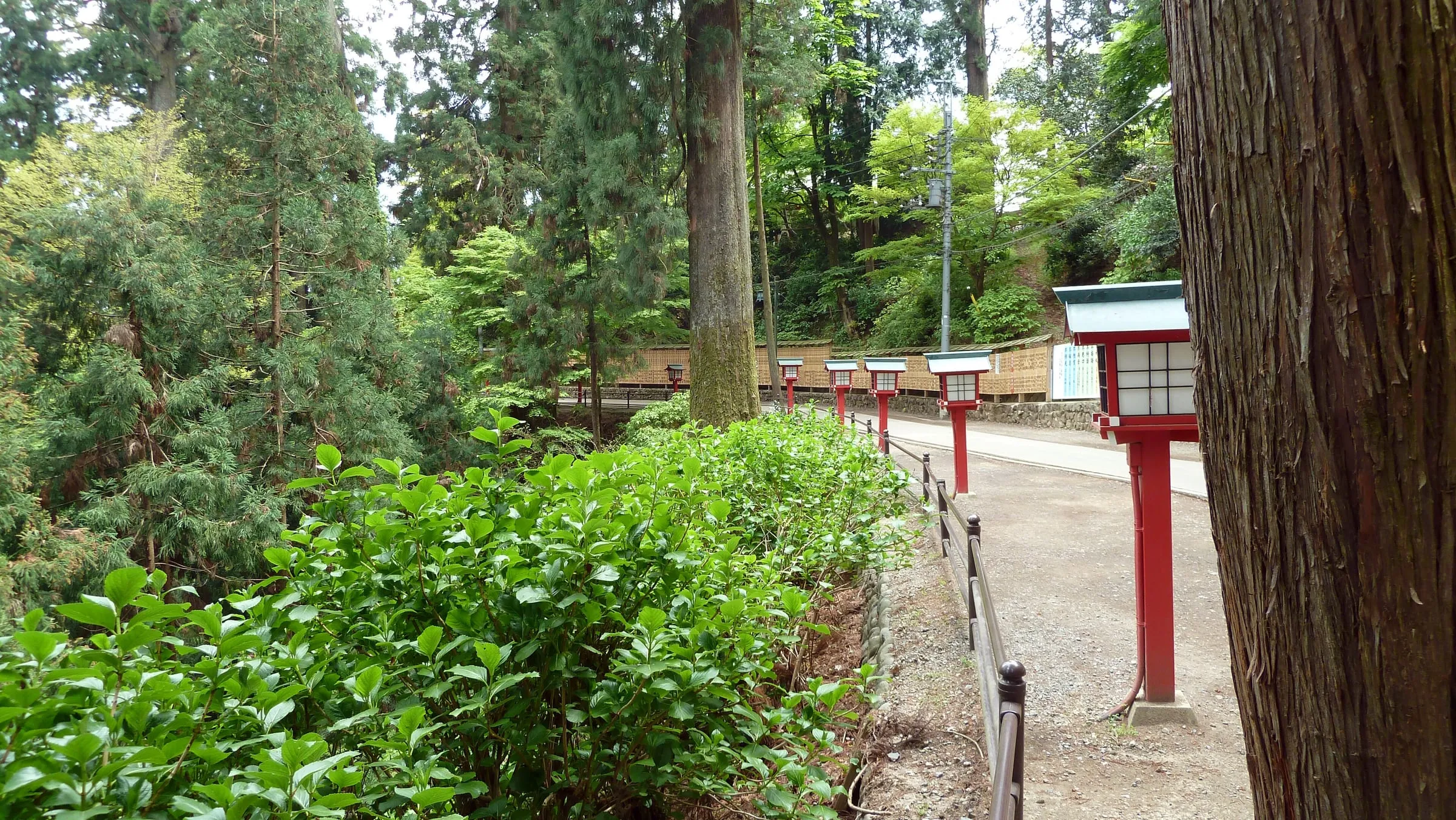
Red lanterns along a paved stretch of Trail 1, in April 2013. Photo: Rob Young / Wikimedia Commons (CC BY 2.0). Resized.
Trail 4 branches off at Joshinmon gate and rejoins Trail 1 just below the summit, bypassing the temple, so walking one trail up and the other down shows you both the temple and the bridge.
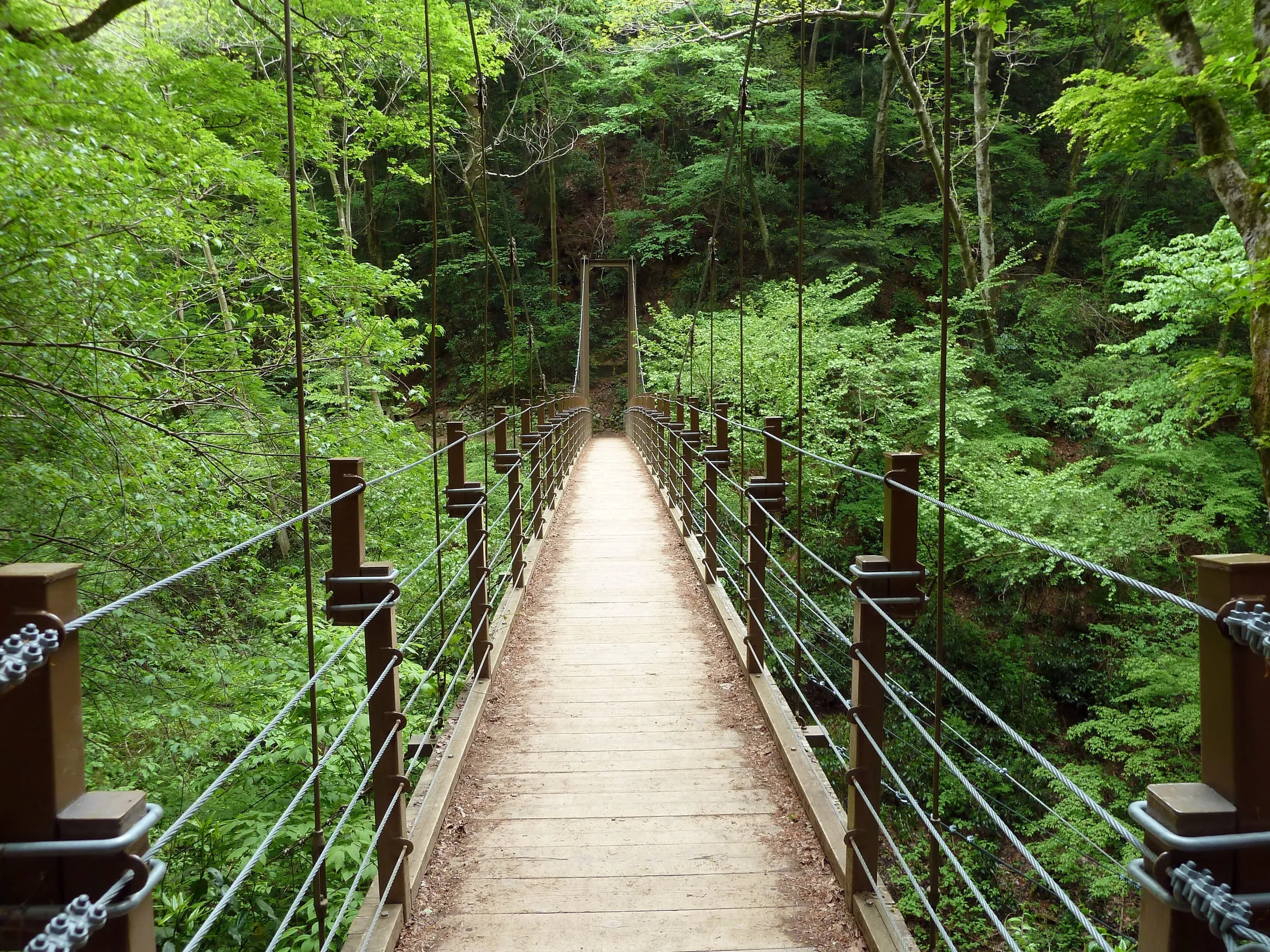
Miyama Bridge, the suspension bridge on Trail 4, in April 2013. Photo: Rob Young / Wikimedia Commons (CC BY 2.0). Resized.
Because Trail 6 turns uphill-only at busy times, plan to come down another way. The cable car company calls Inariyama its ridge-with-a-view course.
Mount Takao is also where the Tokai Nature Trail begins. The Ministry of the Environment’s long-distance footpath runs 1,748 km through 11 prefectures to Meiji no Mori Minoo Quasi-National Park in Osaka Prefecture; its first section continues past the summit to Kobotoke Shiroyama.
Cable car or chairlift: which should you ride?
Ride the cable car for a roof and a shorter trip, and the chairlift for open air; both charge adults ¥490 one way and ¥980 round trip. The cable car takes about six minutes and leaves every 15 minutes from 8 a.m., while the lift’s open two-seat chairs take about 12 minutes and start at 9 a.m.
The cable car climbs 271 meters on 1,000 meters of track. Its steepest gradient, 31 degrees 18 minutes, is the steepest of any cable car track in Japan, according to the operator, Takaotozan Railway. Each of its two cars, the green Aoba (“fresh leaves”) and the red Momiji (“maple”), carries up to 135 passengers.
The line opened in 1927, stopped in 1944 under a wartime order consolidating businesses, and reopened for business in 1949, the operator’s history page says.
Plan around the last ride. The lift stops well before the cable car: on weekdays its last chair leaves at 4:30 p.m. from May to November and at 4 p.m. from December to April, and on weekends and holidays it may run later.
Each rider can tap their own Suica or PASMO card, or a contactless credit card, at the gate. One card cannot pay for a group, so buy tickets at the window or a machine instead.
A round trip costs exactly twice the single fare: the operator announced on Sep 5, 2025, that it was ending its round-trip discount, so guides quoting less are out of date. Pets cannot ride the lift; on the cable car they must stay fully inside a carrier, at ¥250 per carrier each way.
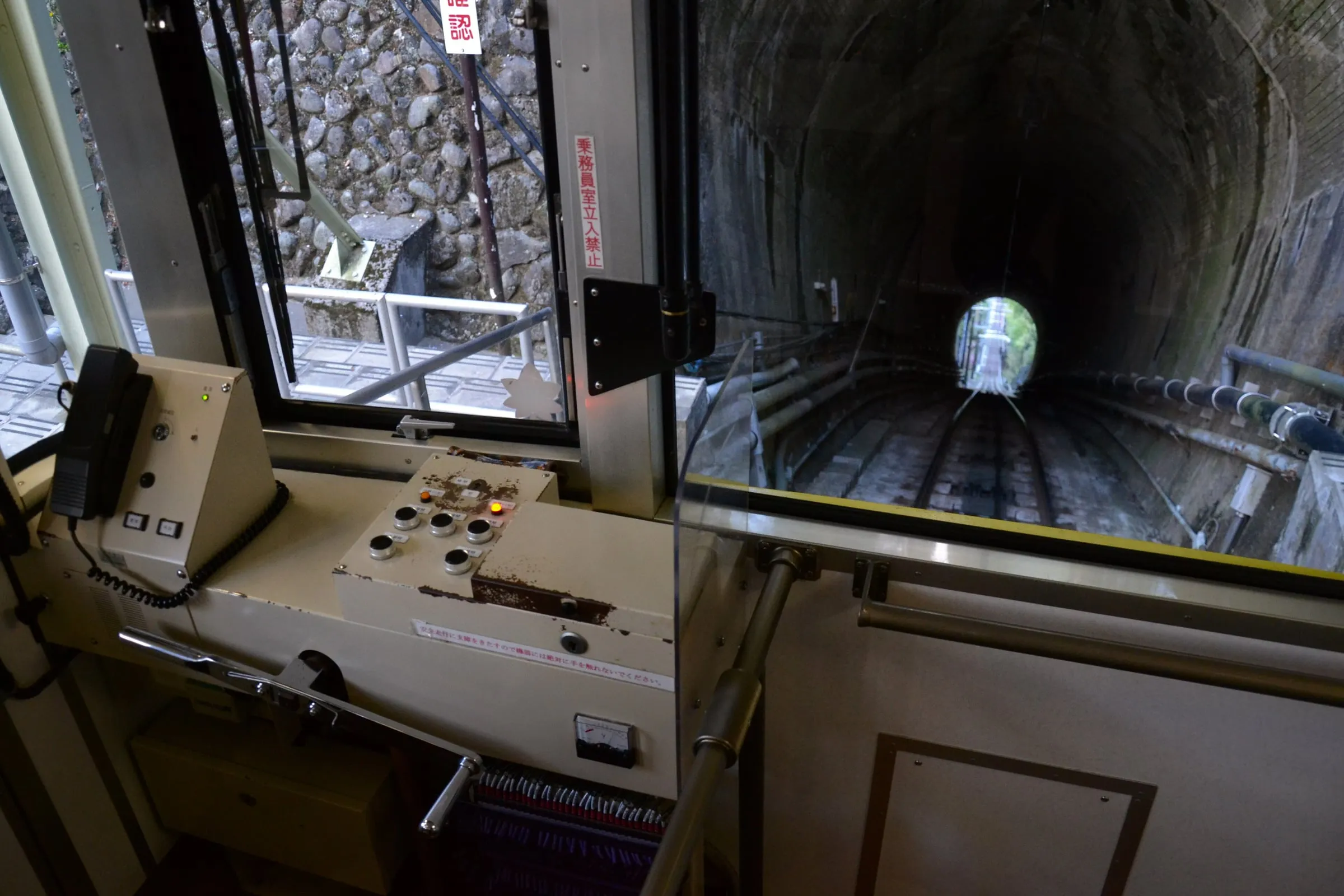
The driver’s cab of the Mount Takao cable car, with the track running into a tunnel ahead, in April 2013. Photo: Aapo Haapanen / Wikimedia Commons (CC BY 2.0). Resized.
What is Yakuoin, and why are there tengu everywhere?
Yakuoin, formally Takaosan Yakuoin Yukiji, is the Buddhist temple on Mount Takao, and it worships Izuna Daigongen, whose attendants, the temple says, are tengu, mountain beings of Japanese legend. Statues of a long-nosed great tengu and a crow-beaked karasu-tengu stand at Yakuoin as guardians of the principal deity, and tengu figures turn up all over the mountain, according to the Tokyo Metropolitan Government’s park pages.
The temple’s history, as it tells it, begins in 744, when the monk Gyoki founded it on the orders of Emperor Shomu as a place to pray for the protection of the eastern provinces. Its name comes from Yakushi Nyorai, the Buddha it first enshrined.
In 1375, a monk named Shungen arrived from Mount Daigo in Kyoto and, after a fire ritual of 8,000 prayer sticks, enshrined Izuna Daigongen. The temple counts this deity as a form of Fudo Myoo, the fierce Immovable Wisdom King.
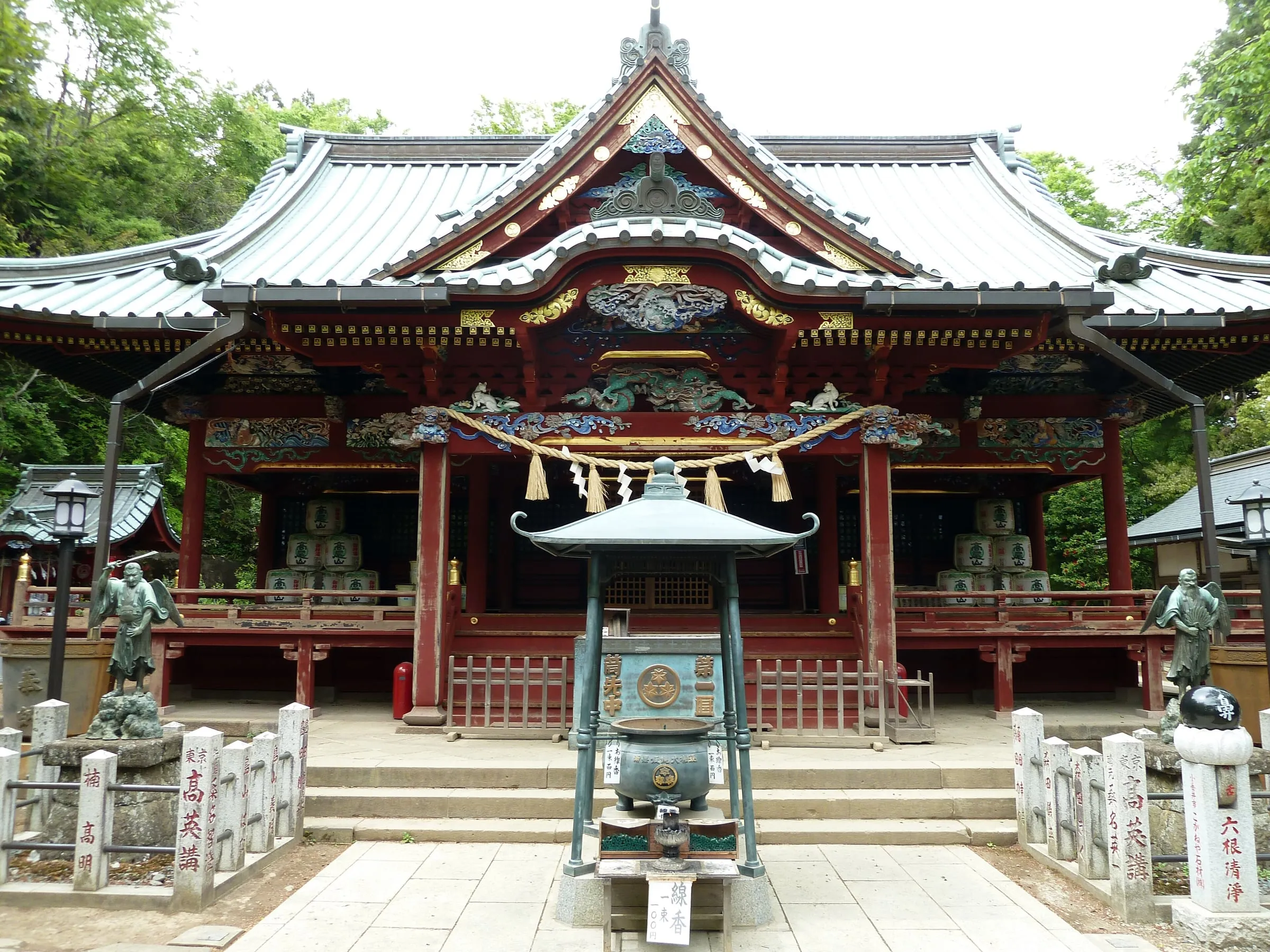
The Izuna Gongen-do hall at Yakuoin, in April 2013. Photo: Rob Young / Wikimedia Commons (CC BY 2.0). Resized.
Izuna drew warriors. The temple says generals of the Warring States period revered it, and that it adorned the front of the helmets of both Uesugi Kenshin and Takeda Shingen. Those two warlords fought each other at Kawanakajima, in what is now Nagano City.
The Odawara Hojo protected the temple, and in the Edo period its ties to the Tokugawa family, especially the Kishu branch, helped it flourish. Yakuoin is one of the three head temples of the Chisan branch of Shingon Buddhism, with Naritasan Shinshoji and Kawasaki Daishi Heikenji. That makes it a different kind of place from Senso-ji in Asakusa, a temple of Kannon, the bodhisattva of mercy.
The temple adds that the yamabushi, mountain ascetics who train here, are often identified with tengu. The Tokyo government’s page offers one explanation: people may have seen the tengu, until then purely imaginary, in the yamabushi racing through the mountains.
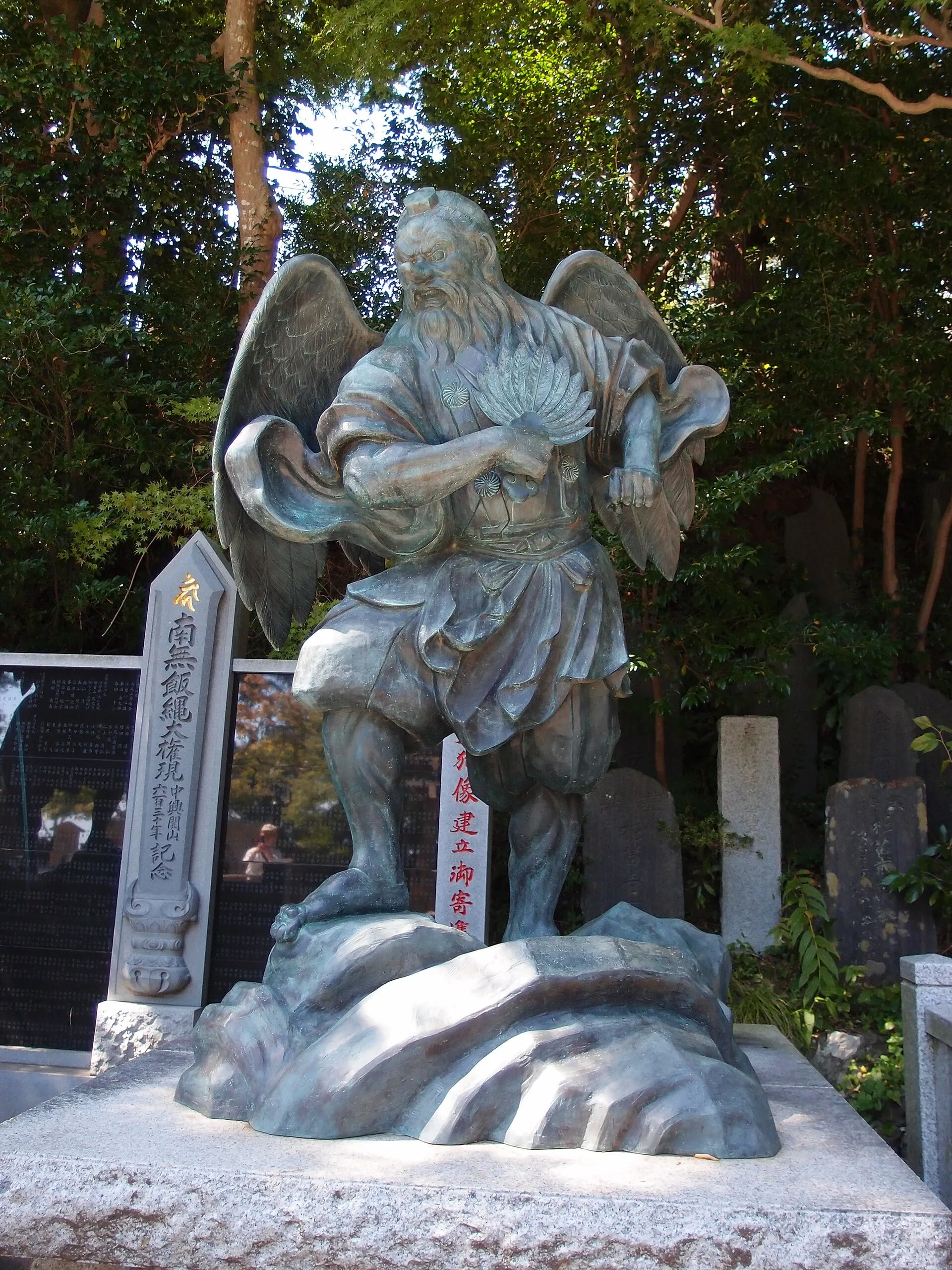
A tengu statue with wings and a feather fan at Yakuoin, in September 2013. Photo: Guilhem Vellut / Wikimedia Commons (CC BY 2.0). Resized.
The temple also serves shojin ryori, Buddhist vegetarian cooking, as a lunch for visitors who reserve ahead; it takes no bookings from mid-December to early February. Sets start at ¥3,300 for the Tengu-zen and ¥4,400 for the Takao-zen, tax included, and the menu changes with the seasons.
In June 2020, the Agency for Cultural Affairs recognized Hachioji’s story of Mount Takao, “Reiki Manzan Takaosan” (roughly, “a mountain filled with spirit”), as Japan Heritage. According to the city, it was the first in Tokyo and at the time the only one. On Sep 1, 2026, the city announced that the recognition continues.
What lives in Takaosan’s forest?
About 1,600 kinds of plants grow on and around the mountain, and more than 4,000 kinds of insects live on it, according to the TAKAO 599 MUSEUM. The Tokyo Metropolitan Government explains the variety by position: the mountain sits on the boundary between cool-temperate and warm-temperate forest, so species of both climate zones grow here.
Centuries of protection left fir forest, evergreen oak woods, deciduous beech woods and plantations of cedar and cypress side by side, the Tokyo government’s history page says.
Mount Takao is known as a “holy land of violets,” the government’s flora and fauna page notes: 18 species have been recorded in the quasi-national park alone, and more than 40 kinds counting hybrids and color variants. One of them, Takao-sumire, was first found here; the tops of its leaves are dark brown instead of green, and it blooms in mid- to late April.
After dark, Japanese giant flying squirrels, musasabi, glide between the trees. They are nocturnal and 34 to 48 cm long as adults, and the Tokyo government asks anyone watching them at night to use a red light so as not to startle them.
Park status came later. Tokyo made the area part of the Takao Jinba Prefectural Natural Park in 1950. In 1967, as one of the projects marking 100 years since the start of the Meiji era, 770 hectares around the mountain became Meiji no Mori Takao Quasi-National Park, designated together with Minoo Park in Osaka.
The name means “Meiji forest.” Tokyo’s other Meiji forest is man-made: the woods around Meiji Shrine in Shibuya, which is dedicated to Emperor Meiji and Empress Shoken.
When is the best time to visit Mount Takao?
Late autumn, for color. The Hachioji Convention and Visitors Association says the leaves usually peak from mid-November to early December, and its 2026 Takaosan Momiji Matsuri runs from Oct 24 to Dec 13. The association calls the color season the busiest time of the year and suggests avoiding crowded hours, weekends and holidays.
On the second Sunday of March, Yakuoin holds its fire-walking festival at the Jidosha Kitoden plaza at the foot of the mountain. After a great outdoor fire ritual (saito goma), yamabushi walk across the embers, and the temple says members of the public may follow them. The violets come next, with Takao-sumire in bloom from mid- to late April.
On New Year’s Day, Yakuoin starts a special goma fire ritual in its main hall at midnight, and the summit holds a ceremony to greet the first sunrise. On a clear morning, the Tokyo government’s page notes, Mount Fuji is in view as well.
In summer, the last cable car leaves at 9:15 p.m. while the Takaosan Beer Mount is open.
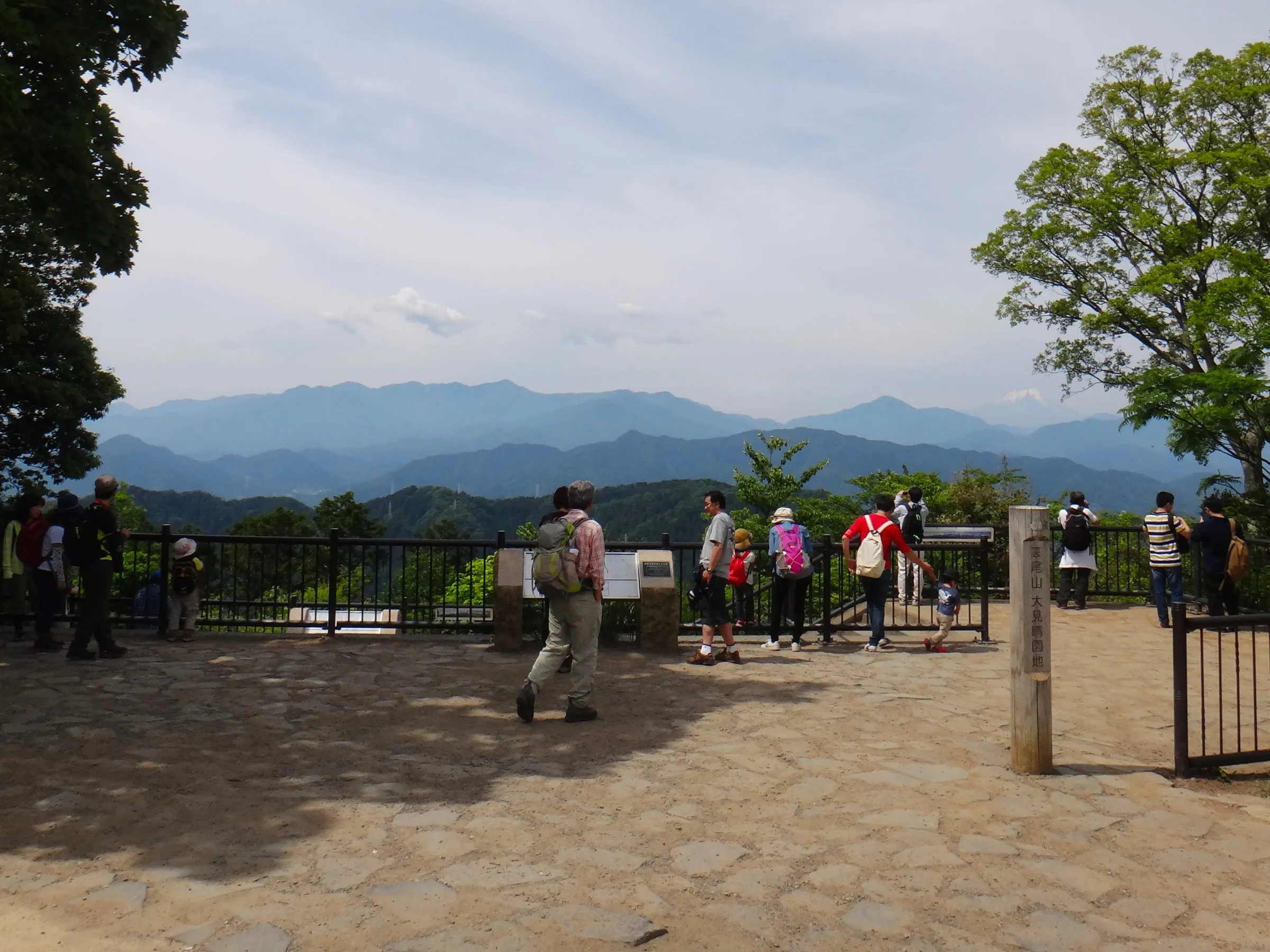
The summit plaza of Mount Takao, looking toward the Tanzawa mountains, in May 2015. Photo: Koda6029 / Wikimedia Commons (CC0). Resized.
If you go
From Takaosanguchi Station, walk about five minutes to Kiyotaki Station, the foot of the cable car and of Trail 1; Trail 6 and the Inariyama Trail leave from its left side. Ride or walk up, then follow Trail 1 past Joshinmon gate to Yakuoin and on to the summit. There, the Tokyo Metropolitan Government’s Takao Visitor Center is free and open 10 a.m.–4 p.m., except on Mondays (Tuesdays when Monday is a holiday).
Between the cable car’s top station and Joshinmon gate, Trail 1 passes the Takaosan Monkey Park and Wild Plant Garden. Adults pay ¥600 there from Sep 1, 2026, according to a notice from the cable car company.
Pick your way down before you start up. Trail 6 may be uphill-only, Inariyama returns along the ridge to the foot, and in autumn the last cable car leaves at 5:45 p.m. on weekdays.
The TAKAO 599 MUSEUM, a free museum about the mountain’s nature, is four minutes on foot from Takaosanguchi Station. It opens at 8 a.m. and closes at 5 p.m. from April to November and at 4 p.m. from December to March, with occasional maintenance days, such as Dec 3, 2026.
FAQ
Is Mount Takao free?
The mountain itself costs nothing: GO TOKYO, Tokyo’s official travel site, lists it as free (updated Jan 28, 2026). The Tokyo government’s accessible-travel guide lists worship at Yakuoin as free too. You pay for the train and, if you ride, ¥490 each way on the cable car or chairlift; the TAKAO 599 MUSEUM and the summit visitor center are free.
Is Mount Takao open in winter?
Yes. GO TOKYO lists no fixed opening hours for the mountain, and the cable car runs all winter: from December to February, its last car leaves at 5:15 p.m. on weekdays and 5:30 p.m. on weekends and holidays.
How long does Trail 1 take with the cable car?
About an hour up and 50 minutes down if you ride the cable car or chairlift for the lower part, by the TAKAO 599 MUSEUM’s estimates. Walking the whole way nearly doubles the climb.
The forest has changed hands several times since the Hojo lords. The tengu, in the temple’s telling, still serve the same master.
More in Travel & Destinations
View all →
Sunshine City Ikebukuro: Aquarium, Observatory, and Tickets
Travel & Destinations · Tokyo
Imperial Palace Tokyo: Tours, East Gardens and Edo Castle
Travel & Destinations · Tokyo
Kabukiza Theatre: Single-Act Tickets, Captions and History
Travel & Destinations · Tokyo
Odaiba: Sea Forts, a Rainbow Bridge Walk and What Has Closed
Travel & Destinations · Tokyo
Related articles
Akihabara: How Tokyo's Electric Town Began, and When to Go
Travel & Destinations · Tokyo
Ebisu Garden Place: Brewery, Sky Lounge and Winter Lights
Travel & Destinations · Tokyo
Ginza, Tokyo: History, Landmarks, and Car-Free Weekends
Travel & Destinations · Tokyo


Hanayashiki Amusement Park: Rides, Tickets and 1853 Roots
Travel & Destinations · Tokyo